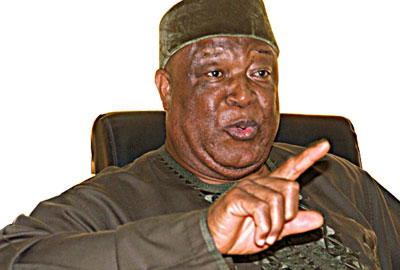
*Gemade
*Says Benue cannot return to Akume’s style
By Emmanuel Aziken, Political Editor
Senator Barnabas Gemade, erstwhile federal cabinet member, first freely elected national chairman of the Peoples Democratic Party, PDP and now Senator representing the Benue Northeast senatorial district has distinguished himself in his engineering profession and his political proclivities.
As Chief Executive Officer, (CEO) of the Benue Cement Company, BCC between 1985 and 1992 he is believed to have laid the foundation for the emergence of that company as the biggest and most successful industrial enterprise in the middle belt.
Gemade’s political ventures have, however, not always flourished. His two year stewardship of the PDP was in its second half characterized by brinkmanship arising from alleged meddling by outside factors. A presidential aspirant on the platform of the PDP in 2003, Gemade was expelled from the party for alleged anti-party activities after the 2003 elections but was subsequently recalled and invited into the party’s board of trustees.
Born on 4 September 1948 in Benue State, Dr. Gemade holds the Tiv traditional title of Nom-I-Yange-I-Tiv, (The Rising Sun of Tivland)
Last Tuesday, Senator Gemade sat down in his Senate office for an interview with Vanguard’s Emmanuel Aziken during which he gave his first impressions of the Senate, the enduring stability of the PDP and what he claimed as the vainness of the opposition in Benue. Excerpts:
How has your experience in the Senate been thus far?
Well, obviously, you know that one month is a very short period but I must say that it is exciting to be here especially that I find the work here much more intellectually based than the work out there in the political arena and it makes you put into use what you studied. It makes you put into use your practical experience in life because you are not restricted to any particular aspect of life; you get involved in all manner of things practically in every aspect of human life because you are here to make laws, propose motions and come up with suggestions on how the society and governance can be better and this does not restrict you to any particular field and that is exciting. You have opportunity to be part of practically everything that is going on.
What is the legislative landmark that Senator Gemade would be remembered for?
I want to be a practical man and I want to play a part in practically everything that comes my way. I am open-minded and I am going to debate any issue that comes my way based on my experience and based on the ideas that I have. And it is going to be relative, in some aspects, my contribution is going to be large, in some it will be small but whatever subject comes up, I can assure you that I am going to give it my best shot.
I will rather say contributions will not necessarily be in the legislative work alone. I will contribute ideas in making sure that our country becomes a better place; our government becomes a better government and our society becomes a better society and this simply means that all those issues that present themselves as impediments in the way of developing a sound nation state of Nigeria, I will definitely contribute to tackling them.
In this particular case, you know that we have very many issues that are bothering Nigeria in a very terrible manner. One of which we sing so much about but do so little about, which is corruption and the other is the provision of infrastructure and even the development of human capital.
The seriousness with which you describe the work of the Senate was, however, lacking in the screening of the ministerial nominees during which some nominees were asked to bow and go against the norm in other democracies where such nominees are quizzed even for days?
Now the issue here is that every organization has a culture and you cannot just sweep the culture of an organization with a wave of the hand. I respect the Nigerian Senate, and I respect the 7th Senate in particular because I think it is made up of people who are extremely sound in knowledge and what they have done by way of experience and I also do not want to agree with you completely on the issue of how serious the senate took the screening of ministers.
I believe that there are so many people out there who have said that the 7th senate took a more serious look at the screening of the ministers than the previous senate. So I think, yes there were a few cases where the culture of the senate allowed a few people to bow and go but not until after they have had the opportunity to say in their own words, who they are and what they intend to do for Nigeria. From there alone you can make a judgment on the quality of a person when you give them twenty minutes or more to express themselves on how their minds are working, vis-à-vis on the job that they are called upon to do.
Having said that, those that had opportunities to answer questions did answer very serious questions. I do remember that I also put up very strong questions to many of them, like my colleagues did in many instances. So, the majority of those ministers were screened in a thorough manner.
The reason why elsewhere in the world, the screening of ministers take a more rigorous approach is that in those countries, the culture of the government is that you send in nominations of ministers through the legislature, appending the portfolio which they will occupy. Therefore, you accord the legislature a better opportunity to drill such people on specific terms under the responsibility which they are about to take. In that way, it is no longer the whole house sitting in a committee to deal with such issue but committees of specific experience and specific nature do interview and screen the ministers.
Like the committee on foreign affairs in the US senate screening Hilary Clinton for up to of forty-eight hours, that is two straight running days! That means that you have a smaller group of people dealing with the issue and dealing with specific subject because the portfolio of the minister is already known. Here, we had to speculate, we had to look at cv’s of people and say, ‘because of your cv, because of your experience and training, it appears the president might put you in this ministry, so, answer a few questions in this ministry.’ And of course, some people will go out to others and ask questions of general nature. That is really the difference. To crown it all, I will like to state here clearly that this senate actually took the job of screening ministers very seriously and they did a thorough job.
How would you compare the last executive with those before it in the mobilization towards general elections?
For a party, election failure means going into the election winning, not in a good way and having the election overturned by the judiciary because of flops that took place. It starts by the procedure of nominating your candidates, the quality of your candidates, to ensure that they meet all the requirements of the electoral body and ensuring that they themselves are people of integrity who will not delve into actions that are detrimental to proper international best practices in electioneering.

*Gemade
I think, compared to 2003, this executive did a better job.
Sir, the better job, was it because of the serenity imposed on the party by the Electoral Act or do you think PDP is now a better party?
Well, I will say both. Definitely by 2003 our party was already experiencing a lot of meddling. The meddlesomeness in the procedures of running the party was so high in 2003 that the executive at that time did not have a free hand to do the things that the executive in 2011 had a free hand to do. This means that that alone was an enabling climate for them to perform better than 2003. I do know the kind of things that went on during that period. It was not so easy. People became candidates from the boardroom of the party more than those who actually went out there and won primaries in the open field and this is one of the areas you know the quality of a party. So, for that reason, I believe strongly they all added up for one to say that yes, the party had gone downhill but it was beginning to look up in 2011.
Given the development in the House of Representatives can you say that zoning is still an inherent policy in the party?
Of course, yes, zoning is and will remain an inherent policy in our party because it is the only way to deal with issues on public selection for officers in a multi-ethnic environment like Nigeria. We are not only multi-ethnic, we are also multi-cultural and multi-religious. So, we have so many factors that are playing themselves in our polity to the extent that, in order not to make a gross mistake, you have to bring in the zoning policy so that you will be a little bit fair, as it may be, for all the parts that constitute this giant Nigerian polity.
Zoning policy
You have to attempt to balance issues and the only way you can balance is to have a zoning policy. If you don’t zone, then you will run the risk of clever winners being in the position to take all and there is nothing you can do about it.
Considering the issues that arose from the failure of zoning in the House of Representatives how do you think the problem can be solved?
Those mistakes came as a result of the party not being close enough with the National Assembly electorate. Let me say, not being close enough on time. During my time and during the earlier parts of this democracy, the party had meetings in caucuses with its National Assembly members, much quicker than it did at this time. You know, it took right up to the 2nd, 3rd and 4th of June for the party to hold any meaningful caucus with the members of the National Assembly. That was very late.
In the past, this thing happened a month or two before the inauguration of the National Assembly and this way, members of the National Assembly were able to know what the party wanted and what the party had done in its national caucus, in its board of trustees, in its national executive committee. This is because not everyone belongs to these committees and therefore, when you finish those meetings, you have to hold caucuses, one of which should be with the National Assembly caucus in order to sell the ideas that have been decided in those meetings.
That was late and that was why we have those mistakes. Having said that, I don’t think there is any disaster. I think the party managed it well up to this point. The fact that the Northwest and the Southeast were fast enough to get for themselves more than one of those positions that normally should go to a zone made the Southwest and Northeast losers in a way of getting the topmost positions that they wanted to get.
I think the party has done well by adjusting this scenario to the extent that today, the south west gets the house leader and the deputy chief whip from the senate and the north east gets the deputy leader in the senate and the chairmanship of the party. This, all put together, somewhat ameliorates the gravity of the problem of the active quick plans of those people who were very quick to rush in and take advantage of the lateness in the party’s decision. Today, the Southeast with the deputy senate president and the deputy speaker, also has the secretary to the government in addition to those two. All those three posts, in the past never really went to any particular zone at the same time but they have gone to the south east.
The vice president and the speaker of the House of Representatives have gone to the Northwest. Those two positions never really went to any zone at the same time but they have gone there. However, we are still marching on because internal mechanisms have been put in place and some kind of repair work has been done and we are still able to move forward. So, I think we are not in any way whatsoever, going to jettison our zoning policy. It will continue.
The party is holding meetings and so on. And after all these, we would have streamlined a proper zoning formula for the positions in the party hierarchy in order to ensure stability.
I believe strongly that at the end of the day, we certainly would come out with a distribution that will certainly be acceptable to the majority of Nigerians.
Sir, you have talked about zoning being a necessary factor in stability. You are from Benue state where there has been some agitation from some for the adoption of zoning. What is your own attitude to this?
What agitation are you referring to?
The agitation by some from Benue South.
Of course, of course for fairness we believe in PDP that chief executive positions in the states should be zoned and should rotate among the senatorial districts and I see that coming and definitely it will come to a point where every zone would get the opportunity to have leadership in the state, in terms of the chief executive.
The political dispensation that came back to Nigeria after long years of military administration in 1999 is 12 years old today. We are on the lap to take it to 16 years by the end of which two zones in the state would have had 8 years each. And definitely, the common practice that one expects is that the zone that has not benefited from the rotation of governorship should also experience that and I don’t think there is any move whatsoever in stopping such a thing form happening.
Your state has been unusually heated up recently because of the political conflict between some major stake holders.
Well, that situation is very unfortunate and it is absolutely unwarranted. We did not have any serious opposition in terms of two political parties pitched against themselves.
It is all an issue of the personalities and that is what makes the fight very ugly and unnecessary. It is people’s personal egos, personal interest, things that are private to themselves as individuals; that have nothing to do with the good of the people, which is unfortunate. Really, when we had opposition in the Benue community in the first republic, for example I do recall the issue of UMBC versus NPC, these were ideological matters, fundamental issues of the government of Northern Nigeria.
But those proponents of opposition at the time had no cause to continue that fight when states where created because at the beginning, we wanted a region of minorities in the north so that they can also have a sense of belonging to this nation. But the majority north at that time did not want a region of minorities to be created and that is what formed the opposition in the north. But we have long overcome that issue. Once in 1967 when states were created this problem of not allowing minorities to have a sense of belonging disappeared. Having come now come to where we are to suddenly say, ‘oh, you have a party that is different from the ruling party; therefore you must take out that ruling party from government and put another one.’
What are your ideas? What are you bringing on the table to change the society? You are bringing personal ego, you are bringing personal interest of managing the treasury on the table. Nobody is going to succumb to the pressure where a particular person wants to control the treasury of government. That kind of opposition, I’m sorry to say, is inappropriate.
Sir, when you say personal ego and sharing of money, do you mean the refrain from some in the PDP about the sharing of money by the former administration?
Correct.
In your words, sir.
I have nothing else to say.
Do you mean that money was being shared by the Akume administration…
We are seeing projects being done in our state today. I have never seen projects being done before and if anybody says he wants to change this government, I say; ‘what is your reason of changing the government? That was why I stood firmly that the government will not be changed and it was not changed.
Why was the opposition to Suswam so strong despite the claimed projects on ground?
Well, one factor is that society has its norms and the society in Benue is a society which is very quick to buy opposition, to buy confusion. So, a lot of people, you ask them; ‘why are you clamoring for this change?’ and they will tell you; ‘I don’t know, but I want change.’
Bad norms
So, it is not an issue of anybody prepared to reason or using his intellect. You know, it comes to a point where a society must wriggle itself out of its bad norms and that is one of the bad norms we have in Benue. You know, if someone comes and tells a lie about you in a typical environment in my home state, that he saw you fighting with your wife, that you undressed her in public and therefore you are a terrible man and that the society should extricate you.
A good proportion of the people who hear this are not going to ask anybody whether they saw that happen, they will just say: ‘ah that person is good enough to be stoned and thrown out of the society.’ Then, if you ask him, ‘did you see it’, they will say they didn’t see it but what he did was very bad. How did he do it? Where did he do it and when was it done? This is a bad norm, but of course that is the society and clever politicians will take advantage of this and I tell you, clever politicians took advantage of this in Benue, brought no policy, no message, no idea, no hope, no aspiration, nothing! Yet, they preached that they had brought a new party and overnight, wanted so many people to go and vote for it.
I don’t think me as a politician, me Chief Barnabas Gemade, fully qualified engineer and a man who is trained, I cannot buy that, I cannot buy that.
Disclaimer
Comments expressed here do not reflect the opinions of Vanguard newspapers or any employee thereof.