By Emmanuel Aziken, Political Editor & Charles Kumolu
TODAY’s inauguration of the National Assembly should come to a climax with the election of the two presiding officers of the Senate and the House of Representatives.
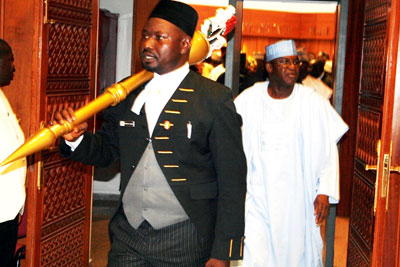
The Clerk of the National Assembly, Alhaji Salisu Maikasuwa garbed in a ceremonial robe is expected to conduct the election of Senate President. It is his most important duty for the day and perhaps every four years.
He would begin the process with a call for nominations for the position of Senate President. Following the nominations which should be accompanied by someone seconding each nomination, a roll call of the Senators-Elect would be taken during which each Senator would shout out to the clerk on how he or she is voting.
Following the election of the Senate President, the same process would be repeated for the election of the deputy.
Today’s election is expected to be a walkover for the pair of Senators David Mark and Ike Ekweremadu given that no opposition to them has surfaced.
Following the election of the Senate President and his deputy, the clerk would conclude his duty by swearing in the duo as Senators and thereafter they would take the oath of allegiance.
The work of the Clerk ends at this point. The Senate President would now take over from him to swear in the remaining 107 Senators-Elect as Senators. This would be done in batches. According to tradition after taking the oath, the new Senator would mount the dais to have a handshake or embrace the Senate President.
Following the election according to tradition, the Senate President would adjourn to the next day to enable the different caucuses to meet to choose other principal officers. The principal officers to be chosen at the caucuses would then be brought to the Senate where they are formally endorsed.
The same process is repeated by the Clerk in the House of Representatives where he presides over the election of the Speaker and the deputy Speaker.
However, today’s election is uncertain given the political intrigues that have surfaced. Muriana Ajibola who was the original choice for Speaker by the Southwest caucus leaders has almost been buried by the backlash arising from the endorsement. In his place, Rep. Aminu Tambuwal and Mrs. Mulikat Akande-Adeola have emerged as the new front runners.
Akande-Adeola is entering the race as the consensus candidate of the Peoples Democratic Party, PDP and those interested in retaining the present zoning formula of the PDP. However, the Tambuwal forces including a number of influence peddlers in the outgoing House who are returning are bent on enthroning Tambuwal. Only very strong influence of the party may well stop them.
NATIONAL ASSEMBLY: Its duties and powers
The legislative powers of the National Assembly to make laws and oversee the good governance of the country is drawn from Section 4 of the 1999 Constitution which specifies that, AThe legislative powers of the Federal Republic of Nigeria shall be vested in a National Assembly for the Federation, which shall consist of a Senate and a House of Representatives. The National Assembly shall have power to make laws for the peace, order and good governance of the federation or any part thereof with respect to any matter included in the Exclusive Legislative List set out in Part I of the Second Schedule to this Constitution.
Besides approving budget, the legislature also has the power of oversight, investigations and issuing warrant of arrests on any individual in violation of the Constitution or any other Act of Parliament. Indeed, a detention centre is said to exist in the National Assembly to enforce this provision.
Section 88(1&2) spelling out the powers to carry out investigation states, A Subject to the provisions of this Constitution, each House of the National Assembly shall have power by resolution published in its journal or in the Official Gazette of the Government of the Federation to direct or cause to be directed investigation into C (a) any matter or thing with respect to which it has power to make laws, and (b) the conduct of affairs of any person, authority, ministry or government department charged, or intended to be charged, with the duty of or responsibility for B (i) executing or administering laws enacted by National Assembly, and (ii) disbursing or administering money appropriated or to be appropriated by the National Assembly.
AThe powers conferred on the National Assembly under the provisions of this section are exercisable only for the purpose of enabling it to B (a) make laws with respect to any matter within its legislative competence and correct any defects in existing laws; and (b) expose corruption, inefficiency or waste in the execution or administration of laws within its legislative competence and in the disbursement or administration of funds appropriated by it.
Section 89 further empowers the National Assembly to request any documents, records or information at the disposal of any agency of the Federal Government in pursuance of Section 88 of the Constitution. It could also summon and cause to appear before it or any of its committees, any person, who, after having been summoned to attend, fails, refuses or neglects to do so and does not excuse such failure, refusal or neglect to the satisfaction of the House or the committee in question.
These are the cornerstones of legislative oversight. The National Assembly has continued to pride itself as the beacon of democracy. Its overwhelming powers to whip the executive into line and give the people the needed representation is the reason why expectations are high.
Disclaimer
Comments expressed here do not reflect the opinions of Vanguard newspapers or any employee thereof.