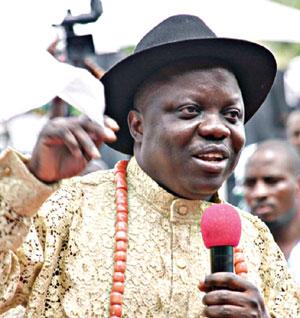
Gov Uduaghan
Emma Amaize, Regional Editor, South-South
GOVERNOR Emmanuel Uduaghan’s first baptism as a troubleshooter was not as the chief executive of Delta State, but as a Commissioner under the administration of his political tutor and ex-governor, Chief James Ibori, starting from his very first day in public office in 1999. The trial case was the Warri crisis and he remained a principal peace broker for the government until 2006 when he resigned as Secretary to the State Government, SSG, to contest for governorship.
In fact, he shot into prominence in the state with his role in the resolution of the crisis. His experiences in crisis management under Ibori seemed to have opened his eyes to the fact that there can be no good governance without sustainable peace.
He had also figured out during his stint that the best bed a man can sleep on is peace; therefore, it was not surprising that peace and security were among his three-point agenda on emergence as governor in 2007.
There was ceaseless bombing of oil installations, kidnapping of hostages and insecurity on the waterways of the state and other parts of Niger Delta by the defunct Movement for the Emancipation of the Niger –Delta, MEND, which was prosecuting a struggle for self determination and resource control when he took over.
First masterstroke
 Uduaghan, the ‘Warri Boy’ came up with a homegrown approach that was exclusive to the state at the time. He identified the central characters in the struggle and constituted them into a special committee known as Delta Waterways and Security Committee, DWSC, Warri. The committee’s brief was to identify the criminal elements perpetuating illegalities on the waterways, give such intelligence information to security agencies and generally, maintain the peace on the waterways of the state. The working group was a blend of militants and professionals, including lawyers, journalists, technocrats, clergy, community leaders and nongovernmental organizations.
Ex-militant leader and leader of the defunct MEND, High Chief Government Ekpemupolo, alias Tompolo, was not personally in the committee, but he was well- represented. Some of his commanders were members of the committee. Virtually all the key ex-militant leaders in the state were members of the committee and the native intelligence learned from his grandmother was simply to give the rat the fish to keep.
The “give the rat fish to keep” strategy hindered the capacity of MEND to strike in the state and the leaders of the group complained openly to Tompolo whose hands, as it were, were tied because his foot soldiers were in-charge of DWSC. Former President, the late Umaru Yar’Adua later saw the governor’s native intelligence and bought into the amnesty package, which finally saw the militants surrendering their weapons in exchange for training and development of the region.
Some other governors were envious of the Uduaghan model, which worked like magic. He said it was a political solution that he invented, using the carrot option and the criminal justice system to contain criminals who refused to embrace the choice of peace and development of the state.
The E.K Clark hurdle
Much as he tried to hit the ground running in his first tenure, the acrimony and bitterness over his emergence, led by no less a personality than the elder statesman and Ijaw national leader, Chief Edwin Clark, was a source of concern. He tried to manage the big man, Clark, for many years and as he later confessed, the daring confrontation and the court cases by Chief Great Ogboru caused him quite some distractions. Anybody who knew the doggedness of Chief Clark and how his group ran Ibori out of town, all in the bid to stop Uduaghan as governor would appreciate what the governor went through.
Uduaghan understood ab initio that to have dialogue is the beginning of a peaceful resolution and he explored every channel of communication to get the understanding and cooperation of the elder statesman and his group. Clark was later to own up that during his crisis with the governor, he was respectful to him and never insulted him unlike some other politicians that blew their lips.
Chief Clark would surely be happy that his ‘political son’ adhered to his counsel of leaving office in peace. It was a sermon he personally invited the governor to his house to preach and urged him not to act to the contrary. Once during a wrestling competition the Uduaghan government named after him, Clark apologised for haranguing Uduaghan in his early days as governor. It was an emotional speech for which Udaugha’s peace initiatives were highlighted.
EPZ debacle
One of the things that tasked Uduaghan’s claim to peace negotiation was the gridlock between the Gbaramatu-Ijaw and Itsekiri ethnic group over the location and ownership of the site for the Export Processing Zone, EPZ project, otherwise known as the Delta Gas City in Ogidigben, Warri South-West local government area. While Itsekiri said it was on its land, the Ijaw said it encroached on its territory and the Itsekiri ethnic nationality expected the governor, who has an Itsekiri blood to cut the Ijaw to size.
War was imminent as the Gbaramatu- Ijaw, apparently latching on the blood tie with President Goodluck Jonathan, who is from the neighboring Bayelsa State, used every tactics to sway Presidency and the Nigeria National Petroleum Corporation, NNPC, to its side.
The Itsekiri leadership was understandably miffed with Uduaghan for his approach, which presented his ethnic group as a small fry. Some of the Itsekiri leaders scoffed at him for boasting that nobody would stop Jonathan from coming to perform the groundbreaking at the time, whereas Ijaw youths eventually stopped him. It took the personal intervention and visits to the state by President Jonathan and the subtlety of the governor to settle the cause of disagreement. Looking back at the episode, Uduaghan would have muttered: ‘Peace is costly, but it is worth the expense’.
Why I offered myself as political lamb
What could have made nonsense of his peace efforts in the past eight years was his ambition to represent Delta South Senatorial district at the National Assembly, which clashed with that of the incumbent, Senator James Manager, an Ijaw by tribe who had served three terms in the senate.
Despite his spirited explanations, many are yet to come to terms with why he abandoned the bid. There are three distinct tribes, Itsekiri, Ijaw and Isoko in the Delta South Senatorial district and in the present political dispensation that started in 1999; the Isoko took the first shot with Senator Stella Omu. She did one term only because of the disagreement she had with Ibori and the mantle swung to the Ijaw with a tacit agreement that it would rotate among the ethnic groups.

E. K. Clark
However, since he entered in 2003, Senator Manager had done one, two, three terms and refused to surrender the position. Uduaghan was practically the major hope of the Itsekiri and the Isoko to challenge Manager infraction and restore the rotational arrangement.
All Progressives Congress, APC, Senatorial candidate in the election, Prince Yemi Emiko, an Itsekiri like Uduaghan, told Saturday Vanguard days before the election, “The politics of seclusion and divisiveness which they play in PDP is what has happened in the instance (Uduaghan case) you just mentioned.”
“The governor by himself withdrew from the race because if he stood his grounds from the beginning and say I want to face the primary and whatever we see, let us take, that would have been different, but he voluntarily, as it were, withdrew. There might have been some pressure here and there, but he had a choice to stay and say I am going to stick by my ambition, but he said in the interest of peace, in the interest of security of our people, that he is not going to pursue that race to a logical conclusion,” he said.
However, explaining why he withdrew less than two days to the primary paving way for Senator Manager to return unopposed, Uduaghan, the peace lover, told reporters at Asaba that he had a meeting with President Jonathan and the national chair, Adamu Muazu, at which the political situation in Delta State was decisively, examined, after which he decided to make a sacrifice by stepping down.
“I have to offer myself as a sacrifice to ensure that the political and security tension that had built up in recent times is reduced. In doing that I am aware that a lot of my followers will be very unhappy but I want to appeal to them that I have to do this for the sake of this state,” he said.
My most treasured achievement
Many have continued to lambast the governor for his “peace sacrifice,” but an unperturbed Uduaghan, recently conferred with the “Silverbird 2014 Man of the Year Award,” retorted, “I am leaving a more peaceful Delta State than the one I met when I assumed office in 2007.” To him, making peace is a legacy that he he cherishes most.
Speaking at the inauguration of the N4.1 billion four-lane Warri-Effurun flyover constructed over the busy Effurun Roundabout in Uvwie Local Government Area of the state, last month, Uduaghan also described peace as his most cherished achievement, emphasizing that it was a prerequisite for the attainment of the other two legs of his three-point agenda.
Further clarifying the matter at a breakfast meeting with reporters in Warri, he said, “There were several build- ups leading to the primary. When I looked at the elections, there is heavy build up most especially in Delta South Senatorial elections and I asked myself, what I am going to do in the Senate if the process leading to that election would lead to another crisis in Warri.”
“I am sure you will have more to report as journalists but you will also not feel comfortable if there is no freedom in the city. We are enjoying some freedom and there is no curfew. I have the strong belief that if I had gone for the PDP senate primary, there would have been curfew in Warri,” he said.
My desire
His words, “I don’t want to leave office in a crisis situation. That is the reason I had to drop my senatorial ambition. I believe we do not have to go to the extent we go sometimes to seek power. We do not have to go to the extent of causing war or chaos.” He explained that it was a similar intelligence report that President Goodluck Jonathan received, which made him to postpone the groundbreaking of the $16 billion Delta Gas City, which he finally performed March 26.
The most difficult to handle
What appears to be his last test case in office was managing the fall-outs of the PDP primary won by Senator Ifeanyi Okowa, who many, logically thought he opposed his emergence. However, the adroit way he managed the upshots and prosecuted the campaign for Okowa’s election left many wondering if the governor, who never masked his agenda to have a Delta Northerner as his successor, did not play a quick one on them. Not a few now suspect that he employed a diversionary tactics that made them think he was against Okowa only to fall back to the hidden plan. He had congratulated Okowa while counting was going on and the following day he flew with Okowa to Abuja to continue talks on how to ensure the senator became the governor. Speaking recently on his puzzling body language at the time, he said, “The details will come out in a book. Let me reserve them for the future (laughs). However, anybody who followed me from Day 1 would have known that I had always advocated for a power shift to Delta North. But, you see, in politics, things happen along the line.”
“As the person managing the process, sometimes, you show your forehead; sometimes you show your lips; sometimes you show your hands, so it depends on the direction that people are heading at a particular time, you may be perceived to be heading to the right direction, but you are not. However, I am happy for somebody who started early and threw this Delta North issue on the political space, and it got a lot of us bashing, especially from Delta Central at that time. But we managed it, and I am quite glad about that. As a Deltan, the dream came true.”
Disclaimer
Comments expressed here do not reflect the opinions of Vanguard newspapers or any employee thereof.