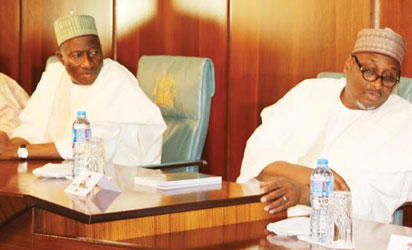
Jonathan and Muazu
•The move to sack the NWC
•A ruling party’s bumpy road to the opposition
BY HENRY UMORU
THIS is not the best moment for the Peoples Democratic Party, PDP. The party, which has been in power at the federal level since 1999, suffered a crushing defeat in the 2015 general elections.
Besides the loss of the March 28 election by President Goodluck Jonathan to the All Progressives Congress, APC, presidential candidate, Muhammadu Buhari, the ruling PDP also suffered defeat at the Senate and the House of Representatives which it hitherto controlled.
It lost the polls in its traditional states of Plateau; Niger; Kaduna; Benue; Bauchi; and Jigawa, just as, ahead of the inauguration of the National Assembly, on June 4, the PDP will become an opposition party in the Senate with 49 senators while the APC has 60 members and same applies to the House of Representatives where it has been thrown into the opposition.
Meanwhile, the defeat is tearing the PDP apart as the leadership, its governors and the Presidential Campaign Organisation (PDPPCO) are engaged in blame game over the party’s misfortune.
The governors, led by the Chairman of the PDP Governors’ Forum and outgoing governor of Akwa Ibom State, Godswill Akpabio, started the fight for the removal of the Adamu Muazu – led National Working Committee, NWC, attributing the abysmal performance of the party at the polls to the role played by the leadership.

Mu’azu: The emergence of the game changer
Ekiti State governor, Ayodele Fayose, the PDPPCO spokesperson, Chief Femi Fani- Kayode, others joined in the push for the sack of the NWC, voicing their lack of confidence in Muazu and the leadership for leading the party into what they described as a disastrous electoral performance in Nigeria’s presidential, governorship and legislative elections.
Fani-Kayode, on Tuesday, demanded the sack of majority of the members of the NWC, alleging that they betrayed the President. “We must throw out the bad eggs in the NWC and prepare for a long-drawn war of attrition with the new incoming government. In order to survive over the next four years as a party, we must make the necessary changes at the top, otherwise we will be utterly decimated,” the PDPPCO Director of Media and Publicity said.
A group under the aegis of the PDP National Renaissance Movement, the 9,000 Support Group, and some organisations that supported the aspiration of Jonathan for second term, also raised their voices calling for fresh minds, fresh ideas, fresh vision and fresh strategies in the PDP leadership.
According to the Coordinator, Dr. Ayakeme Whisky, the PDP needs rebuilding to bounce back in 2019 and the beginning of the rebuilding process was for the NWC to throw in the towel, adding, “That in order to effectively rebuild and reposition the party as a credible opposition with intent to win back power in 2019 at the centre, there is urgent need for immediate injection of fresh minds, fresh ideas, fresh vision and fresh strategies at all levels of the party.”
After weeks of the battle of wits, Muazu bowed to pressure and resigned on Wednesday, citing his failing health as one of the reasons. He submitted his letter of resignation to his deputy, Prince Uche Secondus.
Addressing journalists at the end of the 399th meeting of the NWC, the PDP National Secretary, Professor Adewale Oladipo, who confirmed that the party received the National Chairman’s letter of resignation, said that it was accepted and wished him well in his future endeavour.
According to Oladipo, in line with Sections 45 (2) of the PDP’s Constitution as amended in 2012, the Deputy National Chairman, Secondus, would step in, in acting capacity, until Muazu’s zone, the North East, brings in a replacement.
Oladipo said, “The National Working Committee (NWC) of the Peoples Democratic Party (PDP) at its 399th meeting today, Wednesday, May 20, 2015 received and accepted the voluntary resignation of the National Chairman of our great party Ahmadu Adamu Mu’azu.
“Consequently, in line with the provisions of sections 45 (2) of the PDP constitution, the Deputy National Chairman, Prince Uche Secondus acts in place of the National Chairman pending a replacement from the North East zone”.
Hours after Muazu resigned, the Chairman, Board of Trustees, BoT, of the party, Chief Tony Anenih, also resigned.
Prior to his resignation, meetings were shuttled between Anenih’s Asokoro residence house and the Presidential Villa on the need for him to resign to allow for injection of fresh blood into the administration of the PDP, especially at this critical moment of the party, just as he agreed to bow to allow Jonathan to step in as the Chairman of the Board.
When Muazu submitted his resignation letter, pressure was said to have been mounted on the BoT Chairman to also quit.
In line with Article 32(2(c) of the Constitution of the party which stipulates that the Chairman and Secretary of the BoT shall serve a term of five years and no more, Anenih would have been left with another two years to hold on to the position because he came in, in 2013.
Citing the current state of affairs in the party, the BoT Chair, in a one-page letter to the President, dated May 20, 2015 and titled: “Notice of my decision to step down as Chairman, Board of Trustees of the Peoples Democratic Party”, said his decision would enable Jonathan to effectively assume the chairmanship of the BoT.
“The National Working Committee (NWC) of the Peoples Democratic Party (PDP) has received the resignation of the Chairman of the Board of Trustees of our great party on personal grounds”, the PDP National Secretary, Oladipo, said while announcing that the NWC also received Anenih’s letter.
“In accepting the resignation, the NWC noted the outstanding contributions of Chief Anenih in the party over the years especially in his capacity as the Board of Trustees Chairman.
“Consequent upon the resignation, the Secretary of the Board of Trustees, Senator Walid Jibrin, holds forth pending the election of a new BoT Chairman.”
It would be recalled that six years after he was removed as Chairman, BoT, Anenih, in 2013, bounced back to the position through a consensus, just as, on June 27, 2007, former President Olusegun Obasanjo emerged the Chairman of BoT when he took over from Anenih.
Anenih became the PDP BoT Chairman at a time the party was faced with major challenges, mostly from within. When he came, his leadership contended with the feud between The Presidency and the Nigeria Governors’ Forum, NGF. He also came at a time some loyalists of Obasanjo, including Chief Bode Mustapha and Prince Olagunsoye Oyinlola, were sacked from the NWC of the PDP, even as the South-West congresses believed to be in favour of the Obasanjo camp were also cancelled.
Anenih’s emergence faced the threat posed to the PDP by the newly formed All Progressives Congress, APC, and with his vast knowledge of the inner workings of the party, it was believed he could reconcile all contending power blocs within the party.
He did his best to bring back to the PDP the then aggrieved Governors Abdulfatah Ahmed of Kwara; Aliyu Babangida of Niger; Aliyu Magatakarda Wamakko of Sokoto; Musa Rabiu Kwankwaso of Kano; and former Governor Murtala Nyako of Adamawa, who left for the APC, but his efforts did not yield result following the problem the then National Chairman, Bamanga Tukur, had with the chieftains.
He was the National Campaign Adviser of the PDP for the 2015 presidential election during which he played stabilising and interventionist roles, but, unfortunately, the PDP lost the election.
For Muazu, he came on board in January 2014 when replaced the former National Chairman, Alhaji Bamanga Tukur, who assumed office on March 24, 2012.
The immediate past PDP National Chairman came on a rescue mission at a point the party was going through some major problems under Tukur which climaxed at Eagle Square during the August 31, 2012 Special Convention organised to right the wrongs made during the March 2012 National Convention.
On that Saturday, crisis ensued when the party split into two parallel NWC, with former Vice President Atiku Abubakar and six northern governors staging a walk out to later form what they tagged the New PDP with Governor Chibuike Amaechi of Rivers State in attendance and former Acting National Chairman of the party, Alhaji Abubakar Kawu Baraje, emerging the National Chairman and Sam Jaja,Deputy National Chairman and Prince Olagunsoye Oyinlola National Secretary.
The crisis consumed Tukur.
 Muazu was supposed to have come to help put the party on the right path, but could not bring back those governors who left the party. He was accused by the NWC of doing a one-man show as he did not carry them along in the scheme of things.
Lack of internal democracy and indiscipline, which constituted major problems of the PDP, reared their heads as the party did not carry out what could be described as true and genuine primaries elections to get their candidates for the general elections except in some few states. During his tenure, the PDP experimented, for the first time, the right of first refusal for the President with Jonathan becoming the sole candidate of the party, thereby locking out other aspirants.
Even though the decision was carried by the party leadership, it didn’t go down well with many people especially from the North and this became a scar in the PDP that never healed. Some of the governors also had their ways in the primaries for the general elections which led to the dumping of the party by aggrieved members for the APC where they picked the tickets and the PDP lost in such states like Adamawa, Niger, Katsina, Jigawa, among others.
There were allegations that Muazu betrayed the PDP and worked against Jonathan at the polls.
PAST CHAIRMEN: HOW THEY LEFT
Muazu’s resignation as National Chairman of the PDP was a replay of the past. From its pioneer Chair, Solomon Lar, to Barnabas Gemade, Audu Ogbeh, Ahmadu Ali, Vincent Ogbulafor, Okwesilieze Nwodo, Tukur, and now Muazu, it is like the PDP leadership is haunted by a jinx as only Ali served out his tenure and stepped down without rancour.
Muazu was the 11th National Chairman. Former Vice President Alex Ekwueme was protem National Chairman at the PDP’s inception in 1998. He stepped down to contest for the party’s presidential ticket, but lost to Obasanjo. The late Chief Solomon Lar, a former governor of old Plateau State, stepped in as PDP National Chairman till 1999. Senator Barnabas Gemade, from the Tiv axis, came in after the first ever competitive convention of the party. He defeated the late Chief Sunday Awoniyi.
Gemade was a tool in the hands of Obasanjo as he hounded the National Assembly between 2000 and 2006 deciding on who emerged the Senate President and Speaker of the House of Representatives.
Preparatory to the 2003 polls, Obasanjo kicked out Gemade. Chief Audu Ogbeh succeeded him.
Ogbeh, who came in, in 2001, was forced to resign in January 2005 reportedly at gun point, after he was said to have challenged Obasanjo with a letter advising the President to act on the anarchy that had taken over in Anambra State as as well as the economy of the country.
He was replaced by Ali, a long-time associate of Obasanjo.
In 2008, Prince Vincent Ogbulafor, from Abia State, was elected the new Chairman at the PDP national convention, but resigned May, 2010.
Ogbulafor was replaced by the pioneer National Secretary, Dr. Okwesilieze Nwodo, in January 2011 and he also left under controversial circumstances after a dispute with his state (Enugu) governor, Sullivan Chime, which resulted in an Enugu High Court ruling sacking him on the grounds that he was not a card-carrying member of the party, just as he had also at the time fallen out of favour with Jonathan.
The then deputy Chairman and former Minister of Defence, Dr. Mohammed Haliru Bello, from Kebbi State, took over in acting capacity and, when he was appointed a minister, Baraje moved from the position of National Secretary to become the acting National Chairman.
In March, 2012, a National Convention was held and Tukur came in as National Chairman, but his own troubles started from home where his control of the party structure in Adamawa was challenged by former Governor Nyako. For the fact that he offended his then state governor, prior to the 2015 election, several governors, including Nyako, asked for his removal, fearing that, as Jonathan’s loyalist and friend, he would lend his support and turn over the party’s machinery to the President should he seek re-election, thereby locking out other contenders. In January 2014, Tukur bowed to pressure and resigned. In January 2014, Muazu, a former governor of Bauchi State for eight years and who also vied for the position with Tukur in 2012, became the National Chairman.
PDP IN SEARCH FOR MUAZU’S REPLACEMENT
Though the Deputy National Chairman of the PDP, Secondus, is now acting as National Chairman, a replacement for Muazu would come from his North East zone to complete the present tenure of the NWC which would end in March, next year.
Article 47(6) of PDP’s Constitution as amended in 2012 says: “ Where a vacancy occurs in any of the offices of the Party, the Executive Committee at the appropriate level shall appoint another person from the area or zone where the officer originated from, pending the conduct of election to fill the vacancy.”
Disclaimer
Comments expressed here do not reflect the opinions of Vanguard newspapers or any employee thereof.