By Ochereome Nnanna
IT is the hottest debate in town. Boko Haram and terrorism have been pushed to the back seat, for now. Temporarily forgotten is the proposed electric power tariff increase the Federal Government vowed must go into effect this month. Sidelined for now are the petrol subsidy report and its mind-numbing revelations on which many interest groups have served notice they would soon go on “occupy” street protests.
In fact, the first year post-election performance rating of the President Goodluck Jonathan has been drowned in the cacophony over the renaming of the University of Lagos as Moshood Abiola University (MAU) (or is it Moshood Abiola University of Lagos MAUNILAG?)
There are those who strongly believe the President deliberately planned it this way to divert attention from the growing perception that he has performed way below the expectation of Nigerians in the past year. If that was so, I promise the President’s strategists that the diversion will be brief. No matter how noisy and strong the jet stream of urination is, it will it will soon pipe down, so the elders say.
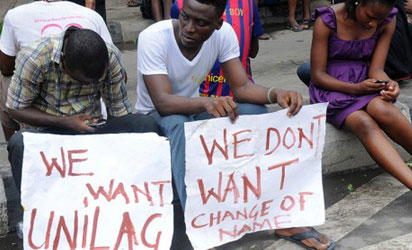
As soon as President Jonathan completed his rather dry and un-arresting speech presentation, the University of Lagos exploded in a spontaneous outrage. Students, teachers and sympathisers closed ranks and poured into the streets. Their bold and vehement message to the President: WE DON’T WANT! And let me add: I DON’T WANT!!
Given the outburst of opposition from across the spectrum, I wonder where the President made his “wide” consultation. From the way staff and students of the University reacted to this change of name, it was clear they hadn’t the slightest inkling of it. A consultation that did not involve the staff, students, alumni nor flown as a kite in the media to feel the pulse of the nation could not in all honesty be described as “wide”. Even members of the national parliament, whose duty it is to amend the laws to enable the change of name, were taken by surprise.
Abiola’s political enemies
I am left with the following conclusion: the President only consulted with the camp of the ruling political establishment, Abiola’s political enemies. These people and their supporters annulled the June 12 1993 presidential election won by Abiola. These were the people who, sensing disintegration possibilities hurriedly ceded power to the Yoruba and chose General Olusegun Obasanjo as the person to take up the presidency rather than Abiola.
These were the people who ensured that both General Sani Abacha and Chief Abiola should vacate the scene and give way to a “neutral” leader as a way of ending the fight for self-succession and revalidation of the annulled election. These were the people who chose May 29th as the hand over date to civilians, rather than October 1, our National Day. And also, these were the people who, since 1998 when Abiola was killed in government custody, have refused to recognise his contribution to the restoration of our democracy, let alone honour him for it. These were the people who ignored June 12 and instead settled for May 29th as our Democracy Day.
Jonathan, I believe, told them he was determined to recognise Abiola’s contributions to the restoration of our democracy after 13 years of denial by the political establishment which the People’s Democratic Party (PDP) is the driving vessel. The renaming of UNILAG was probably the end product of the negotiations.
I smell mischief in this whole thing. The idea is obviously to localise Abiola’s memory to the South West, thus making him seem not good enough to have an institution in Abuja, (such as the National Stadium) our nation’s seat of power named after him. This was a man who held 197 chieftaincy titles from all over Nigeria, built 63 colleges, 121 mosques and churches, 41 libraries and was grand patron of 149 societies, a record yet to be attempted since. Above all, he won the fairest and freest presidential election on a Muslim-Muslim ticket. These same people seeking to belittle him never thought twice when they named the road fringing the Atlantic Barbeach, Victoria Island in Lagos after a regional leader of the north, Sir Ahmadu Bello.
Quite obviously, also, the idea is to diminish the brand known as the University of Lagos (UNILAG), a fifty year-old legacy university and one of the three top universities of choice in Nigeria. When Professor Jibril Aminu was the Minister of Education, he tried to do the same thing to my glorious alma mater, the University of Nigeria, Nsukka (UNN). Aminu was fond of calling it “University of Nsukka”. An attempt was made to rename it after the father of Nigerian nationalism, Dr. Nnamdi Azikiwe. When the Great Zik founded the University in 1955 with its formal opening on October 7th 1960, he named it the University of Nigeria to honour the nation and emphasise his own nationalist propensities. Zik continued to reject the renaming of UNN till he died.
He, however, happily welcomed the creation and naming of the Nnamdi Azikiwe University, Awka, after him by the Anambra State Government.
Mischief taken too far
These two factors are at the heart of the rejection by the staff, students, alumni and well wishers in the naming of UNILAG after Abiola. It has nothing to do with ignorance by the students of the contributions of the man. The renaming is mischief taken too far. It is capable of killing a proud brand and rubbing it with the mud of “Abiola politics”. It is an act of diminishing Abiola and UNILAG with a single effort.
Whether his enemies like it or not, God used Abiola to save Nigeria from disintegration and to preserve its democracy.
If Abiola had not fought the annulment of his election, General Babangida or his alter ego, General Sani Abacha, would have still been in power today if the nation had not since disintegrated. Abiola’s struggle forced the north to cede power. It made it possible for the idea of power rotation and zoning (which was spawned during the days of the National Party of Nigeria (NPN) in power to address the fears of sectional domination) to be practicalised. The north had resorted to using the military to return to power any time the date for the zoning of the presidency to another part of the country seemed around the corner as we saw in the Muhammadu Buhari coup of December 31, 1983 when Dr. Alex Ekwueme was already being touted as the next president in 1987.
Abiola’s struggle helped put paid to military intervention. It helped douse the agitation for national disintegration or secession threats. It also led to the election, for the first time in our history, of two southern presidents within 12 years. It made the election of a minority president of Nigeria possible. Abiola is the founding father of Nigeria’s modern democracy. He must be honoured with an institution in Abuja, our federal capital. UNILAG must be left to remain as UNILAG.
Jonathan’s goodwill towards Abiola must not be sullied by a very unpopular and mischievous decision. Having done so already and getting the resounding NO from stakeholders and patriotic Nigerians he must listen. He must follow due process of the law, since he is neither a General nor Pharaoh.
It is a brave man who realises his mistake and takes steps to correct it.
Emeka Nwosu’s book for launch tomorrow
AFTER years of chronicling the current affairs of Nigeria as a political reporter, Emeka Nwosu, former Political Editor of Daily Times, National Chairman of National Association of Political Correspondents and now the Special Adviser to the Deputy Speaker, House of Reps, has compiled his writings into book form. The book is entitled: Nigeria and the Crisis of the Nation-State, Agenda for National Consensus. It is a 248-page volume with 67 single-article chapters covering about everything under the sun of Nigerian politics and governance as seen through the eyes of an experienced reporter and opinion leader.
Emeka is a veteran of the trade whom I have met in the field both home and abroad. While I have remained on the pages, he forayed into the practical world of politics. In fact, he even ran for the House of Representatives. Nevertheless, he has never missed an opportunity to write and express his views about unfolding events in Nigeria with his articles making frequent outings across the spectrum of the Nigerian Press.
The book launch will take place at the Shehu Yar’ Adua Centre, Abuja on Tuesday, June 5th 2012 under the Chairmanship of Prof. Jerry Gana. The Governor of Abia State, Chief Theodore Orji will be the Chief Host, while Emeka’s principal, Hon. Emeka Ihedioha, will be the Chief Guest of Honour.
We will be there to support him. Join us.
Disclaimer
Comments expressed here do not reflect the opinions of Vanguard newspapers or any employee thereof.