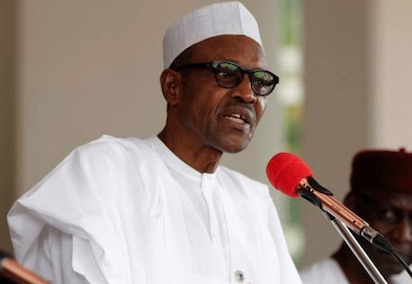
Buhari
—Says sector faces abuses, impunity.
—-Describes as tragic teachers falling primary school test
—-As N4trn needed to fulfill APC’s 13 campaign promises on education – Adamu
By Johnbosco Agbakwuru
ABUJA – PRESIDENT Muhammadu Buhari Monday said that the nation’s education sector was seriously in bad shape that required serious concern and immediate attention.
President Buhari who stated this at the Presidential retreat for members of the State Executive Council, FEC, at the Old Banquet Hall Abuja, said it was tragic for teachers to fail primary school test.
According to the President, “The state of education in Nigeria calls for a serious concern and that is why we are all gathered here today. The problem is no longer a secret that the quality of education in Nigeria requires greater attention and improvement.

Buhari
“That our country is facing numerous challenges in education and all other sectors as a result of historical abuses, mindless impunity and corruption is not news to anyone.
“With an estimated 13.2 million children out of school, high illiteracy level, infrastructural deficit and decay, unqualified teachers, and inadequate instructional materials, to mention some of the challenges, we can clearly see the effect of decades of neglect that the education sector has suffered.
“We are determined to turnaround the sector for the better. We are already making appreciable progress in this respect. This summit must therefore, among other things, sharpen our strategies for addressing the challenges of basic and secondary education, teacher training and professional development; technical and vocational education.
“The summit must work to enhance quality in, and access to, higher education and other challenges in the sector that will debar us from attaining the SDGs and be among the top 20 economies in the am delighted to welcome you all to this important ministerial summit which I consider crucial to our quest to improving the lot of our people through the provision of quality and functional education for all, at all levels.”
In what appeared as a tacit support to Governor Nasir El’Refai of Kaduna State, the President said, “To digress a little bit so that you know that I meant what I read.
“Having been an orphan, I still feel that whatever I did in life so far was built by boarding school. For nine years was in boarding school, three in primary and six in secondary school.
“In those days, teachers treat their students or children like their own children. If you did well they will tell you, you did well, if you don’t do well they never spared the rod.
“When I finished my secondary school, I didn’t work for a day, I refused to work for a day, I left home, I refused to work in the local government, and then I joined the army. And the army of that time we went through all we went through up-to the civil war.
“And then I listened to one of the Nigerians I respect, he said after his training here in Nigeria and the United States, he went to his alma matta, his primary school to see what he could contribute. I won’t mention his name but when he went, he couldn’t differentiate between the students, the children and the teachers.
“And what El-Rufai is trying to do now is exactly what that man told me about 10 years ago. It is a very very serious situation, when teachers cannot pass their exams that they are suppose to teach the children to pass. It is a very tragic situation we are in and this our gathering together to me is one of the most important in this administration.”
Buhari commended the Minister of Education, Mallam Adamu Adamu and the entire education family for setting the stage for the national conversation that was aimed at refocusing the education sector not only to overcome the numerous challenges, but also to strengthen the Ministerial Strategic Plan that had already been developed by the ministry.
He said, “The significance of this summit is obvious. We cannot progress beyond the level and standard of our education. Today, it is those who acquire the most qualitative education, equipped with requisite skills and training, and empowered with practical knowhow that are leading the rest.
“We cannot afford to continue lagging behind. Education is our launch-pad to a more successful, more productive and more prosperous future. This administration is committed to revitalizing our education system and making it more responsive and globally competitive.
“One of the primary roles of education is to build and sustain individual and society’s development. It renews and improves the economic, social, political and cultural aspects of any nation.
“Education upgrades the living standard of citizens and enables people to become better and more productive citizens. It is a human right that creates a safe, healthy and prosperous society.
“It changes the visions and perspectives of individuals, enhances critical decisions and improves democracy. Indeed education is paramount and necessary requirement for all-round development.
“Nigeria’s participation in all relevant international education fora together with our investment in education and collaboration with development partners is an indication of high level of commitment towards ensuring that every capable Nigerian receives good quality education.
“These efforts are justifiable only to the extent that schooling is effective in promoting the realization of national objectives, attaining the Sustainable Development Goals (SDGs), and Education For All (EFA) by 2030.
“These targets are, happily, in harmony with the manifesto and the change agenda of our Party, the All Progressive Congress (APC).
“It is also in agreement with my campaign promises during the 2015 elections exercise and in pursuit of the yearnings and aspirations of the generality of Nigerian citizens.”
The President said with the calibre of participants at the summit, the road to a better future was on course.
He said, It is my expectation that at the end of this summit, we shall come up with feasible, implementable but far-reaching action plans for the ministerial strategic plan that would make education play the pivotal role as the engine that drives national prosperity and development.
“While there are numerous other competing demands and responsibilities from different sectors of the economy, I want to assure you of this administration’s commitment to confronting and tackling the challenges in the education sector. This will be part of our deliberate policy of revitalizing education provisioning and capacity building.”
He emphasized the need to get things right in the country, adding that to get it right meant setting the education sector on the right path.
“No nation can achieve economic, social, political and cultural prosperity without a sound and functional education system.
“We should also bear in mind that the security and stability of the country hinges, to a large extent, on its ability to provide functional education to its citizens.”
In his remarks, the Minister of Education, Mallam Adamu Adamu noted that if education was weak or dysfunctional, society and its development will also be weak and dysfunctional.
He said, “And all change – including our very Change Agenda – begins with education; because it is education that shapes, corrects and restores society.
“But to be able to restore order to society, education has to be made a national priority. This truism is valid for every society and is of particular relevance for our society which, we all agree, is confronted with a litany of challenges and deficits.”
Adamu said civilization was at risk and in great peril when access to proper and quality education was denied and majority of its citizens.
He said, “Such a denial can lead to a number of undesirable consequences, the most pernicious of which are Value erosion and character failure among the youths who are supposed to become leaders of the society.
“It is also high time we paid attention to teachers and to teaching as a profession. Mass literacy, adult education, distance learning, nomadic education and the rest are all important; but we cannot deliver them without giving respectability and renewed stature to the teacher. We must learn to make education attractive to the best brains, makes its study free, its outcome lucrative – and accord it the respect it deserves.
“That is why we must attract and retain the best brains into the classroom as it is done in many other nation’s of the world.
“I am strongly persuaded that if we offer automatic scholarship to students who take education, and automatic employment and a preferential compensation package to those who take to teaching as a profession, our system will improve tremendously.
“If we give regulatory agencies the teeth to bite and do their work, mediocre teachers will soon disappear from our classrooms. If we insist on professionalism with appropriate deadlines set for those who teach, the situation will improve phenomenally. We can minimize and in due course eliminate mediocrity in the education sector.
“There is need to harmonize the learning and teaching that transpire our tertiary institutions as well as redefine our national goals periodically.”
Adamu also stressed the need for the nation to return to the national development plan if the nation was to develop; or else, it will remain one vast landscape of unconnected contracts, and disconnected researchers unable to connect their work with national development policies and vision.
Disclaimer
Comments expressed here do not reflect the opinions of Vanguard newspapers or any employee thereof.