By John Chukwuma Ajakah
The play, Our Husband Has Gone Mad Again was premiered at Yale School of Drama in 1966 and published by the University Press Plc in 1977.
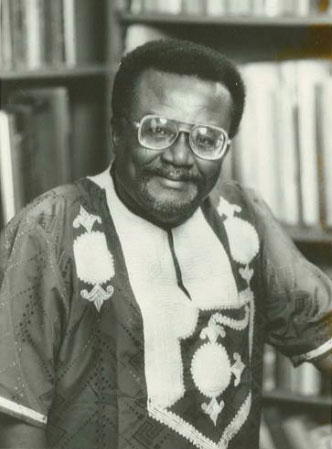
Ola Rotimi (1938-2000), a renowned Nigerian playwright, set the play in Lagos, Nigeria against the backdrop of the political climate of the First Republic, preceded by the struggle for and subsequent attainment of independence. Though written in the 60s, the play reflects the contemporary political situation.
In the play, Ola Rotimi dramatically ignites the biblical injunction that those who desire to lead the people of God must first prove their mettle by successfully handling their own homes. The author takes a swipe at the political class, especially those he portrays as ideological misfits and opportunists who venture into politics for reasons other than selfless service to humanity, to the detriment of the poor masses.
The play is a political satire dealing with the struggles of a typical African country, Nigeria, where a select few, including ill-educated ‘money miss road‘ opportunists, maintain a strong grip on power.
Plot,Summary,& Characterisation
Our Husband Has Gone Mad Again revolves around the protagonist, Major Rahman Lejoka-Brown, a former soldier and cocoa farmer, who decides to run for a political office on the platform of the National Liberation Party (NLP). He bankrolls the party to realise his ambition and become a major stakeholder. However, his inability to manage his matrimonial life, as a polygamist with three wives, becomes his undoing.
The play attains a climax when Lejoka-Brown finds himself in a fix as Liza, his legal wife, whom he had married while fighting in the Congo, arrives from the United States after her medical studies. Liza meets Mama Rashida, the first wife and widow of Lejoka-Brown’s late brother, traditionally bequeathed to him by his father. There is also the third wife, Sikira.
The marriage with Sikira was contracted for political reasons. Lejoka-Brown hopes to win women’s votes through her mother, Madam Ajanaku, who happens to be the President of the National Union of Nigerian Market Women. Party members include Mallam Gaskiya and Musa Osagie, who applaud every move that Lejoka-Brown makes, affirming him as the consensus spokesperson of the party.
There is Gideon Abednego Okonkwo, a friend and former military colleague to Lejoka-Brown, who also had left the army to study law in London. Lejoka-Brown leverages on Okonkwo’s intellectualism for ideas thereby making him a special adviser.
However, like the political bigots he represents, he is not bound to accept such advice. For instance, he vows to apply military tactics, “surprise and attack,” against his opponents and dismisses Okonkwo’s call for caution, retorting, “politics is war.” Liza survives the initial shock and instead of retreating, she resolves to stay and fight, especially against impetuous Sikira.
Thematic Concerns
The playwright explores themes such as power tussle as portrayed through Lejoka-Brown’s struggle with his political opponents and the keen context among the wives at home for recognition. The theme of cultural conflict is realised in Lejoka-Brown’s polygamous marriage which is acceptable in his tradition and religion, but abhorred to English culture and Catholic religious belief under which he had married Liza. Lejoka-Brown’s obsession and quest for power reveals a theme of inordinate ambition.
The theme of inferiority complex is expressed in Lejoka-Brown’s desperate attempts to improve his social status. He feels intimidated by Liza’s credentials and needs a political position to fit into her social class. Man’s inhumanity to man and oppression is depicted through the reckless demolition of the ancestral homes of Alhaji Mustapha and others in Lejoka-Brown’s neighbourhood by a ruthless demolition squad, aptly described in the play as ‘government demons.’
Dramatic Techniques
Ola Rotimi deploys a series of dramatic techniques in the presentation of the play. Humour is one of the dominant techniques. A good example of this is realised in Act1, Scene 1, where Lejoka-Brown relives his military life experiences with Okonkwo by re-enacting parades and drilling exercises in his living room, chanting songs and barking orders, in preparation for political campaign outing, Another instance is in the conflict that ensues as Lejoka-Brown complains that he had given Liza eight hundred pounds to proceed on holidays to any country of her choice in order to allow him time to concentrate on the elections, but as he puts it, “…she uses that damned money to fly straight into my secrets.”
That statement implies that politicians always have something to hide even from their spouses. Again, while Lejoka-Brown drives to the airport to pick and take Liza to a new apartment where she will be shielded from his other wives, the plane arrives earlier than scheduled, altering his carefully orchestrated plot and resulting into a dramatic irony as Liza takes a taxi to the family house, where she experiences a culture shock on realising that the women she mistakes for home helps are her husband’s other wives.
Resolution of Conflict
Believing that she is the only legitimate wife, Liza explores the competitive edge she has over the other wives – education and sophistication – to her advantage. She helps Mama Rashida to set up her egg business and provocatively flirts with her husband, to the chagrin of Sikira, who becomes so jealous that she throws in the towel and runs back to her mother, complaining, “Our husband has gone mad again!”
Happy that she now makes huge profits, Mama Rashida, reciprocates Liza’s goodwill by leaving the marriage to concentrate on her business. Liza, now Lejoka-Brown’s only wife, convinces him to leave politics, explaining that she prefers the man she had met and married in the Congo to the politician he has metamorphosed into. Sikira, with her mother’s staunch support, emerges on the last scene as the new candidate of the National Liberation Party. With this ironical twist, the play ends on a comic note as the dialogue below depicts:
Okonkwo: Come take a look at your party’s new candidate for the elections, Major !
Lejoka-Brown: Aahh! …I’m through with politics, brother.
Sikira: Vote …vote for me! It is true that I am a woman, but that does not matter…
Lejoka-Brown: A woman?
Sikira: MEN AND WOMEN ARE CREATED EQUAL
Madam Ajanaku: No more, no less!
Lejoka.Brown:… The world has come to an end!
Disclaimer
Comments expressed here do not reflect the opinions of Vanguard newspapers or any employee thereof.