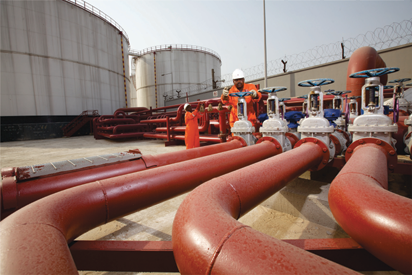
Oil rig worker
By Sonny Atumah
The German-born U.S. philosopher and historian Johanna Hannah Arendt (1906-1975) wrote on the ‘Crises of the Republic’ in 1969 that the Third World is not a reality but an ideology. Arendt’s postulation is factual to the extent that what was termed Third World tended towards the ideological divides of the cold war rather than reality.
Many countries were emasculated in the togas of Third World when the two opposing blocs led by the United States (capitalist First World) and the other led by Union of Soviet Socialist Republics, USSR (communist Second World) were embroiled in the cold war. The bipolar arrangement had the non-aligned nations of Africa, Asia and Latin America dubbed Third World.
The collapse of the Soviet bloc was the Second World’s death knell with a new paradigm of bipolarity in the First and Third Worlds. Developmental indices have shuffled and altered the nomenclature that many hitherto classified as Third World have advanced.

Oil rig worker
China and some ‘Asian Tigers’ have joined the league of First World thus giving an affirmation in Arendt’s Third World being a mere ideological appellation. Even at that many nations have become intrinsically incapable of development thereby sliding into an emerging “Fourth World.”
Many natural resource endowed nations are dangerously at the cliff edge. Some nations in the Organisation of the Petroleum Exporting Countries, OPEC have conveniently asserted economic relevance in exporting crude oil to industrial nations whose foothold on alternative energy source would soon become a reality. Nigeria has caught the daily impact of crude oil price volatility. With threats that internal combustion engines, ICE that use petroleum products would soon be phased out, most of our leaders still doze in the slumberous heat of the afternoon without inspiring confidence.
From the subordinates the approach has been that of prevarications; avoiding giving truthful accounts for fears of victimisation. Senior staff members of the NNPC are not courageous to tell political heads on how to channel scarce resources to address the country’s intractable refining problems. The Minister of State Ibe Kachikwu gave orders when he was newly appointed in 2015 that the refineries must work in one month. Leaders come and go without ironing out the wrinkles of comatose refineries.
They were close to exposés when NNPC rose from an Annual General Meeting last December with a resolution to comprehensively rehabilitate the refineries. The Corporation’s statement quoted the Chief Operating Officer, Refineries, Mr. Anibor Kragha as saying that the rehabilitation of the refineries would be the priority of the corporation in 2017. Kragha said: ‘’ the plan for next year (2017) is to get the comprehensive rehabilitation programme done.
The situation is like having three cars in your garage that have not been maintained for 15 to 20 years while you expect optimal performance from them. Changing one fuel pump here, one compressor there is not helpful. What we are doing now is to step back and take a holistic approach and do a full rehabilitation of all the refineries.’’
That frank talk was countered almost in the same breath when the Minister of State for Petroleum Resources Dr. Ibe Kachikwu addressed members of the House of Representatives Committee on Petroleum (Upstream) led by its Chairman Hon. Victor Nwokolo who had oversight visit to the Ministry. The Minister explained that for the purpose of efficient management of the refineries, the Federal Government will no longer invest in the repairs of the country’s refineries, and would also not concession or privatise the refineries. Rather, prospective private investors will bring in their money, take part in managing the refineries and from there recoup their investment. That has been his position in the last two years of being on the saddle without result.
Kachikwu recent storyline was that if Nigeria was not product sufficient by 2019 he would resign as Petroleum Minister. The English folks would have described that as a smart-aleck who knows that the terminal date of his appointment is 2019.
Since 2015 with all the state’s fund he could muscle he has surrendered to Nigeria’s alternating current Aliko Dangote who commenced construction of his 650,000 barrels per day capacity refinery in 2016, that would come on stream in 2018. The Minister’s lamentation of a nation that imports petroleum products is unfortunate when refineries in Port Harcourt, Warri and Kaduna are waiting for his genuine and selfless decision to rehabilitate.
Capacity building is a major problem in NNPC that we need to address. Doing so means value additions for energy, technology and skills. It is gratifying that some progressive minded persons are still in the NNPC. It means there is hope for the nation but a lot of hard work needed. The system is so venal that the monster which is common place needs to be uprooted to entrench efficiency and improve productivity. But two years on it has been prevarication and procrastination.
Disclaimer
Comments expressed here do not reflect the opinions of Vanguard newspapers or any employee thereof.