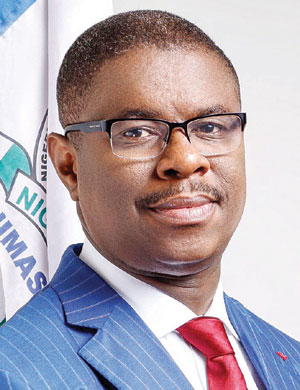
Peterside Dakuku
AT the end of the just concluded 3rd conference of the Association of Africa Maritime Administrations, AAMA, in Abuja, the Director General of Nigerian Maritime Administration and Safety Agency, NIMASA, Dr. Peterside Dakuku, spoke with Vanguard’s Maritime Correspondent, Godfrey Bivbere, on the benefits of the conference for the continent and Nigeria. Dakuku, who was unanimously elected first President of AAMA at the end of the conference, also spoke on sundry issues in Nigerian maritime. Excerpt:
Why does it seem like the world trade is tilted against Africa even with the huge potentials?
Thirty countries in the littoral states and inlands in Africa generate a lot of cargo, we have the market and we are the second biggest market in the world, yet we are not an active player in the maritime industry. Meanwhile maritime has a lot of potentials to uplift the living standard of our people, so we intend to tap from all of that. To do that, it is the maritime administrations and the regulators that must be at the driving seat and the heads of government have agreed on it, ours is to make it work.

Peterside Dakuku
What does AAMA hope to achieve at the end of this conference?
At the end of the conference we expect that we would have developed a framework on how to implement the resolution of our heads of governments in Lome, the African charter on maritime security, safety and development. We would have given effect to agenda 2063 that was also resolved by our heads of governments. We will agree on how to collaborate and cooperate to work together for the growth of maritime industry in Africa. We will also be setting in place a peer review mechanism and most importantly, Nigeria’s profile will be raised. Our profile will be raised within the committee of nations in the world not just in Africa. So, there are lots of expectations.
Can you throw more light on the Africa Integrated Maritime Strategy, AIMS?
AIMS is an initiative of the African Union which was endorsed by all heads of government, it is a framework to tackle the issue of piracy, sea robbery and maritime crime generally. Now to give effect to that are Navies of our countries and the maritime administrations of our countries. It is one of the issues that was dealt with in this conference.
What his your opinion about Nigeria’s drive for a seat in the Council of the International Maritime Organisation, IMO?
Nigeria will be bidding for a seat in the IMO Council in November and I think that this conference for us as Nigerians, will give us leverage towards our bid for the IMO Council seat in November.
There are claims that most of the vessels sailing on our waterways are sub-standard that is why there are so many mishaps. What is NIMASA doing to reduce such mishaps on our waterways?
Under our flag-state and port-state functions, there is no way a sub-standard vessel will find its way into our exclusive economic zone. If it does, it will be detained until it is rectified and so I do not agree with you that we have had accidents because of sub-standard vessels; it is not likely.
What is NIMASA doing about ship wrecks along the nation’s waterways?
We recently announced that we are going to commence the removal of wrecks but before you remove wrecks you must declare it wrecks and you must follow a convention, the Nairobi convention. So we are following legal procedure before we commence removal of wrecks from our waters but you can be sure that it is receiving priority attention.
Let us look at the Cabotage Vessels Financing Fund, CVFF, over the years a lot have been collected, why is it difficult to disburse and how much is in it now presently?
I have said this over and over again. The ultimate power for the disbursement rests with the honourable Minister of transportation not NIMASA. NIMASA is to address the guidelines to the Minister and the Minister is to approve and send the guideline to the National Assembly. NIMASA can also recommend those who qualified for the CVFF but the ultimate power lies with the honourably Minister Transportation and so it is the ministry that should explain why it has been impossible to disburse the funds over the years.
My suspicion and this is the level of suspicion, is that they do not want the Fund to go the way of the Ship Building and Ship Acquisition Fund, SBSAF which was a precursor to the Cabotage. They do not want the Fund to go the way of the aviation fund. That is my suspicion, which is the pedestal explanation I have for it. It is that they are busy tightening loose nuts, dotting the I’s and crossing the Ts to make sure that when we begin the implementation, when we begin the disbursement of the Cabotage Fund, only serious minded investors will assess the funds to enable us grow tonnage. That is where we are heading to.
How soon will the disbursement begin?
I may not be able to place a time line on it because it is outside my purview. This revision of guideline will rest with the minister, the approval for the implementation will rest with the honourable minister and I can’t stand here and say the minister must do A or do B. The minister of transportation is my superior, is my supervising minister but I can tell you that we are pushing; I know that we are making a lot of progress. We are working collaboratively with ship owners and the ministry of transportation.
There is this deadline against the use of single hull vessels; I do not know how prepared NIMASA is?
First question, single hull vessels would soon be phased out, it actually has been phased out except there was an extension for developing countries depending on the circumstance in our various countries. It was realised that whereas in the developed countries they can successfully phase out single hull vessels without having any serious issue but in the developing countries it is difficult to find funds to phase out single hull vessels and acquire double hull vessels.
However, for us in Nigeria we have set out target for ourselves when we must phase out single hull vessels and we are already working with those who have single hull vessels either to convert it to double hull vessels or phase them out completely.
Disclaimer
Comments expressed here do not reflect the opinions of Vanguard newspapers or any employee thereof.