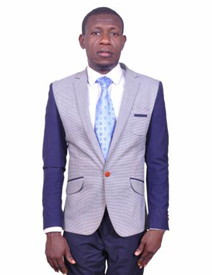
Joseph Chikunie
By Dapo Akinrefon
Joseph Chikunie is a lecturer at University of Lagos (UNILAG) and holds a Ph.D. in philosophy from the same university.

Joseph Chikunie
Born March 10, 1972 into a family of eight, Chikunie’s growing up was difficult owing to disability. Because of the disability, his father, an archdeacon of the Anglican Church in Obulokiti, Aniochia South local government area of Delta State, prevented him from attending school.
Chikunie, however, did not allow that deter him as his uncle, Professor Willy, took interest in him and enrolled him in school.
After completing his secondary education with six distinctions and three credits, Chikunie wrote the university matriculation examination (UMC) before going to study philosophy at UNILAG, in 1995.
While in the university, he emerged Secretary General of the Faculty of Arts students association and from there, became the first President of Disabled Association of Nigeria.
Married and blessed with two sets of twins, he is the founder and National President of Association of Indigenous People with Disabilities (AIPD).
In this encounter, he laments the plight of people with disabilities and calls on government and corporate bodies to step in to see what can be done. Excerpts:
“Early life
Life then was difficult and full of traumatic experiences. In fact, my father did not want me to go to the school because he said I could not cope. He said he could not see the way I could cope but I had an uncle, Professor Willy, who actually is my benefactor. Today, through him, I have been able to accomplish this achievement.
How did you start and how long did it take you to get to this point?
This has actually been in the pipeline since my primary school days and I have always nurtured the idea of helping people who are physically challenged. You know that in Nigeria, you can have an idea but if don’t the resources, you cannot live your dream.
So, it all started immediately after I graduated but I had put all the work together, I had the concept I decided to put this together by eminent Nigerians for support.
So, formally, I would say it started on January 16, 2017, when the Student Affairs Department of UNILAG registered the Association of Indigenous People with Disabilities (AIPD).
That actually now gave us the legal teeth operate as an association. It is a non-governmental organisation within the university.
“You are a university don. What inspired you to establish the association?
The inspiration came from the challenges I faced as a toddler, a teenager. Usually in advanced societies, when you encounter difficulties in certain areas of life, you try to as much as possible to go into that area to make things better.
For instance, the Kanu Heart Foundation was founded because Kanu had heart ailment, he went into that and he is helping people today.
So, life was challenging while I was growing up. I remember how I would go to the corner of a room in my father’s compound and cry my eyes out because out of eight children, I was the only one who was physically deformed. I could not really wrap my head around why it was like that.
There were some mischievous friends and peers, who would mock the way I walked. I was actually limping. You see, when life and nature have deprived you of certain parts, it has a way of developing the other parts.
So, I decided to go into academics to develop my mental faculties. Today, I hold a doctorate degree from the University of Lagos and I have met with many prominent people just because of education.
So, the inspiration is to help people who are physically challenged and to inspire them so that they can know that, irrespective of their challenges, they can still surmount the challenges and become people who can be useful to themselves and the society at large.
How far have you gone in sensitizing the people on the project?
It is said that the journey of a thousand miles starts with a step. Having gone through the University of Lagos for the first, second degree and Ph.D., they say charity begins at home. So, I have decided to start from the University of Lagos but it is going to spread to other universities. Why we are limiting it to the university is because most of the people there have the intellect and can understand the project’s objectives.
Objectives
We are out to promote equality, equal opportunity, independent living and economic empowerment for people with disability. These are our actual objectives and our members cut across.
Challenges
A report in 2011 stated that there were 25 million Nigerians with one physical deformity or the other out of which 3.5million have very difficult challenges of moving around. The greatest challenge is the impediment in mobility. Government and corporate bodies seem not to factor in the fact that not everybody is able- bodied. For instance, I watched emotionally a young woman who had money in the bank but could not withdraw from the ATM machine. This woman actually sat in a wheelchair and if you see the way the ATM is designed, it is a bit high for someone who is in a wheelchair. So, she tried to withdraw her money with her card but fell as she was stretching; she kept trying but she did not succeed. Now, if that hole had been low, she would have been able to withdraw her money effortlessly. This is just an instance. You see very high buildings with no elevators.
For instance, I was at the University of Lagos for four years. At the said time, the elevator at the Faculty of Arts was not functioning and I remember I had to walk the four floors because most of our classes held on the fourth floor. So, I walked up the staircase almost every day. There are still some tall buildings in this country without elevators and the people who are physically challenged must gain access to do one or two things there.
So, these are some areas that government and corporate bodies should think about. They should know that not everybody has functional parts of the body. If they begin to look into that, I think we will begin to address some of the challenges that we face.
Dream for the physically challenged
The way forward is that I have articulated a nine-point agenda that once we are able to implement, I think life will be rosy for people who live with disabilities.
Some of these include employment. The moment a physically challenged person leaves the university, there should be a job waiting for him or her because there is discrimination going on in the employment market. Government has not even taken care of every able-bodied person not to talk of the disabled.
You talk about skill acquisition programmes, we are going to organise skill acquisition programmes from next semester in UNILAG for the physically challenged. They are going to learn how to repair electronics, how to make bags, shoes so that they can be useful to themselves and generate revenue even while they are students. That someone is physically challenged does not mean that he or she cannot work. By the time those who are undergraduates work while as students, the employers will know that there is the ability in disability and they will readily employ them.
Dealing with physically challenged persons on the streets
For such people, they should actually be taken to a centre. The Association of Indigenous People with Disabilities, will in due course, provide over 1000 wheelchairs to people who are in dire need of them. They should be taken to a centre where they can put their brain to use. We want to be provided with the opportunity so that we can work hard to earn a living. That is why we say we want to be empowered to live independently. We could have care givers but for a very long time, I have been the breadwinner in my family and I have seen my siblings through school.
Imagine if that opportunity was not there if I was not really fortunate to have an uncle who understands what education can do in the life of a physically challenged, I would have been on the streets as well begging. So, people like that should be taken off the streets, they should be taken to a place where you have computers, where they can be empowered and teach them different vocations and you will be amazed at what these people can do.
Disclaimer
Comments expressed here do not reflect the opinions of Vanguard newspapers or any employee thereof.