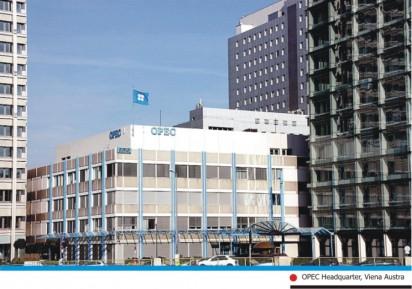
OPEC
As OPEC members, others struggle to comply with supply cut
By Sebastine Obasi & Ediri Ejoh
OIL prices reduced yesterday, weighind down in part by renewed concerns about global oil supply after a meeting of the Organisation of Petroleum Exporting Countries, OPEC producers failed to impress investors.
May West Texas Intermediate, WTI, crude fell 44 cents, or 0.9 percent, to $47.53 a barrel, while May Brent crude eased 33 cents, or 0.7 percent, to $50.47 a barrel.
Five representatives of countries that signed up to the OPEC output agreement, Kuwait, Algeria, Venezuela and non-OPEC nations Russia and Oman met in Kuwait on Sunday to review the current levels of compliance. While most members are sticking to an agreement to make production cuts, data suggests not all non-OPEC members are adhering to quotas. Prices shifted lower on Monday as that meeting provided little concrete news, said analysts. Those OPEC officials urged members to cut oil production in line with last year’s agreement, and said the compliance committee will meet again in late April to recommend to the cartel whether cuts need to be extended another six months.
Ability of individual producers
The current ability of individual producers to provide price support with cuts currently in place is limited unless a more collective statement is made,” said analysts at the JBC Energy Research Centre.
“A primary concern remains how long OPEC and other oil producers will be willing to support growth in U.S. shale production. We see risks to U.S. crude supply stacked to the upside in the coming months vs. our base case and if stable or higher prices materialize, each barrel produced in the U.S. would in theory need to be offset by lower production elsewhere,” said the JBC analysts.
A report from Baker Hughes released Friday showed the number of active U.S. oil rigs rose 21 to 652 rigs last week, suggesting the likelihood of a rise in domestic production to come. The oil rig count has climbed every week this year so far, except for one.
“We remind that the selloff in the oil markets was triggered by record high levels of U.S. oil inventories, which are not meant to fade under the Trump administration, which is longing for less energy dependency for the U.S.,” said Ipek Ozkardeskaya, senior market analyst at London Capital Group.
Oil price to stabilise: Meanwhile, the renewed volatility in the oil market may come under control and return to stability as the major producing and exporting nations renew commitment with the directive of the Organisation of Oil Exporting Countries, OPEC, to cut supply.
The Joint OPEC/Non-OPEC Ministerial Monitoring Committee, JMMC which convened in Kuwait City for its second meeting last Sunday said many nations have started to comply.
OPEC indicated, in a statement, that based on the report of the Joint OPEC/Non-OPEC Technical Committee (JTC) for the month of February 2017, the cartel and participating non-OPEC countries have continued their progress towards full conformity with their voluntary adjustments in production.
JMMC was established following OPEC’s 171st Ministerial Conference Decision of 30 November 2016, and the subsequent Declaration of Cooperation made at the Joint OPEC/Non-OPEC Ministerial Meeting held on 10 December 2016; at which 11 non-OPEC oil-producing countries cooperated with OPEC Member Countries in a concerted effort to accelerate the stabilization of the global oil market through voluntary adjustments to peg combined output at around 1.8 million barrels per day.
The Organisation indicated that the resulting Declaration, which came into effect on 1 January 2017, is for six months and is extendable for an additional six months, depending on the status of supply and demand, including global inventories.
The JMMC expressed its satisfaction with the progress made towards full conformity with the voluntary production adjustments and encouraged all participating countries to press on towards 100 per cent conformity.
As at February 2017, the OPEC and participating non-OPEC countries achieved a conformity level of 94 per cent, an increase of 8 percentage points over the January 2017 performance. This demonstrates the willingness of all participating countries to continue their cooperation.
The JMMC took note that certain factors, such as low seasonal demand, refinery maintenance, and rising non-OPEC supply, have slowed down the positive impact of the production adjustments on inventory drawdowns.
At the same time, the liquidation of positions by financial players in the market was also observed.
However, it was felt that the end of the refinery maintenance season and a noticeable slowdown in the US stock-build, as well as the reduction in floating storage, will support the positive efforts undertaken to achieve stability in the market.
In view of the above, the JMMC requested that the JTC with the OPEC Secretariat review the oil market conditions and revert to the JMMC in April 2017 regarding the extension of the voluntary production adjustments as stipulated in the Declaration of Cooperation, in order to ensure market stability.
The JMMC will deliberate before submitting its recommendation to the participating countries.
This reaffirms the commitment of OPEC and participating non-OPEC countries to continue to cooperate for the benefit of producers and consumers alike, as has been consistently advocated.
The JMMC, led by its Chairman, HE Issam A. Almarzooq, Minister of Oil and Minister of Electricity and Water of the State of Kuwait, paid a courtesy call on the Emir of Kuwait, His Highness, Sheikh Sabah Al-Ahmad Al-Sabah, to thank him and his government for the support and guidance given OPEC in the run up to the historic OPEC decisions in November and December 2016 and pledged their commitment to the full and timely implementation of the decisions.
The Secretary General of OPEC, Dr. Sanusi Barkindo disclosed that production numbers for January and February were well received and the market has responded affirmatively to the determined efforts of all participating countries.
“I want to emphasize here that some producers have over-performed. They certainly deserve recognition for their efforts. So I would like to expressly offer my appreciation to both Angola and Saudi Arabia for conforming beyond expectation.”
I hope their achievements will motivate other participants to reach their own goals – and perhaps to even go further.”
“Meanwhile, some other countries have not been able to meet their production adjustments due to temporary difficulties. I would like to candidly say that, in general, more has to be done. We need to see conformity across the board. We assured ourselves – and the world – that we would reach our adjustment to 100 per cent conformity. Our voluntary adjustment is and will remain 100 per cent, and although this should be seen as a collective effort, individual countries also need to take their conformity very seriously. If we reach our common objective, we could see balance returning to the market by the third quarter of 2017. If not, this date may be pushed further out,” he added.
As we have observed over the past couple of weeks, stocks remain stubbornly high, particularly in the US, where a seasonally rising trend has hit new historically high levels. We have also seen some traders liquidate their long positions and Brent prices have dropped from the mid-50s to the low-50s. Volatility has also increased.
Disclaimer
Comments expressed here do not reflect the opinions of Vanguard newspapers or any employee thereof.