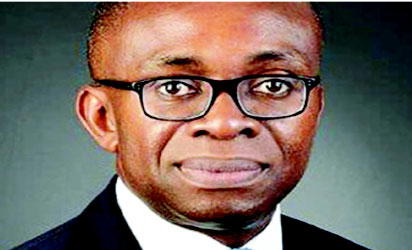
•Ike Chioke, CEO Afrinvest
The financial sector outlook for 2017 remain hazy as policy environment that placed it on hard places still loom large. Managing Director of Afrinvest West Africa, a leading investment banking institution, Mr Ike Chioke, in has fielded questions in this interview on the circumstances and the way forward.
Excerpt.
By Emeka Anaeto
WHAT are the factors that would drive solution to banking sector challenges in 2017, are we going to see mergers or capital raise?
I think the factors on ground in the banking sector will be that if you look at where exchange rate is we are officially at N305/USD and parallel market is at N490/USD. And quite a number of banks have Dollar denominated risk assets on their balance sheet. The more we move towards a free floating of the Naira or devaluing of the Naira, the more it drags down their capital adequacy ratio.
If the threshold is 15 percent or 16 percent, and at N305 you are just at 16.5 or 17 percent, and you move the official rate to say N350 to a dollar you might see the same bank, because 30 percent of its risk assets are in dollars, finding the capital adequate ratio has dropped to 14 percent. At that point, it means then you need to start raising more capital.
Weaker large tier banks
And I think quite a number of mid-tier banks, some of the weaker large tier banks are in that space, where a slight movement in exchange ratio might force them to fall below the regulatory minimum of capital adequacy ratio, which means they will have to raise capital, do right issues and definitely new capital injections.

•Ike Chioke, CEO Afrinvest
We are already seeing that. You can see that as they begin to close their 2016 accounts watch out their announcements for Annual General Meeting of Shareholders, you can see that they will be taking measures to give them all kinds of flexibility to attract new capital. So that is likely to happen.
Why we are talking about the need to reform the currency market, for the banks it has this little bit at the backside because the reform is what will create that requirement for additional capital injection.
The external reserves is on the increase. What is the implication for the economy?
There has been a positive accretion in the external reserves. We have seen it growing. But at the same time we are not paying our bills. That you are seeing your bank account grow and you have not settled your debts, you have not paid your children’s school fees, you have not paid your medical bills, you are being slightly disingenuous.
I know we have a slide on the FX Forwards position and as at last count we were at USD4 billion of unsettled forwards contract, that if it is settled immediately, will take out USD 4 billion from the external reserves and then you then go back to lower position without including the new demand for Dollar that will happen this month, this quarter and the rest of the year.
The challenge we face is that we haven’t actually gotten to the ideal situation where there is enough confidence built into the country, our governance framework, our politics, our economic turnaround plan, that the investors themselves finds the opportunity to come and invest in the economy.
Economic policies
FDI flows are interesting, but they come and go like the wind. But really where we should be going is tinkering with our economic policies to attract FDI flows and that has been on the negative slide for far too long.
Still on the challenged banking sector, should shareholders forget about dividend this year?
In terms of the banking sector, we shouldn’t forget about dividend. We actually showed that the banking sector was positive in 2016, it was up by two percent. But that is the whole basket. If we look at specific stocks such as Access, UBA, Zenith, GTB among the top performers, but for a number of them their dividend yield today is that of five percent because their share prices have come down.
The bank that used to pay N1 per share when the share price was N20 that works out to be 5 per cent, if the same bank gives N1 dividend and the share price has gone down to N10, that will give 10 per cent dividend yield, and that means it has started competing with FGN Bond.
So we see that dividend is actually looking stronger because the share prices of these banks have come down. In our Portfolio for 2017, we talked about having a recession-proof portfolio where you have stocks that have real sustainable value and also high in dividend yield that we can put into your portfolio mix, but you only get that benefit if you are a customer of Afrinvest.
Floating or not floating, what is the real challenge in the foreign exchange market, and then the interest rate angle to the challenge?
Indeed, if you look at what CBN has tried to do on the exchange rate environment, and I think they have tried, given all the challenges they are faced with. Unfortunately the CBN, in my view, now cannot be said to be a totally independent institution because of interference you have seen not just by the current government but also the previous one by removing the former CBN governor.
And the minute they started with that form of action that means that in this present circumstance he has to go to Presidency from time to time to get instructions. So that has coloured the independence of the CBN. But within the confines of the political, religious, business dimensions and then market risks, I think they are trying in a way and managing the circumstance.
However, if they were to go into a fully flexible exchange rate in the Nigeria we have today, I would probably be against that position. This is because it will be trying to solve a problem on the fringes. If you do that all you just have is that capital will just fly out and we may run out of Dollars.
Flexible exchange rate
If you go to flexible exchange rate you will need to actually impose some massive structural reforms in some of the key sectors of the economy we are talking about and that will help you attract Dollars at the same time some people will like to go out.
You cannot manage in one dimension. You have to realise that your problem are in multi-dimension. As you are trying to fix one, you must remember that others might be opening up. A reform that focuses on a large scale reform of oil and gas, mining, governance, rule of law, ease of doing business in a holistic manner will allow you to let the exchange rate float.
Once upon a time we were actually close to that. There was a time when just between Soludo and Sanusi, we could have done that as we were getting to that sweet spot. The Naira was almost appreciating, but we lost that opportunity.
In terms of the interest rate environment, I did say we hold it steady and I see it that steady during the cause of the year. You have to balance the demands of the domestic market as well as the external market. While we want to have a sufficiently attractive rates to attract international investors to come, we need to be careful with what we are doing with high interest rate in the domestic environment, which will crowd out the private sector if it is too high.
Clearly in an environment where government is borrowing, and you have a massive deficit budget to fund, investors will love to take government risk than private sector risk. That is already a challenge on its own.
Private sector risk
Foreigners will not necessarily come in. As you can see the FDI and FPI flows dropped simply because there are certain policy issues that don’t balance and they don’t see it in the future. We are stuck between the rock and a hard place, while inflation is 18.5 percent interest rate at 14 percent, to go and say let me go and get a positive real rate of return and move interest rate to 20 percent would be very disastrous to say the least.
Quite frankly, we have seen that interest rate is really not the driver in the amount of borrowings that people do.
It is actually more of the reforms in real sector that will drive people to go in there. As you see now, in Agriculture with government committed focus in agriculture you can see massive investment in that sector. You can see the performance of Presco Plc and Okomu Oil Plc, which has taken that sector up 20 per cent. And it is reforms in the real sector that will drive your capacity and your interest in borrowing whatever the rate might be.
Disclaimer
Comments expressed here do not reflect the opinions of Vanguard newspapers or any employee thereof.