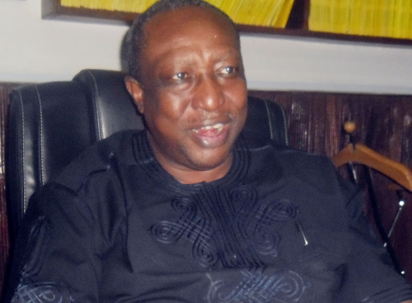
Chief Adrew Oru
CHIEF Andrew Oruh, a notable lawyer, businessman, and politician in this interview tells Vanguard that Nigeria cannot thrive without a formidable justice system that is based on equity. Oruh, whose business interests spread outside Nigeria noted that there are lessons the nation can learn from small successful economies in order to experience economic boom again.
By Charles Kumolu
You have achieved much as a lawyer, politician, and businessman, how was that possible?
It is good to understand that every business, no matter its nature is essentially premised on the existing laws in the land. I have always obeyed the rules. The same goes with politics where there are certain rules of engagement. As a lawyer, I am well equipped to understand the different issues that confront an entity, especially when it comes to governance and business.
Are there landmarks that you will look back to and describe as outstanding in your career and what lessons do you think can be drawn from them?
I am actually 33 years now as a lawyer. When we started, this environment was not as challenging as it is now. It was just a question of trying to learn the ropes. I didn’t just have many responsibilities then regarding my family and society because no one then was looking up to me as a role model.

Chief Adrew Oru
It was when one started thinking of progressing from one stage to the other that I actually started preparing for responsibilities which include family life and society. Even as a student at the Universty of Nigeria, I had been involved in little businesses to make ends meet. In terms of politics, I was actually involved in the politics of UNN.
As an undergraduate, I was involved in national politics through my leadership of youth wings of political parties. I remember a particular incident in 1979 when the present Secretary to Delta State Government, Festus Agas and myself staged a two- man demonstration against the then Governor of Bendel State, Prof Ambrose Ali, who was visiting our local government.
On Ambrose Ali
At that time, the roads in our area were very bad to the extent that bicycles were getting stuck. I reasoned that there was no way the governor will come and go without assuring that our roads would be fixed.
Even though my mother at the time was a state executive member of the Unity Party of Nigeria, UPN, I was not deterred from propelling the protest. We slept in the same house but she did not know what I wanted to do on that day. She hosted the governor and even sat next to the governor at the occasion but I was not bothered.
I came into the field with placards and marched towards the governor alongside Festus Agas and we were being chased around by security agents at the venue. We were lucky that it didn’t happen now, if not we would have been shot. Even though my mother was embarrassed, the governor told everyone to let me be, after which I handed over my letter of protest to him.
I also distributed hundreds of the copies there. In the letter, I informed him about the deplorable state of Ughelli roads and told him that his government was not doing enough. The key achievement was that two weeks after the demonstration, the contract for the construction of Ughelli roads was awarded. That gave me an idea that if you don’t stand up and fight for your society, community, and country, nobody is going to do it for you because even before the governor visited, he must have received reports about the state of the roads.
And that was not his first time of coming because he had been there during his electioneering campaigns. So, that propelled me later in life to try to speak out as much as possible whenever I notice any form of injustice or inaction by governments.
On practice of law
I am among those, who belong to the school of thought which believes that as legal practitioners we must be able while paying obeisance to judges, bring their attention to the lapses in their operations. I have been vilified sometimes for taking such actions but I remain undeterred.
The corruption we are talking about in the judiciary, I am sure a lot of people will know that I was right for taking some steps on the matter in the past. I took so many steps early to address this malaise, unfortunately, I can tell you that there is a cabal that does not want those vices exposed among legal practitioners. Not so many judges are corrupt in Nigeria. In fact, so many are very outstanding but the few that are corrupt are seriously corrupt.
And because of the level of corruption that they are involved in, they find themselves adjudicating over matters that are very sensitive. Unfortunately, their involvement in such matters negatively affects the society. Because of their corrupt nature, they do so many damages before anybody realizes. However, a lot still needs to be done because there are still some judges, who have suspicious conducts.
Are you satisfied with the modus operandi being used in prosecuting alleged corrupt judicial officers and what other measures would you want the government to adopt?
I will not say that the modus operandi is satisfactory. With the kind of method being used to prosecute the cases, it will be very difficult to get to the root of a corruption case when a judge is being investigated. First, the National Judicial Council, NJC, is headed by judges and that is an issue. I am not saying that the headship of the NJC by judges is wrong but you need certain other inputs. When a judge is being accused of corruption, we must not forget the fact that corruption is a criminal offence.
And the NJC does not have the wherewithal to investigate criminality. That is the job of the law enforcement agencies. It is not the job of the NJC to invite an erring judge to come and say whether he is actually corrupt or not with facts and details. The prowess and skill with which to investigate a criminal accusation are not with the NJC.
They don’t have the skills. If I may suggest, such allegations against any judge must first be investigated by the Police, DSS, or any other security agency that is well equipped to investigate criminality. The trial at the NJC should be based on the findings of such investigation. The NJC should not be the one investigating, prosecuting and judging at the same time. It does not make sense.
If you were to assess how well the judiciary has contributed to efforts at deepening democracy. What would your assessment be like?
If the truth must be told, the judiciary has not been forthcoming in deepening democracy. They get too technical. The judiciary knows the truth but shies away from it based on technicalities. And to me, such practice smacks of corruption. It encourages corruption in the legal practice and in the country. They often refuse to look into a substance based on some silly technicalities. The judges often say that justice cannot be sacrificed on the altar of technicalities but when it involves high profile cases, they end up sacrificing justice on the altar of technicalities. It is unwise and not good for the country.
A lot of them tend to give the impression that they are hiding under technicalities to do injustice. The judiciary in Nigeria should get involved in judicial activism, it happens all over the world. Until the judiciary stops saying that they are only there to interpret the law as it is, we will not get anywhere.Even the Federal High Court has said that when the law is in conflict with the rules of equity, the rules of equity should prevail. And what are the rules of equity? Fairness of justice on the face of it which is based mostly on morality, based on the facts before you and not the facts in relation to the law.
So, the judges should look more at the equity of the situation and look more at the facts before them rather than looking at whether the facts are admissible in evidence. They should also stop looking at whether the method with which the evidence was brought is acceptable in law.
For instance, when a video recording of something is brought to the court, they will tell you that is an electronic device and by the virtue of that should not be admissible. That is injustice at the height of it. However, a number of judges have been able to overcome some constraint. Such judges should be emulated.
On delay in administration of criminal justice
There is no society that can thrive without a formidable justice system. A formidable justice system will depend on the cases that judges handle. If you go to more prolific jurisdictions, the numbers of cases handled by a judge are fewer than the number of cases handled by a Nigerian judge.And the reason is this: They have enough courtrooms, they have enough facilities, they are more advanced technologically. In advanced countries, apart from the fact that cases are fewer, they don’t operate manually. That is not the situation in Nigeria. The courts in Nigeria are too few and it boils down to funding abilities and willingness to fund the judiciary.
It is not as if the government does not have the funds to fund the judiciary to the extent that it deserves, the willingness is not there because the system wants to continue to wallow in injustice. There are so many wasteful areas that the government is funding if they can only stop that and fund the judiciary by building more law courts, building more prisons, funding prison reforms and provision of facilities needed by judges to work, dispensation of justice will be fast. I am not removing the fact that there are some judges that are lazy, but they are not in majority. The typical Nigerian judge is overworked.
When you hosted the Liberian Vice President in Lagos, you made us realise that you are a major investor in that country. Are there some investment-friendly policies there, that you think can be replicated in Nigeria in order to have a more investment-friendly environment?
The security situation in Liberia is 85 percent better than the security situation in Nigeria. People are in a position to move around freely without being harassed. The fiscal policies there are much friendly than ours. Even though their economy is smaller, they have friendly monetary policies that allow access to foreign exchange. One is surprised that our economy that is larger cannot accommodate that. No matter what anybody would posturize tomorrow, Jonathan held Nigeria’s economy for six years and it did not go burst. In Liberia, their primary currency is the American Dollar and it is easier to make dollar in Liberia than in the United States because of their fiscal policies and welcoming attitude to investors. In Liberia, nobody comes to extort money from you in the name of Customs officers and nobody is going to restrain you from moving money in or out. I can tell you that the Liberian dollar is even stronger than the naira now.
So, how come such a little economy has strong instruments in place to guarantee the sustenance of business actives? In Nigeria, what the government needs to do is to allow a situation whereby the naira will not be desperately chasing the dollar. Liberia does not manufacture agricultural equipment, so, when you are bringing them in, the duty is virtually zero. Unless the naira is allowed to float freely whereby foreigners can do direct foreign investment here, with the guarantee that when they will want to move their money, they can do it, investors will not have the confidence to bring their money here.
Disclaimer
Comments expressed here do not reflect the opinions of Vanguard newspapers or any employee thereof.