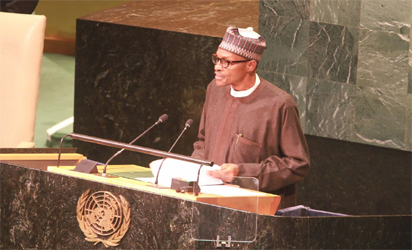
Buhari at UN
President Muhammadu Buhari has said that part of Nigeria’s efforts at tackling the climate change which has become a menace to the whole world is the increasing use of climate-smart Agric, diversification of energy mix, working to end gas flaring and Implementing cleanup of Ogoni land.” He said Nigeria has also announced plans to reduce emissions by 20% before 2030, and to raise this target to 45% with support of International community.
Buhari who gave the statement after taking the floor at the ongoing 22nd Session of the Conference of Parties, COP22, holding in Marrakech, Morocco, to deliver Nigeria’s Statement at the Opening Plenary of the High Level Segment of #COP22 #COP22Nigeria also lamented on the effect of climate change which has taken its toll especially on Lake Chad as it has shrunken to a mere 10% of its original size, with negative consequences on the livelihood of more than 5 million people.
President Buhari said the impact of Climate Change is also being felt by the more than 2.1m Nigerians displaced by devastating floods suffered since 2012.
He said the call to resuscitate Lake Chad is urgent. “We welcome the entry into force of the Paris Agreement on 4th November 2016. We’re launching a strategic plan for implementation of our INDCs. We’ve also embraced issuance of Green Bonds to raise climate finance.”
“Our goal is to make Nigeria one of the world’s best examples of how reducing emissions can benefit environment, economy & people.”
“We cannot succeed alone. Addressing climate change is a shared responsibility, as its negative impacts are universal. We stand ready to engage in meaningful partnerships to tackle climate change.”
He also said that “Nigeria has submitted its instrument of ratification for the Paris Agreement.”
On what the Paris Agreement is all about and how it relates to Nigeria, President Buhari said his government has developed a 15 point Fact sheet to provide context into what and where the country stands. Below are the points raised in the fact sheet:
The Conference of Parties (COP) of the United States Framework Convention on Climate Change (UNFCCC) is an annual gathering of governments, civil society groups and multilateral agencies working together to mitigate the effects of Climate Change on the earth.
- This year’s COP is the 22nd, hence the#COP22. (Morocco previously hosted COP 7, in 2001). The UNFCCC was established in 1994, to nudge ‘Parties’ (all 195 countries and the European Union who are signatories to the United Nations Framework Convention on Climate Change – UNFCCC) into committing to specific steps to reduce Greenhouse Gas (GHG) emissions into the atmosphere, and to adapt to the effects of Climate Change.
- COP 21 in Paris in December 2015 produced the landmark 12-page Paris Agreement that mandates all 195 negotiating countries to ensure that the increase in global average temperature this century is limited to “well below 2C above pre-industrial levels” and to make every effort to limit it to “1.5C above pre-industrial levels.” The Paris Agreement is the first International Climate Change Agreement, and emerged from a lengthy series of negotiations.
- The signatories to the Paris Agreement are expected to achieve this target through the implementation of specific efforts and engagements known as ‘Intended Nationally Determined Contributions (INDCs)’. Nigeria’s INDC document captures 5 priority sectors: Agriculture, Water Resources, Energy, Transport and Industrialization.
- Nigeria has also announced ambitious plans to reduce Greenhouse Gas emissions by 20 percent by 2030 – with the aim of raising this to 45 percent as soon as possible.
- Signing of the Paris Agreement opened on 22 April 2016 at the United Nations Headquarters in New York.
- President Buhari signed the Paris Agreement on behalf of Nigeria on 22 September 2016 on the sidelines of the UN General Assembly in New York. (Nigeria accounts for 0.57% of global emissions).
- Following Signing, the next required step for the Paris Agreement is Ratification. Ratification is the process by which a country that has signed the Agreement submits itself to be legally bound, on an international level, by the terms of the Agreement. As at 11 November 2016, 193 countries had signed, and 109 of them had ratified the Agreement. Nigeria, having signed the Paris Agreement in September, is expected to ratify it soon.
- According to the Terms of the Paris Agreement, the Agreement comes into full force 30 days after it has fulfilled TWO conditions: One: It has been signed and ratified by 55 countries; Two: the ratifying countries collectively account for a minimum of 55% of total global emissions. These conditions were met on 05 October 2016, which meant that the Paris Agreement came into full effect on 04 November 2016 (30 days later).
- COP 22 is the first meeting of Parties since the Paris Agreement came into force. It has been described as primarily being the ‘Implementation / Operationalization’ COP for the Paris Agreement. Another area of focus for COP 22 is mobilizing financing – the target is $100 billion by 2020 – to finance Climate Change response and adaptation in developing countries. (Nigeria has announced its intention to issue Green Bonds as an innovative means of raising Climate Finance).
- The entry into force of the Paris Agreement has triggered the inaugural session of the Governing Body of the Agreement, known as the CMA – The Conference of the Parties serving as the meeting of the Parties to the Paris Agreement). This session will hold between 15 and 18 November 2016.
- To understand how Climate Change affects Nigeria, consider the following:
- The Lake Chad has shrunk to 10 percent of its original size, affecting the lives and livelihood of more than 5 million people. This vulnerability has been capitalized on by terrorist groups like Boko Haram.
- b. Since 2012, Nigeria has suffered devastating floods that have affected more than 2 million people along the Rivers Niger-Benue Basin
There is clearly a strong link between Climate Threats and Security – as seen in the Lake Chad Basin, and in the Niger Delta, where the Buhari administration is finally implementing the long-overdue clean-up of Ogoniland, with a view to restoring damaged ecosystems.
- What is Nigeria doing at #COP22?
President Buhari is leading Nigeria’s delegation to COP 22. Also on the delegation are the Minister of Environment and the Ministers of Agriculture, Water Resources, Power, Works and Housing – the focal points of Nigeria’s INDC Document. - President Buhari will deliver Nigeria’s National Statement at the Opening Plenary of the High Level Segment of the Conference, on Tuesday November 15, 2016
- President Buhari will participate in and speak at the COP 22 Africa Day Commemoration holding on Wednesday November 16, 2016
- There will also be a number of Side Events in which Nigeria’s delegation – Ministers and other Government Officials – will participate in. For example:
- • ‘Building Legislative Support for Climate Action’ (November 14, 2016)
• ‘NDCs and Private Sector Engagement – Exploring Alternative Sources of Funding Climate Change Initiatives: Sovereign Green Bonds and the Role of the Private Sector in the Green Economy in Nigeria’ (November 14, 2016)
• ‘Exploring Youth-Led Innovation & Strategic Advocacy As Gateway to Climate Action’.
Disclaimer
Comments expressed here do not reflect the opinions of Vanguard newspapers or any employee thereof.