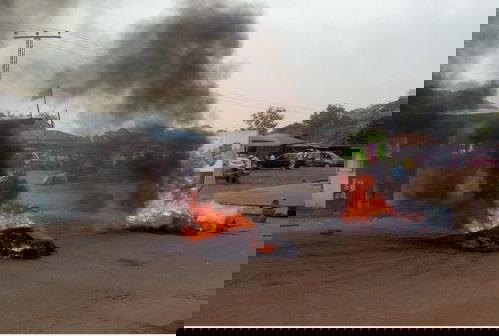
Pro-Jegede Protesters in Ondo burning tires, blocking roads
By Tonnie Iredia
Ondo State is set to play host to Police personnel numbering 24,000 from across the various Police commands in the country. They are being deployed to the state for the November 26 governorship election. The state Commissioner of Police, Mrs. Hilda Harrison who disclosed this at a stakeholders meeting held last week with representatives of various political parties said her men would be complimented by other security agencies during the polls. She gave the assurance that there would police presence in all the nooks and crannies of the state days before the election to prevent pre-election crisis in any part of the state. With this clear assurance, everyone ought to go to bed with his two eyes closed, but not in Nigeria where history has shown that the presence of thousands of the Police and other security operatives combined has neither stopped nor reduced electoral mal-practices. Indeed, there is no Nigerian election, including the ones supervised by the much praised team led by Prof Attahiru Jega where ballot boxes are not snatched irrespective of the numerical strength of the Police on ground.

Pro-Jegede Protesters in Ondo burning tires, blocking roads
So, in the case of Ondo, how did the Police arrive at its figure of 24,000? In the recent governorship election held in neighbouring Edo state, the figure was one thousand higher. But then, the security operatives according to media reports did not only adopt the posture of spectators who merely watched several unwholesome behaviours, they themselves were shown on the internet as active participants in vote hawking. Till date, no one knows what was done or would be done to such erring operatives who tarnished the image of their organizations. Instead, fresh assurances are being made as usual in respect of a new but similar event. Under the circumstance, it would be naïve of Ondo people to go to bed with any eye closed because Nigerian politicians are not yet ready to play the game of elections by the rules as they have always gone at great length to commercialize any election. On national television the other day, the nation watched and heard the most senior electoral official at the Edo elections, Amina Zakari complaining about the use of money on voting day. It would thus be simplistic for anyone to expect a change in Ondo.
One major reason why it is patently unwise to have faith in Nigerian elections is because the referee, the Independent National Electoral Commission (INEC) has not been able to evolve a framework that can render nugatory any form of electoral chicanery. Like our security personnel, INEC officials appear to enjoy their unending issuance of fake assurances. Only last week, Olusegun Agbaje, the Ondo State Resident Electoral Commissioner (REC), was reported to have said that with the new procedure for conducting election, “it would be difficult to influence the election with the use of card reader. I as commissioner cannot influence the vote of the electorate and if I cannot influence, how will my lieutenants do so? “With the coming of card reader, nobody can influence the election. There is transparency and the process is straight forward.” Interestingly, everyone including Agbaje who made the statement knows that the only thing that is true about what he said is that it is untrue.
As a matter of fact, Agbaje made the statement last week in his Akure office when an organization, the Youth Initiative for Advocacy Growth and Advancement (YIAGA), visited him. The organization’s Executive Director, Samson Itodo reportedly urged INEC to block loopholes that could compromise the integrity of the forthcoming governorship election in Ondo State. Itodo made his appeal against the backdrop of the generally held belief that politicians are capable of lobbying the staff of INEC to manipulate elections. Whether INEC likes it or not Nigerians have ample evidence that many of their officials are usually ‘mobilized’ by different sets of politicians to ensure that the card reader functions intermittently. Lateness to election venues, deliberate muddling of documents and disappearance of operatives are all insider abuses leading to the resort to manual voting where the outcome of an election can be stage managed. This belief is not new. Just before the 2015 Presidential election, it was such a belief that led the Conference of Nigerian Political Parties, a forum representing all the political parties in the country, to issue a statement expressing faith in the card reader. According to the forum, the “device had been used to conduct free, fair and transparent elections in many countries like the US, UK, Brazil and the 2014 Indian general elections, an event where 600 million Indians voted seamlessly.”
Can this happen in Africa? It is already happening as many African countries have since used technology to install stable electoral systems. Ghana for instance has progressively moved on since its Electoral Commission successfully used the device in 2012 to prevent double registration and eliminate phantom names in the old register thereby laying a credible foundation for free and fair elections. Kenya did likewise for its March 2013 elections. For those who continue to argue that Nigeria’s literacy level would hinder such a performance, it is important to make the point that the capability of the voter is irrelevant in the process. The technologies merely sanitize the process by disallowing electoral irregularities. They do not task the intellectual competence of an average voter beyond what he or she currently does with other devices like the ATM cash withdrawal arrangements in banks or even the use of the cell phone. In any case, if our banking system has been able to evolve a device which makes it possible for a citizen, literate or not, to open an account in his name in Umuahia or Zaria; pay cash into it in Katsina, Ibadan and Uyo or anywhere else and withdraw cash from the same account in Yola, Enugu, Warri etc, why can’t Nigerians register and vote anywhere? Why do we need to shut the economy of a state, close its borders and militarize a civil event like election?
The point to be made is that what Ondo voters and indeed all Nigerians expect from INEC is not some stereotype fake assurances that have always failed but a posture which recognizes the technological deterministic assumptions about technology as a key governing force in society and the redeeming feature of humanity.
Disclaimer
Comments expressed here do not reflect the opinions of Vanguard newspapers or any employee thereof.