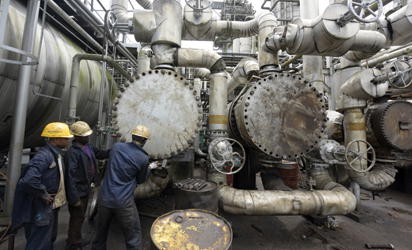
File image.
By Sebastine Obasi
GLOBAL crude oil supplies increased by 600,000 barrels per day, primarily due to a rise of half a million barrels a day from Russia and Kazakhstan, the International Energy Agency (IEA) stated in its monthly Oil Market Report for September just released.
The agency also noted that the Organisation of Petroleum Exporting Countries, OPEC, supply reached an all-time high of 33.64 million barrels a day in September. The IEA report sent the price of Brent crude for December delivery down about 1.1percent at $52.57, while West Texas Intermediate (WTI) crude for November delivery traded down about 1.3 percent to $50.69 in electronic trading last weekend.
The IEA projects global demand growth of 1.2 million barrels a day for the year, down from 1.4 million barrels a day as recently as July. The agency noted: “Growth continues to slow, dropping from a five-year high in the third quarter of 2015 to a four-year low in third quarter 2016 due to vanishing Organisation for Economic Cooperation and Development, OECD growth and a marked deceleration in China.”

It further explained that global production rose by 200,000 barrels a day in September to 97.2 million barrels a day. The IEA expects non-OPEC supply to dip by 900,000 barrels a day in 2016, before bouncing back to add 400,000 barrels a day in 2017. Commercial inventories dipped by 10 million barrels to 3.092 billion barrels in August with preliminary data for September indicating a further decline.
While the oil market continues its rebalancing act, the IEA does not expect balance until next year: Even with tentative signs that bulging inventories are starting to decline, our supply-demand outlook suggests that the market, if left to its own devices, may remain in oversupply through the first half of next year. If OPEC sticks to its new target, the market’s rebalancing could come faster.
Ian Taylor, Chief Executive Officer of Vitol, the world’s largest trader of physical oil, said that he does not see a rebalancing in the crude market until the second half of 2017. According to him, a cut of 1 million barrels a day would boost the price of crude, but he’s not sure if or how OPEC members would divvy up the reductions:
“If they really give us 1 million bpd, I think you’re going to have to say oil is going to be in the high 50s, early 60s. “That for sure will start having an impact, much more on paper immediately, and will bring the market back to balance in the second half of 2017. But can they really give us a million between OPEC and non-OPEC? It’s a tough call,” he added.
Disclaimer
Comments expressed here do not reflect the opinions of Vanguard newspapers or any employee thereof.