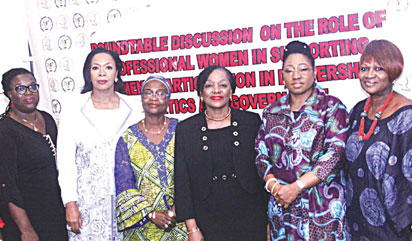
•Founding Director, Women Advocates Research & Documentation Centre, WARDC, Dr.Abiola Akiyode-Afolabi; Chairman, Afriland Properties cum former First Lady of Ekiti State, Erele Angela Adebayo; Former Member, House of Representative, Hon Rafeequat Onabamiro; Chairman, LASACO Assurance Plc cum Vice President, Cosmopolitan Women’s Club, Mrs Aderinola Disu and Former First Lady, Ekiti State, Erelu Bisi Fayemi at the round-table in Lagos recently.
By Josephine Agbonkhese
SINCE their victory at the 2007 elections which saw a huge rise in female representation in elective positions in the country, women’s performance in subsequent elections has gone from bad to worse, nose-diving from eight per cent in 2011 (32 of 469 seats in the National Assembly) to a pathetic 4.5 per cent (21) in 2015.
Surprisingly, the reversal of fortunes in 2011 was in spite of the N100 million trust fund set up by the Ministry of Women Affairs in March 2011 to offset the campaign expenses of 230 female aspirants across the political parties.

•Founding Director, Women Advocates Research & Documentation Centre, WARDC, Dr.Abiola Akiyode-Afolabi; Chairman, Afriland Properties cum former First Lady of Ekiti State, Erele Angela Adebayo; Former Member, House of Representative, Hon Rafeequat Onabamiro; Chairman, LASACO Assurance Plc cum Vice President, Cosmopolitan Women’s Club, Mrs Aderinola Disu and Former First Lady, Ekiti State, Erelu Bisi Fayemi at the round-table in Lagos recently.
To reverse this downward trend, leading women from public and private sectors engaged in a five-hour round table in Lagos, recently. The gathering was convened by the Women’s Advocates Research & Documentation Centre, WARDC, and the Cosmopolitan Women’s Club, in partnership with Voices4Change/UKaid.
Seeking ideal strategies
Some participants identified gender stereotyping as the bane of women and insisted that government should be pressured to implement legislations such as the Gender Equality Bill, Affirmative Action, and then put up a commission to support women while political parties should adopt a more genuine waiver policy for female aspirants.
However, some participants dismissed legislation as a reliable solution.
In the first school of thought were former First Lady of Ekiti State, Erelu Angela Adebayo and Hon. Rafeequat Onabamiro, former member, House of Representatives.
“We’ve had the Beijing Convention and many other treaties, and they’ve not worked. But if they’re entrenched in the Constitution, nobody will hold us back. The affirmative action for example has worked in Kenya and Uganda.
Legislation not the answer
In the group that vehemently opposed reliance on affirmative action were Professor Chioma Agomo, first female Dean, Faculty of Law, University of Lagos, and Munira Shonibare, a successful entrepreneur in the furniture industry, who said women are easily defeated because they’ve neither recognised their power nor taken advantage of their population strength since they make up over half of the country’s voting population.
Before any major miracle can happen, Agomo insisted, women must get back to the root— their homes— and address their child upbringing patterns, which she claimed favoured boys over girls. The reason being that even where laws exist, they will be mere deadwoods if people do not believe in them enough to implement them.
Rooting for non-reliance on legislation, was another former First Lady of Ekiti State, Erelu Bisi Fayemi, who obviously spoke from first-hand experiences in politics. Fayemi suggested a multi-pronged strategy.
Growing social capital
She said: “First, we must understand patriarchy; how men control institutions in the society, and then dismantle it.
Second, we need to fix our social capital as women; men build social capital from childhood. But the daughter is sent to the kitchen while the son is on the field playing football with 21 other boys daily. Later we will expect both of them to start off on the same level. Impossible! We should also attend social events with the mindset of making new friends just like men do.
Building political capital
“Third, many of us women do not have political capital. We should begin to join organisations, unions, old girls’ association, do philanthropy, and so on. Take a chieftaincy title if it is offered. Fourth, every woman over 18 years of age should become a card-carrying member of a political party, invest in political machinery like men do, and also strengthen the women’s wings of these parties.
Lastly, we should bridge generational gaps between ourselves and younger women so as to promote solidarity.”
Drawing from prevailing circumstances and the fact that women have significantly underutilised their population strength as a tool for success in elections, Founding Director of WARDC, Dr Abiola Akiyode-Afolabi, and the Vice-President, Cosmopolitan Women’s Club/Chairman, LASACO Assurance Plc, Mrs Aderinola Disu, both agreed that strengthening women’s alliances and collective pressure strategies are keys to ensuring progress in their participation in leadership, politics and governance.
Publicity strategy
In a no-holds-barred manner that could be described as a tongue-lashing of women’s publicity strategies while running for political offices, ace actress, Joke Silva, in her argument, said female politicians have fared poorly because of their poor publicity strategies.
She criticised past female political aspirants like Professor Remi Sonaiya, a former Presidential candidate who was also among the panellists, for being very poor at garnering publicity, stating that it costs nothing to form alliances with the entertainment industry whose members are reputed for influencing minds, particularly through social media.
Early, active participation in party politics
Women’s poor participation in party politicking way before electioneering processes begin was also identified as a major issue.
On this point, the Women Leader of All Progressives Congress, APC, South-West, Mrs Kemi Nelson, who has been severally accused by some female political aspirants of being passive towards their political success, said most women do not engage in active politics in their wards but only come up about 12 months to elections to declare their ambition.
Other speakers were Dr. Doyin Abiola; Yemisi Ransome-Kuti and Deputy Vice-Chancellor, Lagos State University, Professor Ibiyemi Olatunji-Bello.
The highpoint of the dialogue was the formation of an action group saddled with the task of setting-up a database of women from across the country that are genuinely interested in politics, to ensure they are adequately supported in 2019.
From the entire discourse, it therefore becomes obvious that if women politicians need the much desired level-playing field, they must start the game themselves and use their numbers in future elections.
Disclaimer
Comments expressed here do not reflect the opinions of Vanguard newspapers or any employee thereof.