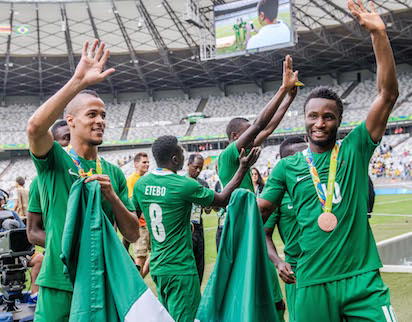
Nigeria’s players William Ekong (L) and John Obi Mikel (R) celebrate after receiving their bronze medals during the medal ceremony after defeating Honduras in the Rio 2016 Olympic Games men’s bronze medal football match at the Mineirao stadium in Belo Horizonte, Brazil, on August 20, 2016. / AFP PHOTO / GUSTAVO ANDRADE
By Jacob Ajom
After nearly three weeks of high level competition, fun and friendship, the 2016 Rio Olympic Games wound down August 21 with a never to be forgotten closing ceremony at the iconic Maracana stadium in Rio de Janeiro. By sporting standards, the Rio Olympics was a huge success. Brazil proved to the rest of the world that they are a force to be reckoned with after organising a near flawless Olympic Games, the biggest sporting event in the world.
The games had all the trappings of a first class event. Each competition held on schedule, the venues were first class, while the athletes seized the occasion to establish themselves. Usain Bolt was the star act. He dazzled and shone like a million stars. Bolt led a strong Jamaican athletics team that left the world wondering how they have been able to subdue a traditional Athletics super power like the USA to ordinary beings for such a long time. The Jamaican super star won his 9th Olympic career Gold medal after completing the treble with a 4x200m relay gold.

Nigeria’s players William Ekong (L) and John Obi Mikel (R) celebrate after receiving their bronze medals during the medal ceremony after defeating Honduras in the Rio 2016 Olympic Games men’s bronze medal football match at the Mineirao stadium in Belo Horizonte, Brazil, on August 20, 2016. / AFP PHOTO / GUSTAVO ANDRADE
Team Brazil showed grit, doggedness and determination. Highly motivated Brazilian athletes were adventurous as they kept the fans trooping to the various arenas with good performances in the various sports. With their accomplishments in different sports, the host country actually proved it was not only a soccer nation. The fans were their strongest force as teams that competed against Brazil were at the mercy of the patriotic Brazilian fans who cheered their heroes endlessly. The Nigeria male basketball team were a bundle of nerves in their final group match against Brazil. With scores reduced to as low as 4 point gap in the 3rd quarter, the Nigerians slipped further down as they were swallowed by the chants, hisses and boos from the stands each time they faced the hoop; either during free throws or in normal play. D’Tigers lost and that marked the end of their campaign.
For Nigeria, it was another poor outing, another colossal failure. Although the Nigerian contingent returned with a bronze – some call it golden bronze – which bettered their London 2012 outing, the overall outcome was far below expectations. An athletics coach, Solomon Aliyu is of the belief that the country performed better in London than in Rio, despite the bronze medal won by the U-23 team. Aliyu said, “our performance in Rio was worse than in London 2012. At the London Games we had more Nigerians in the finals of a number of events, the athletes returned better times and we were a constant threat to winners of various events.”
Aliyu who led four hurdlers to Rio submitted, “We did not learn any lessons from our failure in 2012.”
It was indeed a disaster as the country’s representatives failed to come to the party. One after another,they kissed goodbye to the Olympics after putting up listless performances in almost all the events. So much was expected of the basketball team, the wrestling team and some individual stars like Blessing Okagbare, the women’s 4×100 metres relay team, the four Nigerian hurdlers and the country’s lone boxer, Efe Ajagba. Even the football team that showed so much promise in the beginning, failed to go beyond the semi final. They eventually won a bronze medal, Nigeria’s only medal in Rio.
The biggest disappointment came from wrestling team. Before the Games, a lot of hope was placed on the wrestling team which had been drilled by Olympian, Daniel Igali. The wrestling team attended a few championships and were expected to sparkle and land Nigeria a few medals. That never happened. Igali was devastated and Nigeria was worse off.
But there was some reason to cheer and hope for a brighter future in Team Nigeria at Rio Olympics. In table tennis, Aruna Quadri got to the quarter final of the men’s singles event, Efe Ajagba, Nigeria’s lone boxer recorded an encouraging first round knock-out over Nigel Paul of Trinidad & Tobago. He, however, lost to his second round opponent in a unanimous point decision. Ese Brume placed 5th in the women’s long jump final, D’Tigers who found themselves in a difficult group still won a match against Croatia, a performance Ike Diogu, the team’s captain said earned them global respect.
To most observers, the Rio outing by Team Nigeria did not come as a surprise. Indeed, coming home with a bronze was a miracle, given the poor level of preparation. In most cases, there was no preparation for the athletes, except for individual efforts of the athletes with their personal coaches. “You cannot reap what you did not sow,” one of the athletes told this reporter in Rio. “No athlete goes to the Olympics for fun. Everyone wants to be on the podium, but to achieve that one must prepare. To win a medal at the Olympics is always a 4 to 8 year plan,” the athlete said painfully, adding, “in Nigeria we don’t plan but expect miracles to happen during competitions of this magnitude.
The Team Nigeria basketball coach, William Voigt was full of praise for his players despite crashing out in the group stage. “They put in every ounce of their energy to compete with the best in the world,” he said. But what did they get, in terms of support? “Nothing,” Voigt said. “Their performances speak volumes about the future of basketball in Nigeria. If without any form of support the boys could achieve this, one can only imagine what will happen if they got the necessary support from government.”
The story of the football team is well known to all — the Atlanta camping saga, the minster of sports refusal to support the team, the near-ejection from a hotel, their endless wait for flight to Rio, the Delta Airline involvement and their eventual arrival in Menaus, venue of their opening match against Japan a few hours to kickoff. With all these troubles, the coach Siasia team went ahead to beat Japan 5-4 in a dramatic fashion.
The absence of support cut across the entire gamut. In athletics, the Athletics Federation of Nigeria President, Solomon Ogba said he was frustrated, Enitan Oshodi of Nigeria Table Tennis Federation re-echoed it with lack of appropriate funding for the sport in the country. Meanwhile, the Chinese who are the undisputed number one nation work round the clock to ensure they maintain their dominance. “An average Chinese table tennis player trains for at least 8 hours a day,” Oshodi said. “And they organise numerous championships each year.”
Lack of government support for preparing Team Nigeria athletes has been the bane of Nigeria sports. But how did a country like Great Britain do it. In 1996, NIgeria’s best outing at the Olympics, with 2 gold 1 silver and 3 bronze medals, Great Britain were languishing 36th in the Atlanta Olympics medal table, their entire team securing only a single gold between them.
According to Mailonline.com, “the advent of the National Lottery in 1994, and the decision of John Major’s government to allocate significant streams of its revenue to elite Olympic sport, set in motion a funding spree unprecedented in British sport.” This has had a huge impact on the performance of Team GB. At the end of the Rio Games, Team GB has transformed itself from being a minnow 20 years ago to a world sports super power, finishing only second to the United States of America in the medals table.
The mentality of Nigerian government officials who see the Olympics as summer holiday for loyal ministry staff, relatives and even their kids must change. During preparations, officials cry of no money, but during games a lot of people are ferried to the Games. At the Rio Games, over 70 Nigerians were in Brazil at government’s expense. Meanwhile the athletes cried out loud, severally threatening to go on strike over unpaid training grants, although officials admitted that they were settled eventually.
Government must adopt the British approach and reactivate the National Sports Fund. This will take a lot of burden off government and provide enough funds for athletes all year round. The fund will be provided by private organizations and public spirited individuals. Only then can Nigeria sports outgrow the problem of poor funding and pathetic outings at major competitions.
Disclaimer
Comments expressed here do not reflect the opinions of Vanguard newspapers or any employee thereof.