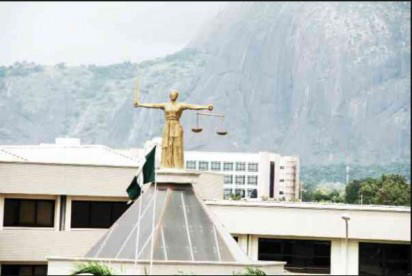
Supreme Court of Nigeria
By Tonnie Iredia
In the last few months, members of the main opposition party, the Peoples Democratic Party (PDP) have been embroiled in squabbles to determine their true leadership. Is it former Borno Governor Ali Modu Sheriff? Some would say yes while many would say it is former Kaduna Governor, Ahmed Makarfi. Having failed to deal with the matter as a family affair, the factions have been in court and on a daily basis, they are getting different decisions which make it easy for each side to follow the judgment it prefers.
The court decisions are not only at conflict with one another, they are all made by courts of coordinate jurisdiction. The rest of us are left with no option but to look for help from different interpreters to comprehend what the courts have said or are saying or intended to say or are likely to say about the subject. Why are the courts contradicting themselves? Could it be that the judges are grouped into two with one working for and the other against the prediction of one of the factions that the cases would run till 2019? Any body’s guess is as good as mine because once it is a case involving our billionaire politicians; our courts amaze the ordinary man.
On May 12, 2016, a court in Lagos reportedly ruled that the PDP convention slated for May 21, 2016 in Port Harcourt should not hold. Sheriff claimed that in obedience to the court order, he had to suspend the convention only for some members to conspire to remove him from office. Did the order stop the PDP from replacing Sheriff, himself an unelected chairman, with someone else? Perhaps the Lagos court felt so; hence it decided to outlaw the decision of the party to constitute a caretaker committee led by Makarfi. Some PDP members say that although they are yet to hold a convention, they have a right in the meantime to end the temporary mandate of Sheriff to hold brief for a proper chairman. His mandate had a May 2016 expiry date. If so, what makes Sheriff superior to Makarfi and why can’t the former be changed with or without a convention when both leaders were similarly handpicked? Perhaps this explains the decision of a court in Port Harcourt to support the Makarfi faction in contrast to the posture of the Lagos court.
The other week, another court in Abuja decided to give due recognition to the faction led by Sheriff. The court specifically directed the Independent National Electoral Commission (INEC) not to accept any list of candidates submitted by any other faction for the forthcoming governorship election in Edo and Ondo States. But because the Nigerian constitution provides for party chairmen to be elected and not appointed, a second court in Abuja nullified Sheriff’s purported appointment. The decision was particularly significant as it suggested that since the process which originally brought Sheriff to power was faulty, there was no PDP leader called Sheriff in the eyes of the law. Expectedly, this was not palatable to Sheriff, who promptly rejected it while announcing his readiness to continue to relate with INEC in line with the decision of the other Abuja court. Sheriff imagined that since decisions against him were given by courts of coordinate jurisdiction, he could remain in power.
From what has been said so far, a number of posers present themselves. First, why are the factional leaders relying on conflicting high court decisions to pick and choose what to accept or not? Why has no one gone to the Court of Appeal ever since? Does it mean the high courts are more malleable? Second, what is the fate of INEC in the ensuing confusion? Which group should it recognize and for what reasons? Third, laymen are often told that courts deal with only those things before them. But with the high level of tension in the main opposition party of the nation, which can scuttle our democracy, shouldn’t our courts in the interest of society take judicial notice of some notorious facts to resolve issues rather than allowing themselves to be seen as part if not the ones fuelling the problem? Why indeed are our courts often in disarray whenever the subject before them concerns politics and elections?
Meanwhile, if court decisions are difficult to understand, the posture of the PDP factions is also a puzzle. It is not quite easy to know who actually belongs to which faction. The case of Edo State makes the point clearer. Following the process for the election of the party’s Governorship candidate which commenced with the conduct of the Ward congresses for the elections of three Ad-Hoc delegates, the Makarfi faction garnered 713 delegates. The latter elected Pastor Osagie Ize-Iyamu as the party’s flag bearer on June 20, 2016. Some days later; Sheriff’s faction accredited 677delegates in a second primaries to elect Mathew Iduoriykemwen as its own flag bearer. Considering that PDP has the same guidelines, the two sets of delegates are likely to be the same persons especially as the winner of the second primaries was also a contestant in the first one. If however, the second set of delegates were fresh, did Sheriff’s faction liberalize the guidelines for the primaries to allow hitherto unqualified delegates to vote? If on the other hand it was the same set of delegates why then did they not originally elect the new flag bearer when he first solicited their votes in the first primaries a few days earlier?
The questions have elicited more allegations. One analyst imagined that while the judgments which favour Makarfi emanate from a location controlled by the PDP, the pro sheriff decisions are obtained from locations controlled by the rival All Peoples Congress (APC). What this suggests is that Sheriff has the backing of the APC. It would appear that both Ahmed Makarfi and his Edo state chapter leader, Dan Orbih believe it. If so, how come Justice Valentine Ashi who has also recognized the Makarfi faction is Abuja based? So, who will tell us in the layman’s language, what precisely is going on? Hopefully, not Icheoku!
Disclaimer
Comments expressed here do not reflect the opinions of Vanguard newspapers or any employee thereof.