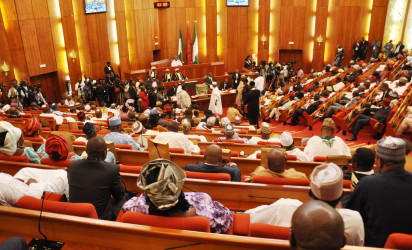
Senate Chamber
….Backs planned stakeholders’ dialogue
By Victor Ahiuma-Young
THE Senate weekend, commended the intervention of the Federal Government for halting on-going mass retrenchment in the banks and other financial institutions.
Chairman, Senate Committee on Labour, Rafiu Ibrahim, said; “I sincerely commend the federal government for being willing to work with the banks to find a common solution to this issue of retrenchment, which affects almost every family.

SENATE CHAMBER
‘’I am grateful that all of us have agreed to dialogue and I implore you to do justice to all issues before the stakeholders’ summit is convened in July.
“I, therefore, appeal to everybody to be humble and to be open in our different positions at the talks. I am happy with the explanation of the Hon. Minister on the issue of bank licenses that he did not threaten that the Federal Government would withdraw their licenses; that it was a case of misrepresentation.
‘’That will give a convivial atmosphere for all the social partners to freely dialogue and peacefully resolve all issues.”
Minister of labour and Employment, Senator Chris Ngige, had said that all the steps he had so far taken on the issue were in defence of the constitution and the labour laws and to safeguard the interests of all parties, while ensuring peaceful industrial milieu for enhanced productivity in the sector.
The constitution
He had said: “The constitution is the supreme law of the land. The constitution is aware that we are in a society where all of us will not be equal and that everybody must be protected – big and small. That is why in sections 14, 15 and 16 and even 17, it protects the employer, the economy and the workers.
‘’It is from these provisions that the National Assembly enacted the labour laws to guide all of us on how to deal with the issues of employment. So, all that my ministry has done is to execute and protect these laws from infractions. I acted in good faith to protect the interest of all.”
He cited petitions from the unions in the financial sector which bordered on unwholesome practices, including mindless retrenchment as the immediate reason for his intervention.
He said that explained why he directed all the parties – the bank employers and the unions- to maintain the statuesque ante-bellum through a press release on June 5, 2016, pending the resolution of the disputes.
“We intervened in the spirit of collective bargaining. We got petitions from NUBIFE on casualization, contract staffing, poor remunerations which is not in conformity with equal work, equal pay in our constitution, ill human conditions of service, rampant termination without due compensation and resistant to unionization contrary to section 40 of the constitution.
‘’We investigated these and found them true in some banks. We invited the concerned banks; they gave excuses on why they won’t honour the invitation while they continued with retrenchments. I know my rights as Minister of labour and I will exercise those rights for the benefits of Nigerians, high and low. It is within my power to declare a truce in any industrial crisis.
‘’That was why I asked the banks; don’t retrench further and the unions; don’t picket the banks so we can sit down to resolve the issues. The labour law on redundancy says in article 20 that if you negotiate redundancy and a party is dissatisfied, the Minister has the right to intervene.
“The law makes provision for the employer is to disengage a worker if he cannot actually run his enterprise efficiently and effectively with a big load of staff in which case, he will declare redundancy but it states clearly the process for doing this.
‘’It says you must engage the labour unions in that industry and if it gets out of hand, the local unions will report to their national union. If they can’t resolve this, the parties, unions or the banks will refer it to the Minister of labour for conciliation,’’ Ngige had said.
Speaking on unionization in the banks, the Minister said the only institution in the financial sector where staff members were exempted from unionization was the Central Bank, adding that no other bank in the country had the right to prevent its staff from forming a union.
“Unionization, according to the constitution and labour laws, is the right of workers. There are exemptions and the institutions that are exempted are clearly listed. Here, it is only the Central Bank that is exempted in the banking sector.
‘’The law says again that the Minister of Labour in his wisdom, can grant a waiver to any institution. I have not granted a waver to any bank and I will not grant such,” Ngige concluded.
Disclaimer
Comments expressed here do not reflect the opinions of Vanguard newspapers or any employee thereof.