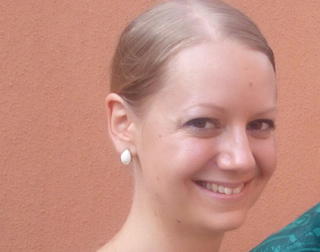
Mirjam Möller
There’s no such thing as dead languages, only dormant minds. — Carlos Ruiz Zafón,The Shadow of the Wind
THE language of a people is their true identity, hence, any group that loses its language has lost its identity. In Africa, many languages are going into extinction due to their love of foreign languages. An average African would rather speak English or French than their native tongue. Unfortunately, very few Africans are disturbed by the trend and fewer still, are doing something about it.
It was, therefore, a pleasant surprise to see a young Swedish lady, Miss Mirjam Möller, doing her PhD on a Nigerian language. In this chat with Woman’s Own, Möller who lives in Paris, speaks on her work, why she came to Nigeria and her experience during her stay. Excerpts:
WHY she came to Nigeria
I study African Languages at a (Langages, Langues et Cultures d’Afrique Noire, LLACAN) in Paris. I got admitted through a three-year scholarship to do my PhD there last year. I had studied African languages for my Master’s degree and BA in Sweden. In the course of my studies, I worked on different minority languages in Ethiopia, Tanzania and Cameroon but I have always wanted to describe a language from scratch, meaning to work on a language with no previous written record or documentation.
My assignment would be to then write a grammar of the language and develop orthography (the conventional spelling system of a language) together with the speakers.

Mirjam Möller
How she got to know about the local language she came to study
My supervisor told me about this specific language, Nyabaa and that he has a project going on for a group of languages spoken in Adamawa State, North-East Nigeria. Nyabaa is spoken by the Kwah people of Adamawa State.
What she hopes to achieve
We aim to publish a dictionary which will include a description of the structure of the language e.g., phonology, morphology, syntax etc.
Challenges encountered in the course of the work
When working on a language unknown to you and totally new, you may have experience from having worked on similar languages or not. However, speaking a language is like looking at the world through a pair of glasses, or reading through a pair of glasses.
So often, we tend to come with our own glasses and analyse what we hear and see based on our previous experiences. But each language is unique and there might be features that don’t show in the first place and the challenge is to ask the questions and collect the data you need to see the full analysis of the language.
Then of course, the difference of culture and climate is sometimes the challenge we face but that is part of the adventure and I love Nigeria so it is a great privilege to be working in this country.
Her view on Nigeria and Nigerians
Nigerians are very generous and hospitable. I have only stayed in Lagos and would have to visit other places too as I visit Nigeria in the following its years. Lagos is chaotic with all sounds, smells and people everywhere; but that is part of the music and rhythm of Lagos.
I love Lagos for its closeness to water, the lagoon is beautiful. Then you can basically find all things you need or wish food-wise. I believe the future is bright for Lagos, in a few years time it will be cleaner, greener and healthier for all of its citizens. That is my prayer.
Disclaimer
Comments expressed here do not reflect the opinions of Vanguard newspapers or any employee thereof.