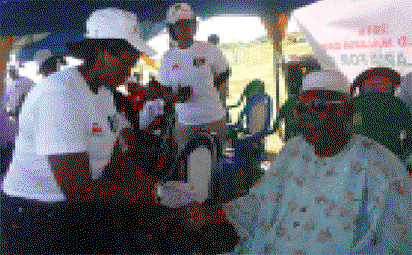
MALARIA TEST: The Paramount Ruler of Igbologun Community, Chief Amisu Alao , undergoing malaria test during an exercise in Snake Island, Apapa, Lagos, recently.
By Gabriel Olawale
THE Nigeria Institute of Medical Research, NIMR, Lagos, has said that not less than 51 million Nigerians, equivalent to 30 percent of the population, tested positive to the malaria parasite in 2015, even as the latest World Health Organisation, WHO, survey shows that the highest number of cases occurred in the North West and North Central zones of the country.

MALARIA TEST: The Paramount Ruler of Igbologun Community, Chief Amisu Alao , undergoing malaria test during an exercise in Snake Island, Apapa, Lagos, recently.
In view of this development, experts say Nigeria is not on track for malaria elimination. Speaking in Lagos, the Deputy Director (Research) and Head, Malaria Research Programme, NIMR, Dr. Sam Awolola, said with such high malaria burden, and continued reliance on foreign intervention, the country is far from being on track to end the malaria scourge.
High burden
Awolola, who raised the alarm at a forum organised by NIMR in commemoration of this year’s World Malaria Day, said the theme: “End Malaria for Good” was not meant for a country like Nigeria which he noted was far from pre-elimination not to talk of elimination.
His words: “The 2014 and 2015 World Malaria reports testify to this fact. The Nigerian National statistics shows that malaria accounts for 60 percent of hospital out-patient visits, 25 percent infant deaths, 30 percent of all under-five deaths and 11 percent of maternal mortality annually.”
“Unless our government funds research by creating enabling environment, putting the right infrastructure in place and human capacity to do research, we cannot make progress.” Currently, NIMR is carrying out site characteristics for the testing of a new malaria vaccine in Nigeria, but noted that the Institute should have advanced beyond that.
Awolola said: “Nigeria has a vaccine development laboratory but for many years, no money has been made available to run it. The American government has put close to $20 billion in developing genetically modified mosquitoes in the last 20 years, and up till now they have not been successful, but with us here, within one or two years we want results. Research is a long term venture, but result will definitely come at the end,” said.
On her part, the WHO Malaria Containment Representative in Nigeria, Dr. Tolu Arowolo said the recent malaria prevalence conducted across Nigeria, and published in April 2016, shows that the North West and North Central zones have high prevalence of malaria cases.
“North West has 37 percent; North Central, 32 percent; North East, 26 percent; South South, 19 percent; South West, 17 percent, and South East 14 percent. But when you look at the 2010 Malaria Indicator Survey result, it was the opposite, because the South West appeared to have the highest malaria burden, but now it has changed.
“Currently, Nigeria is at 27 percent, by the time we would repeat the survey by 2020, it is expected to be less than 5 percent and this is achievable because our prevalence in 2010 was 42 percent and now we have 27 percent which is about 15 percent reduction.”
She however advocated for robust integrated data management to reach out to population at risk, accurate diagnoses of all person at risk, activities that will encourage use of material that prevent malaria, availabilities of commodities in all healthcare facilities among others.
Disclaimer
Comments expressed here do not reflect the opinions of Vanguard newspapers or any employee thereof.