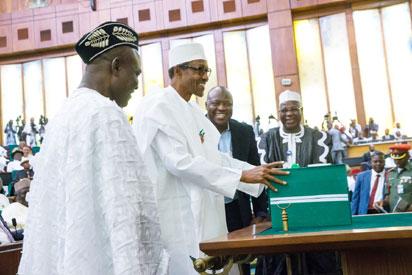
Buhari presents N6.08trn 2016 budget to NASS
By Rotimi Fasan
IT is pertinent to ask where ordinary Nigerians who have no millions kept away as egg nests and have nowhere to go but live out the nightmare that being a citizen seems to have become in today’s Nigeria – it is indeed important to ask if such Nigerians have been considered in the struggle that has led to the failure or refusal of President Muhammadu Buhari to give assent to the budget sent to him by the National Assembly several weeks ago. It is useless now denying there is a tug of war currently going on between the President and the leaders of the National Assembly. It is a war of will that both parties involved in have been shy to take into the public arena. They would rather do their battle indirectly, through proxies or by making oblique remarks that are neither here nor there.
In this struggle the presidency or in fact the president whose administration bears responsibility for the success or failure of the budget has failed to demonstrate how it wants the struggle resolved quickly in the overall interest of ordinary Nigerians. It’s one thing to claim to be working in the interest of Nigerians but quite another to be seen actually to be doing that. This does not mean going out in the street in a populist demonstration of how hardworking the president has been. All the situation demands is proper and timely communication of what has and is being done to meet the everyday expectations of the people. Or the administration would be hard put denying the charge of cluelessness critics desperately want to foist on it.

With the year nearly half way gone a supposed 2016 budget is yet to finally see the light of day, even when the executive had been late in sending the appropriation bill to the National Assembly. The government was indeed very slow in taking the steps that could have fast tracked the appropriation process. We need not detain ourselves with the details of how this delay came about beyond saying that the president was not quick to constitute his team, especially his ministers. But when he eventually did and with that stage finally over and done with, he sent to the National Assembly an appropriation bill that was riddled with errors. But not before the bill had first been declared missing.
The kind of drama that followed this discovery is unbecoming of a country that has leaders. It would turn out that what looked like errors were deliberate alterations of details of the budget by civil servants who must have spent most of their years in the civil service perpetrating all kinds of criminal activities. Padding as this unauthorised bloating of appropriation estimates is now widely known as was done for corrupt purposes. The executive was responsible for this and should be blamed for that sordid affair even if it initially wanted to absolve itself of any blame as minister after minister disowned their supposed input into the budget. The National Assembly tried to look dignified and cooperative by declaring its readiness to work on the so-called missing budget and to help clear up the errors. This it promised to do expeditiously so the budget could begin its implementation journey.
As things have since turned out the budget returned by the National Assembly to the presidency is one the president said he couldn’t sign into law. His reason? The law makers went beyond their brief in tampering with the budget in a way not acceptable to the presidency. Not much was done by way of explanation of the president’s refusal to give his assent to the bill before he jetted out of the country in one of his many trips. The news just filtered out in the media that the president would not give his assent to the returned bill until he has studied every aspect of it. For days thereafter Nigerians speculated on what could have again gone wrong with the budget. It was left for the president’s media handlers, the duo of Femi Adesina and Garba Shehu, to explain to Nigerians what the problem was.
Nigerians would gradually get to know that the committees of the National Assembly that looked at the budget had padded it. They had not simply approved, rejected or cut down the amount appropriated by the executive. Rather they had introduced their own heads into the budget. In other words, the law makers had decided to take on the executive-arm’s job of budget appropriation even when heads of the committees that worked on the budget denied doing anything to alter what the executive had sent to it. One of the most contentious issues with the budget was the alleged removal of the proposed appropriation for the Lagos-Calabar rail project and transferring it to the constituency of one of the leaders of these committees.
This didn’t sound like something unheard of in a country where the first thing so-called elected leaders of the people do is approve huge allowances for themselves before any consideration of public good. This present National Assembly that spent the first few months after its inauguration on recess while approving huge allowances for its members is very guilty of this misdemeanour. While the committee leaders that worked on the 2016 budget deny the charge that they tampered with the budget inappropriately, other members of the National Assembly defended the right of the legislators to appropriate in this unauthorised manner. For speaking in such ambiguous terms as this Nigerians rightly concluded that the Danjuma Goje-led joint appropriation committees of the National Assembly went well beyond their brief and normal legislative practice by trying to create their own heads and make appropriation for projects not proposed by the executive.
But the bottom-line of the foregoing discourse is to highlight how the President in particular and his administration as a whole has signally failed to communicate the President’s concerns on the vicissitudes of the so-called 2016 budget to Nigerians, nearly six months after it was first sent to the National Assembly. In the wake of the latest padding all Nigerians have heard has come from the president’s media assistants. President Buhari has not himself addressed the matter of the alterations in the budget frontally by telling Nigerians in clear terms what his objections are to the job done first by the ‘rats’ in the Budget Ministry or members of the National Assembly. Yet Nigerians continue to suffer in different ways for the delays with the budget.
Communication is central to the activities of a government and no government that wants to succeed takes it lightly. It isn’t enough for Buhari to speak through his assistants, he should directly address Nigerians as the need arises.
Disclaimer
Comments expressed here do not reflect the opinions of Vanguard newspapers or any employee thereof.