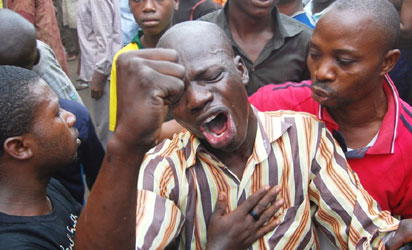
One of the victims, Sarafa, an Eletrical part seller whose shop was gutted by fire. Pix by Dare Fasube
By Francis Ewehrido
Bereavement refers to the period of mourning and grief following the death of a loved one. The origin of the word bereavement appropriately describes how many people feel about it: “to rob” or “to seize by violence.” How else do you describe a situation where the cold hand of death unexpectedly and inexplicably snatches a loved one? Unfortunately, this is one robbery you are helpless about. You scarcely know when the robber comes and even if you know, there is nothing law enforcement agents can do about it. It simply comes and rips your beloved from you.

For many people bereavement comes with shock, denial, grief, anger, acceptance and facing the harsh reality of the death of a loved one. Reactions are influenced by various factors. For instance, Muslims seem to manage the loss better than Christians. The burial is swift and there is this feeling of Allah giveth, Allah taketh. Whether the grief and pain are suppressed, I do not know, but on the surface, Muslims seem to fare better.
Age is also a major factor. While the loss of a loved one is painful, it is celebration when a person dies at a “ripe old age,” but a loved one dying in his/her prime or “before his time” leaves the bereaved bewildered and inconsolable. Other factors that influence the bereaved reaction are personal beliefs, inner strength and closeness to the deceased; the cause of death and whether the death was sudden or expected.
Bereavement has two dimensions, the actual loss and the symbolic loss. When old people die, the bereaved only feel the actual loss, but with younger people and people in their prime, you feel both the actual loss and symbolic loss. The symbolic loss is your thoughts on what could have been if the loved one had not died, which makes the death all the more traumatizing.
There is this common saying that “another man head na garawa.” Many sympathizers simply do not know what bereaved people go through. They cannot imagine the pain and the trauma, neither can they appreciate the nothingness and emptiness bereaved people feel. Many simply add to the bereaved person’s pain and grief with their choice of words: “It’s not the end of the world,” “at least you still have other children,” “you have other siblings,” “you are still young (meaning you can remarry)” “at least, your mother was old” and other such callous and insensitive statements.
For instance, even if a parent has one million children, they tickle him/her differently. One might be because of his great wisdom, another because she is very caring, the other might be the financial backbone and yet another is the parents’ confidant. The death of any of the children leaves a void in the parent’s life; each child is simply irreplaceable.
If you are not adept at consoling bereaved people, it is better you come, stay for while and simply say, “Accept my sympathy” and go away. Or simply visit the bereaved, stay with him/her for some time, depending on your closeness, and tell him/her you are leaving and will be back. Consoling a bereaved person is one of the few occasions when less is better; the fewer words you say the better. The bereaved is not in any mood for long sermons anyway. He/she is lost in his/her world.
Many people experience death of a loved one before appreciating the enormity of what has been befalling other people. When you visit them to pay your condolence, you hear such statements as:”Na so this thing be?” “Is this what you went through?” It is at such times they realize they had been too nonchalant or insensitive to other bereaved people in the past. When you lose a loved unexpectedly, the pain you feel, the invisible fire that burns in you is like a foretaste of hell. It is not something people should trifle with.
Time, money and distance constrain people, but you should be concerned in whatever way possible and convenient (sometimes you inconvenience yourself) when people close to you are bereaved: phone calls, text messages, mails, visits, participating in the burial, providing support (financial, material and moral), etc. Bereaved people need it. Do not just be aloof. Sooner or later, you too will be at the receiving end. The inevitability of death means that everybody is going to be bereaved at some point.
Death seems so distant and far in between when people are younger, but as they get older, it becomes a regular companion: loved ones, friends, colleagues, neighbours, church members, acquaintances, relatives. It just goes on and on. The truth is we either met everyone around us or they met us; therefore, we would either leave them or they would leave us. We should therefore savour and cherish everyone in our lives and be the best we can ever be for them.
Bereavement has two healers: time and death. Over time, depending on internal and external factors, the pain and grief wear off, or the bereaved dies (physically or emotionally) of pain and grief as we sometimes see among very close couples.
The Bible tells us not to mourn like those who have no hope. I know and believe, but looking at death as a strictly earthly affair, I am yet to see any other situation as hopeless and irreversible as death; the helplessness you feel is indescribable. Somebody you once shared a part of your life with lies motionless and there is nothing you can do
Disclaimer
Comments expressed here do not reflect the opinions of Vanguard newspapers or any employee thereof.