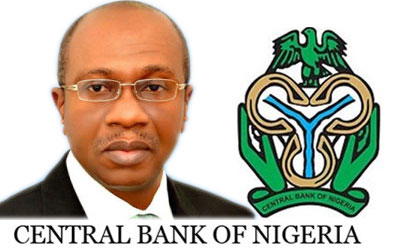
CBN Governor, Mr Godwin Emefiele
By Emma Ujah, Abuja Bureau Chief & Babajide Komolafe
ABUJA — In a bid to tighten money supply in response to the sharp increase in inflation in February, the Central Bank of Nigeria, CBN, yesterday, raised its Monetary Policy Rate, MPR, to 12 percent from 11.

CBN Governor, Mr Godwin Emefiele
The bank also increased the portion of customers’ deposits that banks must keep as cash, known as the cash reserve ratio, to 22.5 percent from 20 percent, while it retained the liquidity ratio, LR, at 30 per cent.
CBN Governor, Mr. Godwin Emefiele, who announced these decisions at the end of the Monetary Policy Committee, MPC, meeting in Abuja, yesterday, said the decision to tighten money supply was informed by the balance of risk against inflation.
Inflation rate rose to 11.38 per cent from 9.6 per cent in December.
Emefiele said while the sharp rise in inflation was caused by structural factors as scarcity of petrol, rise in electricity tariff and exchange rate, the MPC was worried by huge excess liquidity in the banking industry. He added that the MPC noted that the excess liquidity was driving speculation for foreign exchange and also feeding into prices of goods and services.
He added that the committee was also concerned that the spike in inflation could discourage local and foreign investors from investing in the country.
Inflation rate
He said: “The bank had adopted accommodative monetary policy since July 2015 in the hope of addressing growth concerns in the economy, effectively freeing up more funds for DMBs by lowering both CRR and MPR, with excess liquidity arising from the lower CRR warehoused at the CBN.
“DMBs were to access these funds by submitting verifiable investment proposals in the real sector of the economy. The funds have not impacted on the market yet because the CBN was still processing some of the proposals submitted by the DMBs.
“In the first episode of easing which resulted in injecting liquidity into the banking system, DMBs did not grant credit as envisaged. Moreover, the delay in passage of the 2016 budget has further accentuated the difficult financial condition of economic agents as output continues to decline due to low investment arising from weak demand.
“The cautious approach to lending by the banking system underpinned by a strict regulatory regime conditioned by the Basel Committee in the post global financial crisis era has further alienated investors from access to credit as banks prefer to build liquidity profiles in anticipation of government borrowing.
“From the monetary data, the Committee noted that the excess liquidity in the banking system was contributing to the current pressure in the foreign exchange market with a strong pass-through to consumer prices. The Committee further noted that previous efforts to reflate the economy in order to spur growth did not elicit the required response from DMBs, hence; the surfeit of liquidity in the interbank market.
“Obviously, the attendant low rates at that market have not transmitted to the term structure of interest rates. Concerned about the need for low interest rates to support growth and employment, the Committee urged the CBN to explore innovative ways of ensuring the unhindered flow of credit at low cost to key growth sectors even as monetary policy has to, under the circumstance, address the liquidity surfeit in the banking system as well as the pressure on exchange rate and consumer prices. The Committee hopes that fiscal and other structural policies would soon be deployed to strengthen the overall response of macroeconomic policy to the shocks.
Price stability
“The Committee remains committed to price stability across the range of consumer prices, exchange rate and interest rate, which is fundamental to reviving economic growth and employment generation.”
In summary, the MPC voted to: raise MPR by 100 basis points from 11.00 per cent to 12.00 per cent; raise CRR by 250 basis points from 20.00 to 22.50 per cent; retain Liquidity Ratio at 30.00 per cent; and narrow the asymmetric corridor from +200 and -700 basis points to +200 and -500 basis points.”
No plan to convert $20bn in Dom Acc to naira
Responding to questions, the governor said there were no plans to convert the $20 billion held by Nigerians in domiciliary accounts to naira.
“For the avoidance of doubt, the bank will continue to allow domiciliary account holders unfettered access to the funds in their accounts. I need to seize this opportunity to explain that these funds are not idle as have been wronged reported. Those funds on the balance sheet are funding assets on the other side of the balance sheet,” he said.
Mr. Emefiele urged a speedy passage of the 2016 federal government budget in order to halt the depressing effects of the uncertainty that engulfed the waiting period. Knowing that the implementation of the budget will go a long way in boosting business confidence and re-invigorating the financial market.
According to him, the fiscal challenges facing the nation was not peculiar, as according to him, all other oil exporting nations were in similar situation.
His words, “We have been meeting with the fiscal authorities and we have been discussing the direction of the economy and the challenges that face us at this time especially, realizing fully well that this challenge is not peculiar to Nigerian and this is a challenges that confronts practically all economies in the world, whether you are a commodity exporting country or not.”
On Deposit Money banks’ refusal to lend to the private sector, the governor said that there has been rising cases of Non-Performing Loans and that the apex bank was in discussion with the DMBs with a view to working out strategies that would give rise to increased lending without undue risks exposure among the banks.
Disclaimer
Comments expressed here do not reflect the opinions of Vanguard newspapers or any employee thereof.