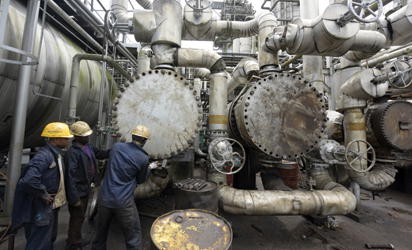
File image.
By Prince Okafor
TOTAL Exploration and Production Nigeria Limited, has said the oil price fall is responsible for the challenging economic environment in Nigeria, while identifying three critical factors for sustainability of the petroleum industry.
 The Managing Director, Total E & P, Mr. Nicholas Terraz, who spoke at the just-concluded 20th Offshore West Africa Conference, OWA, in Lagos, said: “Throughout 2015, we faced a challenging economic environment, due to the sharp fall in the price of oil. This environment requires us to adapt and quickly take actions, whilst at the same time preparing for the future when the market situation will improve again.
“Oil and gas companies have to adapt and generate sufficient cash flow for capital investments. Governments are facing gross revenue shortages and sometimes experiencing difficulties meeting their joint venture funding obligations,” he said.
Elaborating on the three critical factors that will be key for future development in the industry, he said: “Safety, irrespective of all issues, the high safety standards achieved to date by the industry must not be compromised. Cost constraints must in any case not affect the safety of our people; we are committed to ensuring that all our staff and contractors’ staff go back home to their families every day.
“Cost efficiency with the fall in oil price and investment decisions come under further scrutiny by all stakeholders, who focus increasingly on value and profitability while maintaining the capacity to accommodate the future recovery. “Efficient management of costs is, as a consequence, a critical element. As operators, we have to demonstrate our ability to reduce costs and be more efficient in delivering the production and the new projects. Operators also need to work hand in hand with public authorities to be more efficient, for instance by decreasing contract approval cycles.
Petroleum laws and regulations
“Regulation, in the current environment, petroleum laws and regulations in the oil and gas countries of West Africa should seek to encourage investment and prepare the future. Regulations need to provide a robust framework that is conducive to investment and flexible enough for the varied economic climates linked to the price of oil,” he added.
Terrez, further hinted that, “If we are able to achieve these conditions and put in place laws that create a win-win situation for all stakeholders, our countries would have laid a solid foundation for a sustainable future.”
“This will also stabilise investors’ confidence, ensures attractiveness and respect of the contractual and fiscal terms, cost efficiency is critical in the current context. Irrespective of all these issues, high safety standards must not be compromised.
“These are indeed trying times for the global oil and gas industry, but the current context also presents a great opportunity for change. Opportunity to take a whole new look at the way we are doing things, with a view to being more efficient and innovative.”
He further noted that West African is a prolific long term oil and gas region, adding that it has “a well-developed industry, good infrastructure, a skilled industry workforce and extensive local capacities.
The hydrocarbon basins around West Africa are amongst the richest in the world, with large untapped resources.
Disclaimer
Comments expressed here do not reflect the opinions of Vanguard newspapers or any employee thereof.