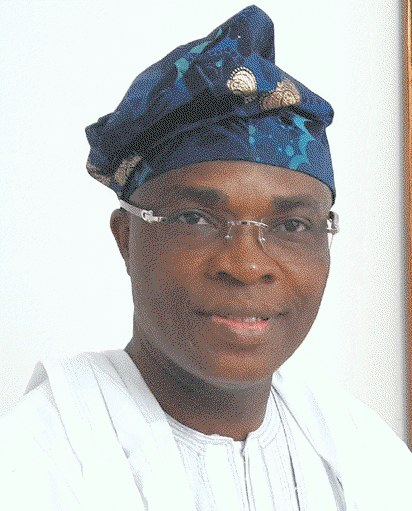
Imansuangbon
By Jemi Ekunkunbor
He is a lawyer, politician, businessman, philanthropist and the chairman of Abuja-based Pace Setters Group of Schools. But on the streets of Benin City the Edo State capital, he is known and fondly referred to as the “Rice Man.” This is not unconnected with his philanthropic gestures of distributing bags of rice to members of the society every Christmas. This he has done consecutively in the last seven years.
Having come face to face with poverty and defeated it, giving to the less privileged, comes naturally to him. He has also been instrumental in giving scholarship to children of military, police and other security officers who lost their lives in active service. In this encounter, Mr. Ken Imansuangbon, a gubernatorial candidate in Edo State under the platform of the All Progressive Congress APC, talks about his life in philanthropy.
What was growing up like?

•Ken Imansuangbon
Life was good and it was fun growing up as a child. We didn’t live in fear of being poisoned or kidnapped. We were contented and satisfied with what we had. My parents were hard working people. We didn’t have much, but we loved one another. What defined us was our common humanity. But today, we’re so divided and polarised.
What inspired you as a child?
My hard working parents. I was born in Ewohimi, Edo State, but my father relocated to Ijebu-Ode where he worked as a rubber plantation manager. He managed a group of people at a rubber plantation in Ijebu- Ode. This inspired me to be hard working. My widowed mother too summoned up courage when my father died and gave us (the children) needed support in her little way.
Having grown up in abject poverty, you could have turned out otherwise. What kept you focused?
Determination and belief in myself. I left secondary school and passed out in flying colours in 1981, but due to poverty, I had to take to menial job as a technical assistant with the Federal Capital Development Authority (FCDA) Abuja. I worked with some great expatriates who spotted my exceptional brilliance and talent and advised me strongly to return to school.
I did not dismiss that idea. I gained admission to study law at the University of Ife (Obafemi Awolowo University) Ile-Ife. So, I have always been a focused young man who in the state of despair was hopeful.
By dint of hardwork, you have emancipated yourself from poverty. But are there situations that remind you of your past?
Yes, of course. When I see people who can’t get food to eat, don’t have jobs after graduation, when a woman who has malaria and cannot pay her hospital bill or cannot go to the hospital because her husband doesn’t have a job, when a woman who is pregnant cannot see a doctor because she cannot afford the medical consultation fees or when a child can’t pay school fees etc. Situations like these make me sad.
At what stage did you decide to give back to the society?
My background must have shaped my philanthropic disposition. I came from a very poor home. All that I have benefited was from my widowed mother and neighbours. Those who were our neighbours never made us lack. They all supported. So, I made up my mind that if God blesses me, I would give back to God and to humanity. To that extent, this is a mission and a pact. I studied law at the University of Ife now Obafemi Awolowo University. I felt law was a tool for social change, a social engineering instrument.
I wanted to practice law, to fight for humanity, defend the poor and to use law to bring about change. That was what I wanted to do until I visited the USA about 20 years ago and saw the huge development that had taken place there. I asked the first white man I spoke with why Africa was not as developed? He said the gap was in education, that developed people are people that are highly read, people that take their education serious. So, I made up my mind that I was going to open schools. That I have done.
Under what charity have you been functioning?
I function under my name.
How do you fund it?
The grace of God is sufficient for me.
In your view, what is the cause of increasing rate of poverty in Nigeria and how do you think it can be eradicated?
Poverty can be eradicated with good governance and good leadership. If you ask me, a good leader is a good shepherd. A good shepherd gives his life for his people. A good leader is one that would not steal the people’s money. A good leader is one that would be fair and equitable in all his decision. A good leader is a leader that would remember tomorrow. And that is why we need people of good character in governance. If the good ones abandon the game of politics for the bad ones, then the common man is done for. So we need people of integrity in governance to turn the situation around and alleviate people from abject poverty.
Can you mention some people that have had great influence on your life?
I have several people that have impacted my life positively. My wife, the late Chief MKO Abiola and the late Chief Gani Fawehinmi. The late Gani Fawehinmi was a great role model. He inspired me to study law. I loved his courage and how he fought for the poor and humanity in general. Unfortunately, we don’t respect our heroes. The true heroes of this country are people like Gani Fawehinmi. He inspired me each time he talked.
Another fellow was the late MKO Abiola. Again, while at Ife, we needed to raise money for the Law Faculty Week. The dean, Professor Fabunmi, called me and said we must go and raise money. We got to MKO’s house at about 3pm. We learnt he went to see Gen. Ibrahim Babangida at Dodan Barracks. We waited until he came at about 1am. I will never forget MKO.
What I observed was that even men in Christian cassock and Muslims in their turbans were also waiting. But when he came, he was told that students of the Faculty of Law, Ife, were waiting. We were the first he saw. He asked what we wanted. I was the lead speaker; I told him we needed N100, 000 for our law faculty. He asked how much we’ve raised? I said we haven’t raised anything. ‘You’ve not raised anything. It’s MKO Abiola’s money you need to do everything?” he chided me and laughed. At the end, he gave us N50, 000. All that we needed actually was N10, 000. MKO Abiola was a giver per excellence. He loved everybody.
He wasn’t discriminatory in his character, attitude, fellowship and fraternity with people. For him, there was neither Muslims nor Christians; everybody was equal. That’s one lesson I learnt from him. That’s why when I share rice; I take some to the mosques in Edo State. MKO Abiola was a great man and undoubtedly one of the legends we have had in this country. And lastly, my wife; she has been very supportive. I wanted a God-fearing woman, but God answered my prayers and gave me an angel.
Disclaimer
Comments expressed here do not reflect the opinions of Vanguard newspapers or any employee thereof.