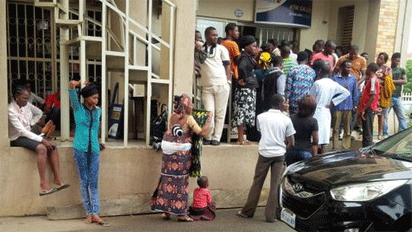
File: BVN registration
The banking industry in 2015 was dominated by foreign exchange restrictions rolled out by the Central Bank of Nigeria (CBN) in its bid to defend the naira as well as challenges that bedevilled the implementation of the Biometric Verification Number (BVN).
Forex market
The foreign exchange market witnessed introduction of several foreign exchange restrictions in 2015. The first notable restriction was the closure of official foreign exchange market (Retail Dutch Auction) on February 18, 2015 which translated to further devaluation of the naira to N197 per dollar from N165 per dollar.
The second notable restriction was the Exclusion of 41items from the official foreign exchange market. Then in August the CBN banned acceptance of foreign currency deposit into domiciliary accounts. In addition to the above was the reduction in the limit on usage of naira debit cards abroad. From $150,000 per annum the limit was reduced to $50,000 per annum per naira debit card. The daily cash withdrawal limit was pegged at $300.
During the year, the CBN banned banks from selling foreign exchange to the Bureau De Change (BDCs) while it revised the operating guidelines of BDCs, banning any form of relationship of street hawkers of foreign currency (black market), and branch operations.
These restrictions coupled with dwindling foreign currency inflow due to continued decline in crude oil prices, as well as continued expectation of further devaluation of the naira, led to ……. depreciation of the naira in the parallel market. The parallel market exchange rate of the naira rose from …..at the beginning of the year to close the year at N280 per dollar.
Monetary Policy
There were two major monetary policy developments in 2015. The first was on May 18, 2015 when the Monetary Policy Committee (MPC) abolished the dichotomy of Cash Reserve Requirement (CRR) for private sector deposit and public sector deposit. Previously, CRR for private sector was 20 percent while it was 75 percent for public sector deposit.
But the MPC harmonised the CRR at 31 percent. Then, on November 24th, the MPC abolished its tight monetary policy by reducing the Monetary Policy Rate (MPR) by 200 basis points to 11 percent from 13 percent. Furthermore the MPR adjusted the interest rate for its Standing Deposit Facility (SDF) to MPR minus 7.0 percent from MPR minus 2.0 percent. The change in policy was prompted by the need to address the declining growth rate of the economy, by encouraging banks to increase lending to boost economic activities.
Biometric Verification Number
The implementation of the Biometric Verification Number (BVN) as unique identity number for bank customers impacted banking activities and bank customers significantly in the second half of the year. In order to beat the June 30th 2015 initial deadline, bank customers besieged banking halls across the country.
This resulted to crowding in most banking halls, which led to calls for extension of the deadline. Furthermore the Nigeria Interbank Settlement System and the CBN were yet to make adequate provision for enrolment of bank customers in diaspora. Also, some resident customers complained of not receiving their BVN months after enrolling for the BVN. As a result the CBN extended the deadline to October 31st 2015.
To tackle enrolment of customers in diaspora, NIBSS collaborated with a OIS, a consulting company, to establish BVN enrolment centers in selected countries. In addition, foreign subsidiary of banks also provided BVN enrolment services for diaspora customers. But as at the October 31st deadline, the BVN enrolment centers have not been extended to many countries, and there were complaints of not issuance of BVN after enrolment. As a result the CBN extended the deadline for BVN enrolment for diaspora customers to January 31st 2016.
In addition to these, the CBN made the BVN one of the criteria for foreign exchange transactions in the country. Thus effective November 1st, banks and BDCs were required to verify the BVN of anybody buying foreign exchange. Consequently, NIBSS created a USSD service (*500*1#) for verify BVN. Prior to this, NIBSS had partnered with GSM companies to provide a USSD service (*565*#) for bank customers to make enquiries about their BVN.
E-Payment and Cashless Policy
On July 1st, the cashless policy was extended to the remaining 30 states. The policy, which commenced in Lagos state in 2012, was in 2014 extended to Abia, Anambra, Ogun, Kano, Rivers States and the FCT. The CBN however suspended the application of cashless charges in the remaining 30 states, as well as directed banks that have imposed such charges to return them to the customers. In addition to the national roll-out of the cashless policy, there policy initiatives aimed at curbing the rising trend of electronic payment fraud in the country.
To curb incidence of card frauds abroad, the CBN directed that banks should limit use of cards in countries where the card system is not based on chip and PIN (non-EMV), to the duration of the customers travelling. Thus customers travelling to such countries were to inform their banks whenever they are travelling to such countries.
Secondly, to curb insider related epayment fraud, the CBN directed banks to introduce Two Factor Authentication, which requires the use of PIN and Tokens for consummation of epayment transaction. Finally, the CBN directed banks to establish dedicated e-fraud desks to address complaints from customers.
Treasury Single Account (TSA)
The implementation of the Treasury Single Account (TSA) led to the transfer of all federal government funds from the banking sector. It is estimated that between N1 trillion and N2 trillion moved from banks to the CBN. However the CBN sanctioned three banks namely First Bank, UBA and Skye Bank for non-compliance with the TSA directive. First Bank was fined N1.8 billion while UBA and Skye Bank were fined N2.9 billion and N4 billion respectively.
In November, the Senate condemned the 1.0 percent charge for TSA transaction, and set up a panel to probe the charge. Consequently the CBN directed SystemSpec, owners of Remita, the platform adopted for TSA and banks to remit all the income associated with the 1.0 percent charge.
Other Developments
Other notable development in the banking sector include: Publication of Bad debtors list by banks; Introduction of Guidelines on management of dormant accounts; creation of a N300 billion Real Sector Support Fund; and the review of the MSME guidelines to allow news businesses borrow from the fund.
Disclaimer
Comments expressed here do not reflect the opinions of Vanguard newspapers or any employee thereof.