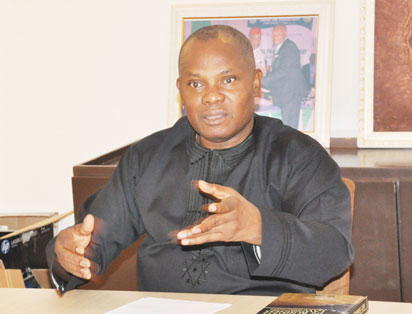
Mr. George Etomi
By Dayo Benson
Mr George Etomi is one of the leading commercial lawyers in the country. An author of repute in his field of practice, he is a former Chairman of the Nigerian Bar Association, NBA Section on Business Law SBL. An expert on energy, Etomi contributed immensely to the drafting of the bill that later became the Nigerian Communication Act.
He is a fellow of the Nigerian Institute of Advanced Legal Studies, NIALS. In this interview, he spoke on how the SBL was conceived, the role of regulators in an emerging economy, Sovereign Wealth Fund, SWF, and other related issues. Excerpts:
How did you conceive the birth of the Section on Business Law (SBL)?

Mr. George Etomi
The idea to set up the SBL was conceived by a few of us who decided to work as Solici tors. You know a lawyer may choose to work as an Advocate or a Solicitor though in Nigeria most lawyers carry out both.
Those of us who chose not to go to court decided to stay back in our firms and work as Solici tors. But of course, when the idea to form SBL was mooted; some lawyers did not quite understand the concept that it is not an al ternative to the NBA.
We had to make our position and the idea behind the concept clear to the bar leadership. However, not quite long we got support from the former NBA President, O.C.J Okocha, SAN and the NBA Constitution was amended during his tenure to accommodate SBL.
When Chief Bayo Ojo came in as the NBA President, he liked the idea; he eventually perfected the arrangement and we have not only the Section on Business Law (SBL) but also Section on Legal Practice (SLP). You know today that since then SBL has been an exceptional section of the Bar.
What government policy changes and practice do you expect in the first quarter of 2016?
I don’t know about any policy changes but we all know that transition is not easy espe cially with a change from party to another. The only way you can look at is promises. In the past ministers were not appointed but now ministers have been named and as they settle, we will see clear directions of the gov ernment policies. Of course, the only thing is that they should have been named earlier.
How will you react to inconsistencies in the policies of Federal Government?
Generally, there is nothing new in the government policies. A new administration can clothe an existing policy in new cloth for example; look at the BVN issue in banks; it has always been there during the Jonathan administration. Most of what we will be seeing is giving teeth to existing policies al though there may be radical departure on some policies.
How will you react to the proposed re-introduction of toll-gates in the coun try?
Policy changes can take place within the same political context. The question should be asked fundamentally, should government have cancelled the old toll gates in the first instance? In developed countries where they have the will power, they have these toll-gates and they used the proceeds from the toll-gates to develop their economies.
How will you react to the proposal that workers should choose between re duction in the work force and reduction in salaries?
You must have heard about zero budget ing. The game changer is that monolithic source of revenue for the government has gone. For instance, one can ask, do we need 36 states in the country? I can say we don’t need this figure because some of these states are not developing. Previous governments created states not based on equality. They ap plied the wrong parameters to create states and so when you applied the wrong prin ciples, wrong policy implications are bound to follow. We have to look beyond the oil and explore other sectors of the economy.
What do you consider to be the role of regulators?
The starting point is this, if you want to grow the private sector, government should determine policies and come out with policy statements. To drive that policies look for regulators that will effectively carry out the task of driving the policies. The telecommu nications is a success story. The fundamental between power and telecoms’ is that tele coms’ is growing and we are trying to reform power.
In power, you are inheriting a sector that was allowed to decay over the years; this is unlike telecoms’. The right thing is to de regulate and that is what they are doing. To address this issue of power you have to deal with the existing infrastructure, the long years of decay, huge number of workers and so on. In effect, the pace of reform in power has been slower than expected.
Do you see any justification in the in rease of tariffs in the power sector in the country?
It is chicken and egg situation. There are estates in Lagos that are enjoying power, they are called captive estates, they pay between 50 and 60 per cent high tariffs and they are enjoying the services. We should take a look at other sectors, take the gas for instance, we need to develop our gas for domestic use. In
Nigeria, the total production of gas is not up to five per cent. This is low and we need to tap this area and develop it for optimum use.
How will you appraise the role of the regulators of the economic sectors in the country?
They are meant to be a balance to promote consumers’ interest and curb government excess es. There must be a balance between con tending interests and the regulators often act as the major players that balance these economic interests.
How would you react to the assertion that some institutions are operating without regulatory laws in the country?
I don’t think any institution can operate without regulatory laws. I think it is enforce ment of the laws that is the problem with the institutions because they cannot exist without any law or Act backing them up; it is the enforcement of laws that is the issue. In Nigeria, you and I know that regulations are observed more in breach.
Can you shed light on what exactly the Sovereign Wealth fund was designed to achieve?
If Nigeria has saved up 50 Billion Naira, we would be able to cushion the effect of the economic problems we are having in the country. If we have enough funds, we can toll. For instance, the Lekki-Epe expressway was tolled, it is a privet public initiative and you can imagine the huge income being gener ated from this initiative.
How do think the pension fund should be managed?
Pension fund should be used anyhow. They are meant for pensioners who will later collect the funds and use them in their old age; they should not have problem accessing the funds at the time of need. Pension fund should be used for infrastructure projects. Infrastructure projects are long-term projects; we can build an infrastructure fund that should have government support but not government-driven. It should be eternity fund; you can build up to a hundred trillion Naira and will yield over the years.
Disclaimer
Comments expressed here do not reflect the opinions of Vanguard newspapers or any employee thereof.