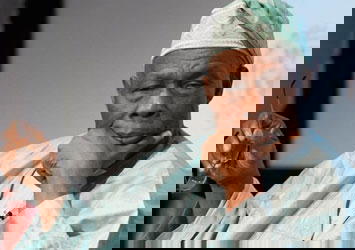
Olusegun Obasanjo
By Tabia Princewill
“A reformer should be exempted from the suspicion of interest, and he must possess the confidence and esteem of those whom he proposes to reclaim”- Edward Gibbon.
THIS is one of the reasons why reformers fail: perception is indeed everything. I’ve mentioned before that those who speak for President Buhari do him no favours: from his spokesmen to the impromptu zealots and sycophants who make such strange and absurd claims as the President’s “shyness” around women.
It is evident that those in charge of his communications strategy are destined to commit the same errors as the likes of Reuben Abati and Doyin Okupe whom they once criticized. By merely reacting to events and onslaughts by the opposition, by refusing to determine and lead the conversation towards certain salient truths about power, corruption and the way governance has been practiced in Nigeria, those who are supposed to be aiding the President by marketing his agenda to Nigerians (in order to carry them along) are failing their country and their president.

Olusegun Obasanjo
There is a propaganda war at hand and its byword is “witch-hunt”. However, there is something greater at stake, greater than the disjointed rants and final spasms of an expiring political faction or even class, who sees its livelihood compromised by change.
A war is coming. A war because most Nigerians now believe that predatory politics is the norm, that selfish political action can benefit them and that some are simply less deserving of any advantages. It should be every media and communications practitioner’s aspiration to fight the war against the root cause of terror and insecurity in Nigeria: greed and social injustice, the acceptance that rent-seeking is a communal business within which we all gleefully consent to be trapped.
Public office holders
The idea that in truth, corruption profits only public office holders is one we must teach: it is neither obvious nor clearly understood by the masses who hail their despoilers and write folk tales, modern myths in their defense. Thomas Jefferson, 3rd US President, wrote in 1784: “mankind soon learnt to make interested uses of every right and power which they possess, or may assume. Public money and public liberty will soon be discovered to be sources of wealth and dominion to those who hold them; With money we will get men, said Caesar, and with men we will get money. They should look forward to a time when corruption in this country will have seized the heads of government, and be spread by them through the body of the people; when they will purchase the voices of the people, and make them pay the price”. The price Nigerians all over this country are currently paying is Boko Haram.
The former governor of Borno state, Ali Modu Sheriff, allegedly once said that the criticisms leveled against him meant nothing because most of the residents of his state were illiterates. The Chad basin’s oil reserves cannot be exploited on the Nigerian end due to the Boko Haram menace. They can, however, using 3D oil drilling technologies be garnered by Chad. As far back as 2002, then governor Mala Kachalla said conflicting border claims in the lake Chad region between Nigeria (Borno State in particular), Chad and Cameroon meant Nigeria was losing island villages to its neighbours.
Island villages which like in the Bakassi case, are rich in petroleum resources. The alarm was also raised regarding the Sambisa forest where years later the Chibok girls would reportedly be held,as it had been identified as a hideout for Chadian rebels, arms and child trafficking. Governor Kachalla’s recommendations, made to the presidential committee on national security, including aerial surveillance and immigration reform, were seemingly ignored or in the usual Nigerian fashion, haphazardly implemented.
The rest is history. But the interesting question is why President Obasanjo and his successors would allow Nigeria to lose both oil-rich Bakassi and the huge potential revenue and resources from the lake Chad basin which extends through Yobe, Borno and Adamawa states, the very states hardest hit by Boko Haram. In the Nigerian political game, there is only one set of winners and one set of losers, the latter being the Nigerian people.
Remnants of rebel armies in Chad and Niger have been formenting political instability in those countries (Chadian President Idriss Deby was himself brought to power by one such rebel group in the early ’90s) for years and are responsible for banditry in the North. The so-called Fulani herdsmen who often trgger volatile situations in the Middle-belt are probably not even Nigerians, in which case, who knows if the men who reportedly recently kidnapped Olu Falae are citizens of this country. But it is most disheartening to see how political greed, voter apathy or disinterest, a lack of education and empowerment have seemingly enabled some powerful groups to covertly decide Nigeria’s future without much input from the masses.
In any society, when things go awry, fingers are first pointed at the media. Who educated the voter on his choices? Who told him he had a choice at all? Rather than joining politicians to analyse or support real or imagined witch hunts, Nigerians need to start asking questions.
Alleged terror sponsors
What did then President Jonathan mean when he said there were Boko Haram sponsors in his government, in the military?How is it that alleged terror sponsors and former Nigerian presidents, are rumoured to have interests in Chadian oil companies tapping into oil on Nigerian soil? If it is true, is this not treasonous, an act of grand larceny and sabotage against the Nigerian state and people?
Who would willingly destabilize a region for financial gain? And if there are some out there who know of this, what will it take to bring them to heel? Are over 13,000 deaths worth protecting a few individuals?
What ever happened to the Australian negotiator, Stephen Davis, reports? In other climes the Senate would have demanded an immediate enquiry into his allegations that top Nigerian politicians and military personnel were sponsors of the Boko Haram sect. What happened to the Usman Galtimari panel report that recommended Goodluck Jonathan should investigate politicians who own private militias used in the 2003 elections, some of whom became today’s insurgents, recruiting the “illiterates” Ali Modu Sheriff seemingly derided?
May the protection of violent, politically connected persons end with this new presidency
De-marketing Nigeria
Another week, another set of strange claims. I have often said that many of our politicians inherited the current system from their military big brothers. Most know or care to know little about democracy and its real workings.
It’s also pretty ironic, given the horrendous, planted stories about him, that a former military man, President Buhari, is the one to defend freedom of information by explaining why the electorate, deserves to be informed.
How can revealing salient truths be seen as sullying Nigeria’s name or “de-marketing” the country like the PDP’s spokesman claims? “We ask how can any reasonable investor still have the confidence to invest in a country where the President himself continues to alert that his country reeks of corrupt people and that the government is broke to the extent it cannot pay cabinet ministers?” Olisa Metuh says.
The question Nigerians should be asking is: who made it so? Who created this situation and why are they still walking free? The Nigerian treasury has been consistently plundered and the problem with Nigeria is the unwillingness to call a spade a spade: can’t we all agree that stealing is corruption no matter who is found guilty?
There is always an excuse why a spade shouldn’t be called a spade but instead be considered a wheelbarrow when it is in someone’s interest for the truth to be subverted or for it to remain hidden. Wheelbarrows masquerading as spades and engaging in goat and yam politics might just be the ones who are in fact de-marketing Nigeria.
Disclaimer
Comments expressed here do not reflect the opinions of Vanguard newspapers or any employee thereof.