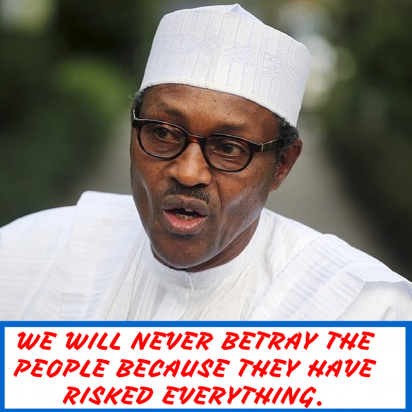
Buhari’s first attempt failed in 1985 . Unbridled zeal and passion dominated sensitivity and discretion. An innate obsession for rectitude and order propelled by youth and absolute military powers would suffer no debilitation from political calculations and compromises. He failed to temper perhaps ill digested idealism with cold realism.
 And the fight to salvage moral decadence was allowed to accommodate wanton disregard for human rights and freedoms. He was so stern he lost his friends.
Collective leadership, that carrying along of members of the top echelon was not an obvious priority, suffered. He was fervently patriotic and resolutely committed to uplifting the society. But he suffered a set back, failed.
Spare and austere, without the flabby morality of others, Buhari is prone to severity and inflexibility rather than political lasciviousness.
Without apparent lust for material acquisition and personal aggrandizement , Buhari would find it easy to be an elaborate living example of the discipline he wants for the country .
Most African leaders suffer a disconnect with the people and leave their countries worse than they met them because they lack the moral stamina to maintain any respectable level of integrity. For when a man preaches one thing and promotes the contrary through his body language and actions, the masses see a bumbling , dissembling hypocrite and withdraw their trust. With Buhari however, the people’s worry is tyranny rather than corruption
Leadership entails visionariness and salesmanship. While exemplary personal comportment enhances trustworthiness , Buhari’s manifest deficit in political dexterity always leaves a certain impression of a fundamentalist whose untempered idealism some , especially his fellow leaders, always see as arrogance and or naivety.
A certain degree of individualism, devotion and single mindedness must be needed to bring about substantial change in a society steeped in permissiveness, held bondage by all encompassing corruption. But independent mindedness that suggests , in its absolutism , that others , including major benefactors , are fit for contempt, in need of cleansing , can be read as arrogance. Resentfulness , bitterness and schisms become inevitable and retard progress.
In 1985 , perceived highhandedness left fellow senior officers estranged and dejected . President Buhari may argue that he deserved no blame for the inability of others to cope with the rigidity of the otherwise beneficial social order that he sought to enthrone. But it cost him his position and his vision for the country.
He may even argue that he is indifferent to losses and setbacks if they are prices to be paid for fidelity with high moral principles and aversion for corruption. And I will accept that one may have to sacrifice private advantages and political positions to promote integrity. But good leaders appreciate that societal transformations require mass participation and inclusiveness.
And that tact and compromise with a firm focus on the bigger picture is good leadership. The bending has to be calibrated carefully to bring change without fracturing the society. Three months in and many who fought the 2015 battle with him are already disenchanted.
It’s easy to assume that those moaning are corrupt politicians whose delusion and bogus sense of entitlement to influence and political office have been badly disappointed . Loyalty is also a virtue , so while he must not yield to evil compromises, the broad legitimate expectations of persons and groups who worked with him must be treated with concern. Sensitivity to little things does not undermine the resolve to bring about change
I don’t read coup speeches. They are often meaningless. Sales pitch of a bunch of ambitious and selfish men , often, desperately , masquerading as messiahs. But I read the 1985 coup speech a few days ago and I would advise President Buhari to read it again. Read it Mr president . You will not agree with the speech but you may learn a thing or two.
I am convinced that many APC leaders would share some of the sentiments expressed in that speech just 3 months into this dispensation. Not for lack of economic progress and freedom as the 1985 coupists had lamented but for a certain sense of betrayal in being left out . Alienation, exclusion.
Buhari’s passion is not in doubt. His dedication and patriotism find eloquent expression in his entrenched aversion to corruption. While a good leader must abhor corruption in words and indeed, he must acquire and retain some political nimbleness needed to provide transformative democratic leadership.
In 1984 he was young , brash, raw and tempestuous. Let’s say he didn’t fail, but it didn’t work. In 2015 , at 73, he must be more measured, more subtle , more pliable. Impulsivity must now yield to moderation. It has to work.
The APC chairman had to publicly announce that the party would become more involved in Buhari’s appointments. The party perhaps needs to. But is the party needed to inculcate in Buhari political realism? Is the party needed to teach Buhari a few lessons in political sensitivity and morality? Is Buhari a hostage of his convictions, his zeal and passions? Is it just obstinacy or is it something more pernicious?
Buhari was painted by the PDPs electoral megaphone as a religious extremist /fundamentalist, a sectional champion , a maximum ruler who is unacquainted with democratic norms of deliberation, persuasion and compromise. Buhari dismissed the charges as puerile nonsense.
He claimed he was a born again democrat and has never suffered from bigotry. We were told that an inspection of his personal staff would reveal his person, a lover of ‘one Nigeria’. I believe Buhari’s handicap is lack of political tact .
And it must have then been difficult for the party to defend Buhari when the public decried the sectional lopsidedness in the appointment of some of his personal staff. We were once told we should vote him because his choice of driver and cook showed he could trust ‘other’ people. Now we are being reminded that the appointment of personal staff is his prerogative.
And that may not brook significant otherness? We don’t know if he has lost the capacity to trust ‘others’. For in present day Nigeria and in the face all that transpired during the campaigns, even a temporary lopsidedness in appointments in favour of the north will agitate the south.
If it can prompt professor Nwabueze to publicly declare that the president is pursuing a northern agenda, then it has done significant political damage. But how can anyone explain such an attempt at a prodigal wastage of goodwill.
Igbos say it is the tiny faeces that often do the real damage. How can the president generate a whirl storm of needless controversy only to talk about balancing the appointments in the future. And many jumped to his defence, preaching that ‘one Nigeria’ means best hands can come from one village.
All sorts of ‘Janjaweed’ type militias now exist ,particularly in cyberspace, on both sides to the political divide, to do damage to rational engagements. If the president seeks through his actions to make a statement on ‘one Nigeria’, meritocracy or presidential prerogative then he must be clear and firm about it. If he seeks to do some balancing in the future then pure meritocracy is not his conviction.
Nigeria is perhaps ripe for meritocracy. But meritocracy cannot be enthroned by hypocrisy. For it is hypocritical to deny many citizens opportunities in the name of belongingness and inclusiveness in quota system only to turn around and talk about meritocracy when seeking to explain away manifest lopsidedness in the presidency’s political appointments.
Quota system and federal character may be due for a review to allow a true ‘one Nigeria’. I hope we are ripe. Without quota system 80% of intakes into the NDA will be southerners. That would not help national unity and cohesion. Quota system has its own utility, a practical unifying national purpose.
The purpose quota system serves is the purpose of giving everyone a sense of belonging. And that purpose is not served when after 34 new federal appointments none has gone to the south east. The appointments will be balanced in due course , we have been told, but why would the fears of marginalization be stoked at all.
Political sensitivity would mean that in the face of lack of political will to do justice , in the face of a collective cowardice against quota system, merit must be mentioned cautiously, with circumspection. Because the sensibility of persons and groups are grated by the noises of merit blown from the trumpets of quota system.
If the society tolerated quota system at some point in its development to foster unity at the cost of justice, to allow some mediocrity to enhance oneness, the sacrifice must always be acknowledged and appreciated.
Any conscientious Nigerian leader who then discovers the requisite political impudence to allow lopsidedness in political appointments even for a moment must find the moral effrontery to speak against the ills of quota system and federal character. If such a leader is as courageous , and as independent minded, as Buhari , then he should seek to abrogate it.
For it is patently hypocritical to speak so loftily of merit , so contemptuously of ethnicity and geographical considerations yet fail to see the glaring injustice of quota system , the very foundation of inequity, the very negation of the superiority of merit. But if quota serves to prevent the sort of exclusion that ultimately led to the Rwandan massacre then the power equation in the country must be compliant with political geography.
No one suffered any chronic injustice that needs some official positive bias to be remedied. So quota system is not an affirmative action, the sort that women in Nigeria deserve. While one may show sympathy for the cultural impediments to the permeation of western education and lack of access to opportunity to the ordinary people in the far north, quota system has to end someday.
The northern political elite has kept the masses of the north perpetually subjugated for private political reasons. Despite lack of opportunity and desperate living circumstances no real effort is made at population control.
We need national unity but no section of the country can continue to service the indolence and willful ignorance of another in perpetuity. Let’s enthrone merit. Let’s discard geographical political balancing. But let’s put away quota system first. One Nigeria is good. But can we?
Disclaimer
Comments expressed here do not reflect the opinions of Vanguard newspapers or any employee thereof.