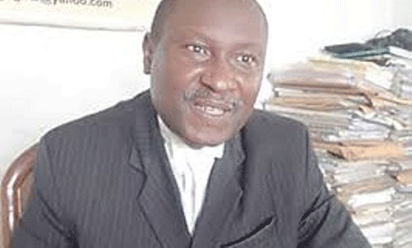
Oghenejabor Ikimi
By EMMA AMAIZE
WARRI — EXECUTIVE Director, Centre for the Vulnerable and Underprivileged, CENTREP, Warri, Delta State, Mr. Oghenejabor Ikimi, is a member of the Flood Committee set up by Delta State Government in 2012 to manage the flood disaster that year in the state. He spoke to Niger Delta Voice on the impending flood and how the committee handled the flood disaster of that year vis a vis the complaints of non-performance by the people. Excerpt.
There is threat of another flood again in Delta and other parts of the country. What happened to the Flood Committee set up by Delta State Government over the 2012 flood, which you were a member?

Oghenejabor Ikimi
I was a member of the Flood Committee inaugurated by the erstwhile governor of Delta State, Dr. Emmanuel Uduaghan on October 29, 2012 to manage the N500 million Federal Government intervention fund for flood victims in the state. I represented the civil community in the state in that committee and we did our job in accordance with the terms of reference handed over to us by the then governor without any interference from the government or anybody.
After completely disbursing the funds, the committee wrote a final report wherein it proferrred far-reaching recommendations and solutions to the state government as far back as August 2014. Unfortunately, the committee did not get audience to formally present the said report to the state government between August 2014 when it concluded its activities to May 29, 2015 when the ex-governor left office.
It was early this month, when the Chairman of the said committee, Mr. Justice Tabai, after several representations to the incumbent governor, Dr. Ifeanyi Okowa, that the committee was finally given the nod to present their final report. This is no doubt a regrettable development.
The victims are unhappy that the state government did little or nothing to alleviate their plight. Are they correct in their thinking? What was your committee’s handicap?
I think it would be most unfair for the victims or anybody for that matter to say that the state government did nothing to alleviate their plight as we all witnessed the little the state government did then in terms of providing accommodation for the Internally Displaced Persons kept in various camps.
The state government solely operated these camps with limited funds at its disposal. The biggest obstacle to alleviating the plight of the victims by both the state government and the committee was simply the paucity of funds.
There was a technical committee set up before the state government then inaugurated our committee. The technical committee, after traversing the flood-impacted 14 local government areas in the state, recommended that government would require N10 billion to alleviate the plight of the flood victims in the state, but unfortunately the flood committee was only given N500 million to manage.
Victims wanted cash
The internally displaced persons wanted cash distributed to them by the committee, while the committee had no such powers to do so under their terms of reference.
Furthermore, even if we were to share the money amongst the victims, the entire sum the committee had would not have gone round the victims. And even if it would have gone round, victims would have ended up getting peanuts owing to the population of the victims concerned and this could have been more chaotic in the sense that rather than alleviating the plight of the flood victims, we would have ended up elevating their plight.
Therefore, the committee in its own wisdom resorted to citing projects per local government areas depending on their level of impact. The committee engaged in projects like borehole, distribution of school benches and medical drugs, local government by local government. It also distributed cassava stems and various crops to farmers. It gave cash to churches and commercial farmers.
Anyone in doubt of how the committee expended the intervention fund can apply for a copy of the report, as it is a public document. Needless to remind Deltans that our committee was a flood committee and not a fraud committee. Each meetings of the committee then were explosive and robust and all decisions reached were in the best interest of the flood victims.
The state government posted an accountant to the committee and a civil servant of the status of a director was a member of the committee, hence it awarded contracts in accordance with the extant procurement law in the state. We did our best in the light of the above, as our committee was seriously handicapped with funds.
What should be done now that there is a flood alert again and people in the riverine areas have been asked to vacate their homes?
I was surprised when I read in the newspaper about the warning by the Deputy Governor of the state, advising people living along the coastline to vacate their homes.
This is because in our interim report, submitted to the state government in November 2012 after members had traversed the flood-impacted areas, this was before the flood receded, we recommended to the state government not to allow persons living along the coastlines to return to their homes from their various camps by building houses on high lands within their location and, thereafter, to relocate them there.
I am sure the state government did nothing about that recommendation, so in the absence of alternative accommodations, where would these people go now? I think we are about to make some of the same mistakes we made as a state in 2012. The state government by now ought to have built camps or hostels on high lands for persons in the riverine areas within their locations to reside in the event of flooding.
Disclaimer
Comments expressed here do not reflect the opinions of Vanguard newspapers or any employee thereof.