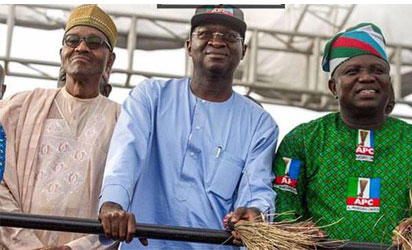
Buhari, Fashola and Ambode
By Tabia Princewill
A LOT has been said about petitions by civil society groups asking the Economic and Financial Crimes Commission, EFCC, to investigate alleged “questionable expenditures” by the former governor of Lagos, Babatunde Fashola, including a much commented upon N78 million website upgrade which the firm contracted to do the job subsequently denied receiving such an amount for.
Even among our best, claims of corruption remain an issue and there are two categories of reactions to such affairs, where Nigerians are concerned: some offer blind and unwavering support to their “heroes”, particularly those whose mien promised a strong, honest, people-oriented character, while others are quick to judge and condemn, based on political calculations, while often refusing to see the log in their own eye.
It is difficult in Nigeria, to find men and women one can admire without having to defend them at one point or another against accusations of graft or impropriety of some kind.
Everyone has a past in Nigeria, all that differs seems to be the extent of the wrongs they are accused of; or in other words, how dark precisely, their past is and how comfortable the rest of us are with the murky waters one must tread to keep up with their colourful lives. One is reminded of a quote by Oscar Wilde: “Every saint has a past and every sinner has a future”. It is in fact, the story of the Nigerian political system and could serve as an anthem to characterise our political dealings.
Political dealings
Indeed, with General Babangida claiming in interviews to mark his 74th birthday, to miss his old “friend”, M.K.O Abiola, one really sees that there is a time for self-avowed redemption for everyone.
A time where re-invention of one’s story seems to be the only possible course. Nigeria has been a victim of this. Every sinner wishes to become a saint which is why former President Olusegun Obasanjo, who some might say “gave” former President Goodluck Jonathan to Nigerians, became one of his most prominent critics once he saw the tide turning.

Former Military President, Gen. Ibrahim Babangida
In political history all over the world, you find characters who survive all revolutions, who are present despite every great change. In France, the name “Talleyrand” is synonymous with political cynicism and survival, maintained prominence through all regimes despite who is in power.
Talleyrand was a French politician whose career spanned monarchies and democracies in 19th century France. So Nigerians didn’t invent the “Any- Government-In-Power” mantra but we definitely perfected it. Our leaders are masters of re-invention but for the first time in our political history, we are about to see real change: it will be difficult for our elite to tell fanciful stories about themselves or how they made their money, to hide their colourful past and present dealings behind brash, untenable statements (although Governor Ayo Fayose might disagree with this assessment).
Things are about to get serious again in Nigeria. As citizens, we are fed up of being misled by leaders who have no regard for our sensibilities as humans beings or for our yearnings for truth and justice. Nigerians will no longer accept the excuse given by politicians who claim allegations of corruption are simply political attacks.
No one is too big to fall in this administration, as the Presidency has assured Nigerians it will not protect any guilty individuals from facing the law.
Jealousy and rifts between godfathers and godsons cannot be the motivation behind allegations or accusations of corruption: the fight is too important, the need to kill corruption before it kills Nigerians is too severe to taint with petty ego and power driven squabbles which have no meaningful impact on Nigerians, besides drawing attention from the real enemy, the mindless stealing which has become part of our political culture.
The APC estimates N13.972 trillion was allegedly squandered by the Jonathan administration in the oil sector alone. However, if we were to look at other industries and also compute indebtedness in states such as Lagos, Osun, Rivers and Kano, which incidentally are APC-led states, the figure would be much higher. The problem with corruption in Nigeria isn’t an APC or a PDP problem: it is one of mediocrity.
Nigerians have accepted that everyone is dirty and therefore don’t ask for much in terms of leadership or governance. We are content with white elephant projects with no real effect on our day to day lives. Now, we have a leader who is searching for ministers whom he believes will be competent and corruption free. Many have mocked him saying that is impossible. It is an insult to decent, well-breed Nigerians. Not everyone is a thief, even if the system does encourage and allow it.
Abdulsalami Abubakar and the Peace Committee
I AM always surprised and disappointed when those who should not only know better, but should be the first to defend the rights of the poor and downtrodden, are the first to

Abdusalami
either indulge in, justify or excuse graft. I was indeed surprised that members of the National Peace Committee seemed to intercede on former President Jonathan’s behalf.
Although that allegation has been denied, that is what it looked like to Nigerians. We are all only human I suppose: sinners who fall short of sainthood because of our closeness to certain people or often times, our involvement in certain affairs.
Forgiveness of sins
This is probably why members of the Peace Committee refuse to call a spade a spade. I was particularly surprised by reports quoting Bishop Matthew Kukah as asking President Buhari not to focus on probing the Jonathan administration.
This idea of a “witch-hunt” is truly getting old. Perhaps Christian doctrine does call for the forgiveness of sins, but nowhere in any major religion does it say that wrong-doing is acceptable, particularly when it harms defenseless people, like corruption does.
Where does change begin if one is to turn a blind eye to those breaking the law, especially if there is proof both in and outside the country? Moreover, what is to discourage other public officials from taking what is not theirs, from deciding they are more worthy of prosperity than the average Nigerian?
Treasury Single Account
IF there was ever any doubt that “change” for the President isn’t just a slogan, even if it might be for some of those around him, his decision to make all ministries, departments and agencies, MDAs, pay all government revenue into a single account is groundbreaking.
The murky accounting system our government usually operates, makes it possible for directors, permanent secretaries, ministers and just about anyone, to withdraw funds from various accounts, in a strange process which facilitated corruption.
The same people who don’t want a probe of the past administration will find all sorts of interesting reasons why a measure which will bring sanity and transparency back into government finances is a bad thing.
With the TSA, everyone can know government’s income and it becomes simple to track and monitor its operations, as well as enable optimal disbursement and utilization of funds. Who would want that despite the Nigerian people?
As for the banks complaining government is shutting its accounts with them and limiting liquidity, I hope this will be a lesson for all: we have reveled in mediocrity because it benefitted us in Nigeria, but now the party is over. Government is the private sector’s number one client: this isn’t normal.
The banking industry never pushed for a system where it could enable ordinary Nigerians to operate and open accounts doing legitimate business with banks, based on accessible loans and realistic interest rates.
It preferred to house ill acquired government money and now that money is no longer available. As Dorothy said in the cult classic “The Wizard of Oz”, “we’re not in Kansas anymore”. I hope everyone in Nigeria can adapt to the no-nonsense style of the Buhari era after years of permissiveness.
Disclaimer
Comments expressed here do not reflect the opinions of Vanguard newspapers or any employee thereof.