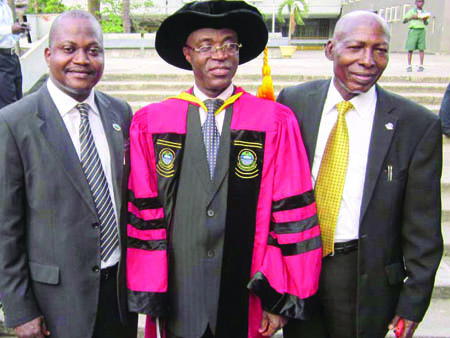
President ITAN, Dr Jimson Olufuye, President, Nigeria Computer Society, Professor Charles Uwadia, and President, Institute of Software Practitioners of Nigeria (ISPON), Mr Chris Uwaje
By Dayo Adesulu
CONSIDERING the importance of teachers to students’ academic success, lecturers have been enjoined to build competence in teaching and learning to boost students’ performance. Professor Sola Akinrinade who gave this charge during a training for top executives in tertiary institutions held in Texas, USA said: “Institutions can enhance their capacity for sustainable development by developing their teaching and learning competencies.”
He said that tertiary institutions need to create a new teaching and learning environment and culture that does not confirm existing academic tradition but explores potentials for a sustainable future.
According to him, institutions can enhance their income generation potential by enhancing enrolment through developing a culture of quality teaching and learning. He explained that for lecturers to deliver quality lectures, they must be willing to upgrade themselves through constant learning.
Constantlearning
Akinrinade while speaking on the theme; Developing Competence for Sustainable Development of Higher Education, noted that some steps need to be considered by every institution to attract quality faculty or teaching staff, saying, it will attract quality students including foreign students to the school.
He urged institutions of higher learning to introduce: “Reward system that recognizes teaching excellence and its contributions to institutional growth and sustainable development. Place more emphasis on research, or, more correctly, publishing.” He, however explained that the reward system does not have to tied solely to salaries, but recognition that entails pecuniary reward.
The institutions, he pointed out should engage in the process of constant capacity building in pedagogical skills for teachers.
“A Ph.D is a research not a teaching degree; it confirms you as a researcher and not necessarily as a teacher in the higher institution,” he said. At the minimum, he said, the institutions should introduce a regime of compulsory pedagogy training workshops for all newly recruited staff from Lecturer II and above, including staff promoted from training positions to these levels either upon acquisition of higher degrees or by experience and publications.
Akinrinade who charged the top executives in higher institutions to build the capacity of their staff to deploy technology for teaching said: “Smart boards, online teaching including use of social media for teaching, use of Google Scholar facilities will enhance effective teaching.” Stressing on the need to build capacity to deploy technology for examination processes, he maintained that tertiary institutions must invest in the development of facilities and infrastructure for quality teaching and learning experiences including laboratories, smart classrooms, library resources and well-equipped workshops.
According to him, curriculum development of tertiary institutions should reflect innovation and dynamism, as well as proactive responses to contemporary developments in the learning systems and environment. Citing examples of institutions which have a reputation for competence and excellence in certain courses and programmes, Akinrinade pointed out Ife for Pharmacy; UI for Medicine; ABU for Architecture; Ibadan Poly for Accounting and Yabatech for Fine Arts to mention a few.
He said, because of the peculiarity qualities of those schools, students desiring to study any of these programmes will naturally see it as a privilege to be admitted to the institution, thus enhancing quality of input and output. Moreover, in order to attract students nationally and internationally to our institutions, Akinrinade counselled schools to introduce courses that are innovative and have enrolment appeal: Mechatronics, Biotechnology, Human Resources Management, International Law and Diplomacy.
Integrity inlearning
His words: “Work with professional bodies such as ICAN and CIBN to make it possible to obtain dual certification for those registered in such programmes. ‘’Eliminate teaching fraud and establish a reputation for integrity in learning. ‘’Introduce and enforce a sanctions regime for erring teachers who skip classes for various unofficial reasons, teachers who extort students in various ways (money, sex and other forms of gratification)
‘’Eliminate, as much as, possible avenues for examination malpractice – sorting, blocking, etc. ‘’Keep enrolment within approved levels that comply with carrying capacities approved by regulatory authorities and capable of being sustained by existing facilities. Set up active, viable and dynamic quality assurance unit.
‘’Boosts your internationally generated revenue as tuition regime for international students at both undergraduate and postgraduate levels are not regulated by government in publicly-owned institutions.’’ According to him, when the aforementioned is done, it will enhance institutions placement on international ranking tables as there is consideration for the presence of staff and students from other countries in the list of factors weighted by ranking bodies such as these.
Other benefits, he noted include, enhancement of international profile of your institution with alumni in places not previously thought possible. ‘’Develop your internal capacity as an institution to be able to attract strong candidates from other countries.
He told the top executives: ‘’Focus on realistic targets. Begin by reaching out to West African countries particularly Anglophone with similar higher education systems. Remember: a foreign student is a foreign student – even if from Benin Republic or Cameroon.
‘’Develop partnerships that involve staff and student exchange and in-courses or programmes where you have strong credentials. ‘’Develop partnerships with institutions that permit credit transfer through harmonisation of programmes that do not conflict with the provisions of national academic standards. “Introduce courses that have enrolment appeal – but this time for international students.
On marketing of your institution, he urged schools to have a visible presence in the international community which does not necessarily have to do with ranking. For example, he explained that Afe Babalola University’s presence in the international media including CNN; internet adverts, have promoted the school. ‘’A little financial investment can go a long way,” he said.
Disclaimer
Comments expressed here do not reflect the opinions of Vanguard newspapers or any employee thereof.