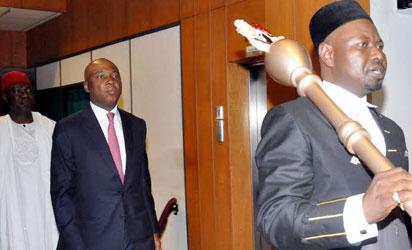
FILE: Senate President Bukola Saraki (M) going in for his first plenary session as President of Senate yesterday. Behind him is Deputy Senate President, Ike Ekweremadu. Photo: NAN.
By Obi Nwakanma
The leadership of the All Peoples Congress (APC) did not quite see it coming: while the party was still bickering over party choices for the leadership of the National Assembly, Dr. Olubukola Saraki and Mr.Yakubu Dogara, engineered something of a legislative coup. In swift, and adroit political moves, they formed a convenient legislative coalition with the rump of the parliamentary opposition, the PDP, and were elected as President of the Senate and Speaker of the Federal House of Representatives respectively, securing victories over Party favorites, Lawan and Gbajabimiala, and thus throwing their party’s legislative plan into free fall. As a trade-off, PDP’s Ike Ekweremadu was returned as Deputy President of the Senate. In actual fact, the position of the Deputy President of the senate has little political weight or significance, and is at best given only for the ride; but it does have just one important dimension: it guarantees the opposition presence in the room where important Assembly matters are to be discussed in a final caucus.
Tongues are still wagging bitterly in the APC. In actual fact, the Lagos caucus of the party, feeling utterly betrayed, has recommended nothing less than a scalping, or a piratical black spot for these party outliers. “They must be punished!” railed APC Spokesman, Lai Mohammed, in the party’s first official statement following the election of the National Assembly leadership. Now, the interesting thing is that President Buhari, who had made it very clear right from the beginning that he was loath to interfere with the process of electing legislative leadership, has accepted the election of both Saraki and Dogara, and has pledged to work with them.

Dogara and Saraki
Two things should be noted here: Buhari is playing a smart game. If the President wants to accomplish anything within the term of his presidency, it would be foolhardy to begin by creating or affirming legislative instability. A great problem that marked and indeed nearly crippled Nigeria’s democratic transition between 1999 and 2007 was the onslaught on the legislative arm of government carried out by the Obasanjo presidency, which sought to undermine parliamentary independence, create an imperial presidency, and very nearly scuttled the foundations of democratic opposition, through what the late Chuba Okadigbo, former president of the senate, once described as the “banana peels” politics constantly engineered by the presidency.
Not much was accomplished by that government even though it had overwhelming legislative majority, and it could push its bills very easily through the parliamentary mill. Obasanjo wanted a full control of the instrument of state, and he set to accomplish this by weakening and corrupting the two arms of government. He succeeded magnificently, but left a legacy of profound corruption, and a parliamentary process whose growth has remained stunted because the legislative arm of government has failed since then to really grasp the extent of its power as the repository of the popular will of the nation. Buhari is signaling a shift, although some are also seeing some kind of subterranean game going on here: a sort of Fulani political insurgency, which has now, with very shrewd and tactical moves, captured the realm of power in Nigeria: from the presidency to the leadership of the National Assembly, and the governance of the Supreme Court.
At the head of the triune power of the nation now are all Fulani men. I personally have no truck with this, except that it might not be too far from the truth to imagine that President Buhari is staging, through his proxies, including old foxes like Atiku Abubakar, and new entrant like Tambuwal, a political shellacking of their coalition partners. Time will unfold this ultimately. But the more obvious reality is that Buhari seems to be clearly steering away from any controversies that might attend any visible attempts to indicate or register executive interference in parliamentary outcomes. But certainly, the president cannot, strategically speaking, not be interested in who steers the National Assembly, particularly if he has to push through his legislative agenda. The question of course, certainly is, given the emerging scenario, what is the President’s legislative agenda for these next four years? The picture is not certain yet, but Buhari is a passionate advocate for the resettling of the pastoral Fulani, and the guaranteeing of grazing rights for them and their herds, from their settlements in the Futa Jallon to the plains of Cameroon and much of Central West Africa, where they are dispersing and generating conflict.
It is not unlikely that one of the legislations that the President would like to see passed might be a bill on securing Fulani grazing rights as a pathway for peace, and as part of the omnibus Anti-terrorism bill that is likely to be introduced in this Assembly. Nigerians are, meanwhile, worried that the National Assembly is opening on a fragile note with the clear signs of a fraying of the coalition that brought Buhari to power. What happened last week, that saw the “rebels” of the APC emerge as Parliamentary leaders, is in my view just a little storm in a tea cup. It will pass quickly. But the real hurricane is brewing, south of here: there is going to be a growing moving apart between the Northern APC, and the Lagos caucus of the APC, the most powerful sector of the party. Analysts have predicted a very quick collapse of the APC coalition, and a party crisis that will see realignments to the advantage of the PDP opposition. We must note that even now, and this was made quite clear with the elections of Saraki and Dogara, that the APC has but a tenuous majority in the National Assembly. It does not have the absolute votes to pass bills, and must rely on making deals with the parliamentary opposition if anything is to happen in the National Assembly. The APC might also lose its majority in the National Assembly, if it is unable to establish a common front right now, rally round its current political leadership, and establish clear governance.
If the party coalition, of really strange bedfellows is to last a good while, the party’s leadership must adopt a very pragmatic policy of engagement, otherwise, the “rebel” arm of the APC, might begin to caucus with the PDP, and take control of the National Assembly. APC might then be left only with the control the executive branch, while a re-invigorated PDP might end up controlling the Legislature; and this might not actually be such a bad idea. In any case, the APC government is starting poorly: there is increasing concern about the slowness in the take-off of the Buhari presidency. It is like a slow moving train; creaky, and ponderous thus far. The Presidency must begin to show signs of life.
Perhaps with the inauguration of the National Assembly, we might begin to see more vigorous governance, but thus far, this government feels too tentative and uncertain, and brooding, almost a month to the day after the president was sworn-in. The APC coalition seems too fragile at this stage, and it seems to be a real deadweight on the presidency, which needs a firm coalition in order to govern effectively. With the APC, Nigerians might just have elected a ghost party. But only time will tell.
One good news, though: Nigeria’s democracy is working. Bukola Saraki’s shrewd negotiations that led to his ascendance prove one important thing: to get anything done in this Assembly, the parties must reach across the aisle. That is a good thing, all things considered. Negotiations and consensus are good for democracy.
Disclaimer
Comments expressed here do not reflect the opinions of Vanguard newspapers or any employee thereof.