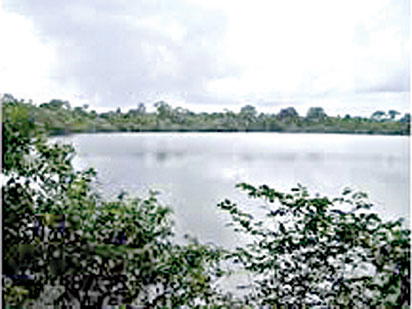
500 year-old Adiegbe-Lake
By Gabriel Ewepu
OSSIAMA—GIVEN its frightening origin, the people of Ossiama, Oboro clan and environs in Sagbama Local Government, Bayelsa State, would have had nothing to do with the ancient Adiegbe Fishing Lake in the community, but rather than disentangle them, the mysterious occurrences of five centuries ago tied their destiny to the deep.

500 year-old Adiegbe-Lake
An Ossiama community leader, Pa Nathan Alade, who spoke to Niger Delta Voice, is himself baffled about the mystery, but said it is the chronicle given them by their ancestors. By the end of this month (June), the people will roll out the drums to celebrate Adiegbe festival.
Pa Alade said: “According to the explanation and stories told by our great grandfathers, there was a married woman in the family of Akodi simply called Sumuh, who went on a particular day to a forest known as Adiegbe to get some food for her seven children.”
Shallow water under a tree with fishes “In the process of gathering what she could take home, she discovered beneath a tree many species of fish swimming in shallow water, and was confused on what to do to catch the fishes. She decided to go home and call her seven children to accompany her back to the spot she discovered the fishes.
“The next day, she and the seven children went to the bottom of the tree, which she saw the migrating fishes. On reaching there, they did not hesitate to catch the fishes,” he said. His words: “In the excitement of a great catch by the family of eight, but suddenly, they heard vibration and before they could realize, it was danger around them ,as the spot they were catching the fishes was eroding in quick succsessions.”
7 children killed in one day
He added, “As the place they were standing started boiling and rumbling, they ran towards different directions to escape to safety. Their mother, Sumuh could not take any of her seven children to safety, rather she ran for her own life.” Pa Alade said the quake continued to chase them and in the end, none of Sumuh’s seven children survived, the mysterious depleting site swallowed the children that went for fishing expedition with their mother.
However, their mother succeeded in fleeing to a place now known as Apoi Creek, where Esoni and other communities are settled. Some villagers, who were paddling canoe saw her and took her to Ossiama town, where she narrated what tragedy befell her seven children. Her story amazed the people.
Mighty lake
They followed her to Adiegbe forest to confirm her story and saw the unbelievable. The place had turned a mighty lake adjudged the largest in Nigeria and West Africa. There are still traces of the points in the form of little streams, where the seven children of Sumuh perished. “I can still remember some of the names of the seven children of Sumuh, which are Apele, Opuh, Dimu, Kala, and the little streams are named after them as a memorial. They were children and mainly girls of age seven, who were not married,” he said.
Aladeh asserted the cause of the vibration and quake that resulted to a great lake was traceable to the handiwork of some spirits. He added that following the mysterious occurrence, crocodiles took over the lake and occupied it.
Battle with crocodiles
Due to the carnivorous nature of crocodiles, nobody could fish inside the lake and this made Kurubiri and Tanyi families of Ossiama to consult some spiritual powers, which they invoked on the crocodiles not to be harmful to humans when fishing, and really, since then the crocodiles have not been harmful to humans up till now.
Money-spinner
The 1,000 anglers- capacity lake could generate over N50 million in a period of four months of fishing using canoes and nets due to the depth of the lake. “It is not only people from Ossiama who fish in the Adiegbe Lake, but the entire Oboro Kingdom comprises Ossiama, Ekpepoluama, Aweama, and Ogbonuama. However, due to the largeness of the lake, nobody steps into the water to fish; rather they use nets and canoes to fish.
No go area for non-indigenes“And they all have their own thatch tent accommodation by the lake, where they stay for the period of the fishing, and that could be about four months. People from different parts of the state do come to witness and buy fish, but we do not allow non-indigenes to fish at Adiegbe Lake, but they could have a view of it and also buy fish,” Aladeh stated.
He urged the Bayelsa state government to consider Adiegbe fishing lake as one of the major tourist destinations in the state, saying that would attract more people to visit the place and generate revenue for the state.
“We also need electricity, road and potable drinking water,” he said.
Disclaimer
Comments expressed here do not reflect the opinions of Vanguard newspapers or any employee thereof.