File Photo
By Mike Ebonugwo, Jude Njoku, Charles Kumolu, Bose Adelaja & Olasukonmi Akoni
Prologue
It was meant to be a joke, so Mr Dan Amor naturally expected his friend to have a good laugh on receiving the message he sent across. The message read: “Next time your woman complains you’ve not taken her to somewhere expensive lately, please take her to the nearest filling station!”
Well, as expected, Mr Amor’s friend, Patrick, had his laugh on reading the message and didn’t think much about it. But he had no reason to smile or laugh when next day he stopped over at a filling station to buy petrol for his car.
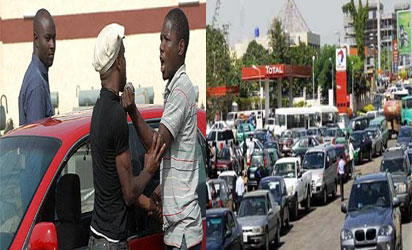
What he saw defied any rational description. His first shock was being confronted by the traffic chaos caused by several vehicles queuing in a disorderly manner from different directions to the filling station. Next was that after managing to squeeze his car into one of the queues and spending over 30 minutes on one spot, he discovered to his chagrin that the filling station attendants had for some inexplicable reasons stopped selling fuel to motor vehicles in preference to those buying in gallons or jerry cans.
This information was conveyed to him by a fellow motorist who walked up to him and said: “Oga, you better go and look for jerry can to buy fuel. These people have stopped selling to vehicles O!” And true enough, when Patrick entered the filling station, he saw the attendants busy selling to several people queuing with sundry sizes and shapes of plastic cans.
On inquiry, he was told that it had become the practice in most filling stations since scarcity of petroleum products, especially Premium Motor Spirit, PMS, aka petrol, hit town. While most filling stations have run out of stock of petrol or pretend not to have the product, those willing to sell dictate a stiff condition for doing so, including deciding whether to sell directly to motorists or those buying with gallons.
The preference for selling to those who come with gallons is said to be anchored on profit motive. For instance, when Mr Patrick eventually secured a gallon and bought N2000 worth of fuel, he was compelled to part with N500 extra which could pass as service charge or whatever. And considering the difficulty in getting fuel to buy, most of those who could find a filling station selling fuel at all, were only too glad to pay the exorbitant amount dictated by the exigency of scarcity.
 Indeed, Vanguard Features, VF, investigations revealed that the situation was one which oil marketers exploited to the full to rip off consumers. Apart from the preference in ignoring motorists and selling to buyers with jerry cans, they readily created avenues to promote black market sale of the product through direct and indirect diversion. For instance, during a recent visit to a filling station located along the Idimu-Ikotun road, Lagos, VF was confronted by a most unusual, indeed confounding, scenario. While the gate of the filling station was locked to several queuing vehicles along the road and the attendants had stopped dispensing petrol to those inside the station with gallons based on claims that the product had finished, most people could not comprehend it when the same attendants started filling several jerry cans loaded on the back of a pick up van with petrol.
When challenged over this, the manager of the station was quoted as saying that the car and jerry cans belonged “to a special somebody”. But most of those present were not impressed with his explanation. Indeed, one Mr Alhassan was quick to quip thus: “Don’t mind him! The gallons belong to their black market customers. That’s what they usually do. If you come here at night you will see their boys hawking the fuel in gallons and jerry cans. And because of the scarcity, these black marketers usually make motorists to pay through their noses for a small quantity of fuel”.
Another jerry can-carrying customer also chipped in: “They told us fuel has finished, but come back in one or two hours time you will see them selling again. I don’t know the kind of game they are playing.” In response to this, another customer said: “The game is obvious: They’re just taking advantage of the scarcity they have created to milk us dry and make a lot of money for themselves”.
Oil marketers fleece Nigerians
But for the crisis that followed the purported removal of fuel subsidies by the Federal Government in 2012, most Nigerians would have remained in the dark about how the activities of oil marketers in the downstream sector of the oil sector contribute to the nation’s economic woes.
It was an incident that afforded an already impoverished populace the opportunity of knowing how these importers of petroleum products defraud the country through bogus importation claims.
Till date, the memories of revelations which showed that some marketers defrauded the country to the tune of N232 billion in fuel subsidy claims, are still fresh.
The Aigboje Aig-Imoukhuede probe panel had revealed that an estimated N1trillion was illegally paid for dubious petroleum products importation between 2009 and 2012.
Though the government had taken some of the identified suspects to court through the Economic and Financial Crime Commission,EFCC, none has been successfully prosecuted till date.
While anger over the inability to bring some of them who fed fat on the commonwealth of over 180 million Nigerians is still boiling, the same set of people have continued to fleece the Nigerian government and its citizens.
Sharp practices
Investigations by VF show that the lingering fuel scarcity which is believed to have been created by the oil dealers, is currently being used to exploit Nigerians through various antics.
For example, in Lagos and other parts of the country, these oil marketers engage in all types of sharp practices including hoarding, hike in pump price, under-dispensing of products, preference for black marketers and collection of extra charges by fuel attendants, to mention but a few.
While the official pump price remains N87, there is hardly any fuel station that sells at that rate. Some of them sell the product between N130 and N200 to hapless buyers.
More worrisome is the allegation that virtually all dealers had their pump prices adjusted to almost half a litre for a normal quantity. It is in that state that the product is sold at exorbitant prices with the prime objective of making huge profits.
Another surprising aspect is the preference given to black marketers by these dubious oil marketers. They deliberately refuse to sell to motorists but would rather sell to black marketers who use gallons to buy the product in commercial quantity.
Further findings in Lagos showed that while some petrol dispensing stations employ the same exploitative antics, a few others differed in their mode of operation.
Fuel stations in Festac, Ojo, Agboju, Ajegunle, Kirikiri and Iyanoba are notoriously known for under-dispensing of the product, resulting from the adjustment of their metres.
Street urchins on prowl
In Somolu and Surulere, street urchins collect varying sums of money at the entrance of gas stations, while attendants collect at the points of dispensing the product.

Fuel crisis
In most places within the city, a particular pump is dedicated to dispense fuel only to people with jerry-cans. VF learnt that pumps dispensing fuel into jerry cans, are usually not tampered with. This is with a view to deceiving officials of the Department of Petroleum Resources, DPR, when they visit for monitoring.
Some marketers even resort to nocturnal operations, selling only at night to black marketers. Policemen who jump fuel queues are also part of the problem. They often buy the product in large quantities. While these sharp practices are going on unchecked, the DPR and Petroleum Products Pricing Regulatory Agency, PPPRA, which are agencies saddled with the responsibility of regulating the downstream petroleum sector, seem to have gone to bed. VF findings in this regard, show that the agencies have failed to take significant steps towards addressing the crisis.
Fire outbreaks escalate
The scarcity of fuel has increased pipeline vandalism as some daring Nigerians go as far as the high seas in a bid to to source for the product.
The Director, Lagos State Fire Service, Razak Fadipe, expressed regret that the fuel scarcity has led to some members of the public storing fuel in their homes. This trend, he said, has led to a spradic increase in the number of fire outbreaks in different parts of the state. According to him, about 71 emergency calls were responded to in the first 14 days of the fuel scarcity.
The situation he said, has led to mass destruction of property and threat to lives.
Fadipe who regarded the number as outrageous, explained that a total number of 756 emergency calls were effectively attended to between January to April 2015.
“It is to be noted that fuel scarcity is not a yardstick to illegitimate and inappropriate storage of fuel to the detriment of our lives and properties; hence, the public is warned to avoid using jerry cans that have been used for petrol to store kerosene and any other flammable items, “ Fadipe said. He warned motorists to avoid storing of PMS in their boots. “Motorists are advised not to store petrol in their boots, especially commercial vehicles,” he added.
Differences resolved
Although the Minister of Finance, Mrs. Ngozi Okonjo-Iweala and the Executive Secretary, Major Oil Marketers Association of Nigeria, MOMAN, Mr. Obafemi Olawore, have said that their differences over the subsidy issue had been settled and marketers agreed to resume the supply of fuel across the country, VF checks showed that the situation has continued to defy solutions. Indeed, the scarcity has continued unabated, thereby worsening the sufferings of motorists and the general public.
Olawore explained that as part of efforts to ensure petroleum products sufficiency and distribution, the NNPC embarked on aggressive rehabilitation of reception depots. “As at today, 18 depots out of the 23 depots have been fully recovered with the exception of Makurdi, Yola, and Maiduguri due to the activities of pipeline vandals,” he said
He noted that carrying PMS is not easy. There are safety implications. Also, NRC cannot just load PMS from a tanker; you have to have sidings to the tank farms. And the offloading sidings have to have sidings too. There are also the issues of the PEF. These are not the things you hurry over because of the safety risks involved. PMS is highly inflammable, so we are very careful with the way we intend to handle its movement. But the good thing is that there are discussions going on already to make this possible within the shortest time possible.
“We have scheduled a meeting between the management of MOMAN and the NRC to finalise all the issues that need to be resolved. If all goes as planned, in the near future, we could begin to lift. The key challenge for us is that it is difficult moving petroleum products. The fact that the railway is functional doesn’t mean that every product could be moved with ease. There are different types of products which could be moved which are not as volatile as petroleum products.
“Now if we rush into hauling petroleum products and there is a major incident relating to safety, you can imagine what the cost implication will be. We also consider the fact that we are entering a market which has been cornered by different people. So there is bound to be challenges. The only way is through negotiations which we have started now. But moving PMS is our highest priority now and that is why we are trying to clear all bottlenecks in order to make headway.
“What all these imply is that the Corporation, despite its capacity to lift, still has to contend with the issues of safety while trying to manage and balance the interest of the oil marketers as well.”
Disclaimer
Comments expressed here do not reflect the opinions of Vanguard newspapers or any employee thereof.