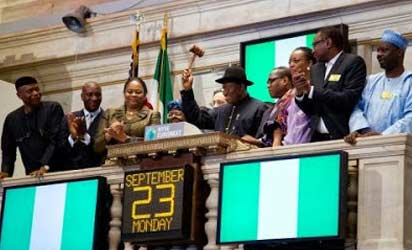
President Goodluck Jonathan at famous Wall Street on Monday, September 23, 2013, closing the bell of the New York Stock Exchange (NYSE)
By Tonnie Iredia
There is a world-wide consensus that Democracy is the best form of government. Accordingly, people in different countries strive not to slide into any other form of government especially dictatorship. If so, how come the avowed ideal system brings more curses than blessings in Nigeria? Why is it that the nation often faces economic doom whenever it has an acclaimed democratic government? In the second republic for instance, many analysts readily testified that the economic dilemma the nation found itself was heralded by the profligacy of the democratic government of President Shehu Shagari.
At that time, everything under the sun especially rice and cement were imported in such large quantities which held our nation hostage to blockedports. Similarly, just before the March 2015 Presidential elections, there were many Nigerians who out of frustration from our ineffectual democracy virtually prayed in silence for a military take-over of government. Does it then mean that the poor management of the national economy is one of the inevitable hazards of democracy? If that is so why is democracy flourishing so much in many other countries?
A common rationalization of poor performances by the pro Shagari and Jonathan supporters is the perverse argument that both Presidents were good men who were unlucky to have bad advisers. What roles did we, the ordinary people play in both men picking bad advisers; is a man not best be understood by the company he keeps? If the Shagari team was into experimentation during its era, Jonathan and his transformation ambassadors ought to have learnt from history.Today under their watch, one story is that the national economy has slowed down by about 3.96% just as the National Bureau of Statistics reports that over twenty-two million Nigerians that is, 31% of our entire population were unemployed in 2014. Yet another story alerts the nation that workers strikes due to non-payment of salaries are on the way amidst unending shortage of petroleum products. The correlation between the World Bank diction of Ngozi Iweala, the coordinator of our economy and our predicament, suggests that our out-going PDP President Jonathan probably appropriated the good luck of every other Nigerian since 2010.
Perhaps the most offensive of the failures of Nigeria’s democracy is the calculated plan of our political class both at federal and state government levels to deprive the ordinary man of his earned salary. For example, as at March 2015, judiciary workers in Benue State under a PDP governor were being owed salaries amounting to N957, 630,349.57. Just because our democratic leaders behave alike, judiciary workers in neighbouring Plateau State were also being owed N673, 019, 948.19,. Unfortunately, efforts by the courts to intervene fell on deaf ears compellingan Abuja Federal High Court to place a constraint on the accounts belonging to Benue and Plateau states in certain banks. Activities in some states have since been paralysed following threats by Labour to do no work until all arrears of workers’ salaries are paid. In Plateau State, where the government failed to clear the six months’ salary arrears of civil servants, union officials locked gates to the State Ministries, Parastatals and Agencies, thereby blocking top government functionaries from having access to their offices.
Painfully, politicians in the state who are no doubt behind the people’s plight are pretending to be on the side of the people. Members of the Plateau State House of Assembly for instance summoned the state Commissioner of Finance, Davou Mang, to explain the situation as if they are not part of the mismanagement of the economy which gave rise to the crisis. Of course everyone is aware of the several ways through which our legislators contribute to the problem.
First, they encourage the poor management of the economy by refusing to let us have a good budget. Throughout the Jonathan administration for instance, every year’s budget got passedonly half-way through the year the budget was supposed to be run. How can we have a sound economy when we spend without planning for about six months before a so called plan is approved as a budget? Is it not laughable that the 2015 budget is now being hurriedly processed after the nation’s resources for the period had been diverted to election malpractices? Second, the legislators would pass no budget until an unreasonable fraction is allocated to them. Even at that,huge sums of money are allegedly shared to them before the ‘lopsisded’ budget in which they take 25% is passed. Third, at no point did our Senate in particular ever examine how a previous budget was implemented before passing a new one. To make matters worse, legislators are always passing laws which give huge severance amounts to outgoing office holders. It is therefore not difficult to identify why it is always difficult to pay workers’ salaries.
The Executive is no less blame worthy as none of them can claim to be unaware of the logical consequences of employing hundreds of political jobbers as Special Advisers and Assistants. Through such recklessness by states like Bauchi, Nigeria’s democracy accommodates personswho are appointed into nonexistent positions with no job schedules. In addition, state governors expend huge sums of money in running duplicated welfare schemes for themselves in their state capitals and their liaison offices in Abuja. Huge travelling expenses and night allowances are spent on bogus entourages that are permanently on the road. The governors on their own part no longer travel by road or by passenger planes; they now utilize aircraft charter flights; yet airport workers are deprived their own meagre salaries. Why will the poor man not suffer?
At the same time, corruption in high and low places has remained in top gear. Only last week, Emir Sanusi of Kano drew attention again to his original alarm of huge sums allegedly diverted through the Nigerian National Petroleum Corporation NNPC. This time, the former Governor of the Central Bank is asking Nigerians to properly read the audit report on the NNPC and appreciate how huge sums disappeared through “duplicated” expenses, “unsubstantiated” costs, computation “errors” and tax shortfalls”. Shame on our political leaders
Disclaimer
Comments expressed here do not reflect the opinions of Vanguard newspapers or any employee thereof.