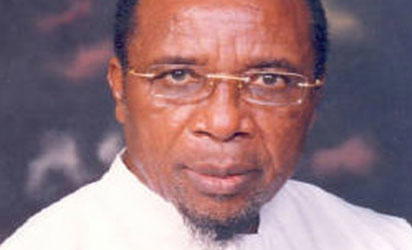
Chukwumerije: Ndigbo must think of 2015
By Obi Nwakanma
I never met Uche Chukwumerije on the personal level, but I met his former wife, a classic Onitsha beauty who was also a former national athletics champion and educator. I was told by those who knew them well that they were well-matched in most things, and that they also drifted as many things also drift.

Chukwumerije: Ndigbo must think of 2015
Although I never met the senator, which now happens to be odd because I should have, given many a shared mutual contacts, he was always somehow in the orbit of my sensibility. He was a Marxist, in a generation riddled by petty bourgeois climbers; he was sartorially simple and elegant in an age of foppish overdress, he was disciplined, focused, and intellectually polished as a politician, in an era when politicians came largely, it seemed, from the gutters. He was already a legend by the time I came to full intellectual consciousness of his work, and I have this lingering image of him in a Daily Times article on the PRP in the 1980s; quite aside from the fact that one of his younger nephews, now a doctor in California was one year my junior at the Government College Umuahia – a truly, stubborn but brilliant ooin – who took many of the prizes at the UNTH medical school in his year.
The Chukwumerijes are like that, stubborn, fearless and brilliant; driven by a kind of internal music, than many of us may hear. Uche Chukwumerije, says everyone who knew him, was like that: articulate and fearless; brilliant; driven by a high sense of public duty, and a moral quest governed by that urge to defend the powerless; a quest that indeed governed his not inconsiderably textured life. I salute his spirit today.
The news of his passing was sudden and unexpected by all accounts. But given the cause – lung cancer we are told – it must have taken real toll on him. Yet it must have equally taken an incredible force of will to conceal the personal suffering and pain that must have accompanied his treatments, and that made it impossible for many to glimpse any flagging of spirit in the senator.
As the journalist and biographer, Chuks Iloegbunam has revealed, up to the last day of his life, Chukwumerije did not seem to be anywhere close to the thresholds of eternity; not in his public conducts, or in his personal bearing. He was indeed billed to meet with him that Sunday, when on arriving, he was informed that his friend had passed. It must have been such a shock, but it has significance in the real sense of what it means to be stoical and preserved. Chukwumerije apparently, unlike many like me who belong to the party of Epicurus, was like a true Paulian intellectual, stoic. His demeanor was constant and defined to its own objective.
He was disciplined and spare. Like the Athenian Zeno of Cithium, he sought moral perfection: I think these were the underlying forces that drove him, first to Marxism, and later to Christianity, both of which he professed with zeal. There is in fact, an underlying relationship between Marxism and Christianity in that regard – one secular, the other divine – but either funded by the commitment to free the oppressed from the travails of their perplexing condition. This question towards a moral perfection is the only explanation that can explain Comrade Chukwumerije’s revisionist turn in later life to Christianity as an emotional choice at the exhaustion, as some would see it, of international communism in the era of perestroika, when Uche Chukwumerije suffered from his own moral and ideological crisis.
Virtuous in his undertakings, from most of the accounts of those who steered close to him, there was a certain moral calmness to Chukwumerije, and in the testimony essayed last week by the columnist Olatunji Dare in the Nation, it is easy to deduce that Comrade Chukwumerije radiated an ethicalradicalism that took its measure apparently from the words of another famous stoic, Epictetus, who averred that virtue is its own excuse for happiness.
With double honours in Economics and Politics, from the University College, Ibadan, when Ibadan was still a real university and could count itself among world class universities, Uche Chukwumerije first taught English and Literature at s a secondary school in Lagos, before joining the Nigerian Broadcasting Service in Lagos. From the testimony of his friend, the now late Major Wole Ademoyega, one of the Five Majors that led the first military coup in Nigeria on January 15, 1966, in Why We Struck, an account of that event, it seems that Uche Chukwumerije only changed his mind in the last minute about joining the Army after graduating from Ibadan, because he discerned that the Nigerian military was a very dull and conservative institution. Nonetheless, following the coup of ‘66 and the widespread massacre of the Igbo nation-wide, Chukwumerije fled to the East, and it was here, in the heat of war, that his true steel was forged. Chukwumerije did not design Biafra’s propaganda nor head its machinery. Michael J.C. Echeruo was the Director of the Biafran War Information Bureau, and Biafran propaganda was its forte.
But Uche Chukwumerije and Oko Okon Ndem, were the public voices of Biafra, and they gave War propaganda one hell of a lift, to the point that to this day, it is still said that Uche Chukwumerije and Oko Okon Ndem nearly won the war for Biafra. Comrade Chukwumerije was a true and fervent Biafran, and gave that nation, while it lasted the passion of his irreducible spirit. And today, one of Biafra’s greatest elephants have fallen. Biafra, in spite of the unwillingness of Nigeria and Nigerians to face that fact, remains the unhealed sore of Nigerian history, yet men like Chukwumerije returned to Nigeria, and returned with them a passionate lesson from Biafra: a will to transcend adversity, and to commit the same passion towards nation-building in Nigeria.
Comrade Uche Chukwumerije in that sense embodied in his life, that great Igbo spirit that would not permit itself to be detained by adversity or pummeled to surrender to intolerant fate. It was the Igbo, afterall, who said: “Onye kwe, chi ya ekwe.” When a man say, yes, his chi also says yes. This commerce between one and his in-dwelling god, was always negotiable, as far as the Igbo were concerned. And t that end, at the end of the war, with his broadcasting career in tatters, and with new gate-keepers manning the gate, Chukwumerije took the bull literally by the horn, and launched his career as a publisher and magazine editor with his widely acclaimed magazine, Afriscope. The magazine suffered from the tyranny of the Lagos advertising cartel that squeezed it out of what is now known as the “Lagos-Ibadan” press, until Chukwumerije abandoned it, and joined Aminu Kano’s people’s Redemption Party, PRP.
His political and economic life was in abeyance from 1984, until he was appointed the Minister for Information in Babangida’s transitional government and as Secretary for Information in the very short Shonekan government. It was this role that gave him,after his Biafran propaganda, his last notoriety. Chukwumerije was a brilliant propagandist, and used his skills to defend what he clearly perceived as a neo-colonialist onslaught against Nigerian sovereignty.
It was not a position against the principle of June 12. It was the defence of Nigeria that mattered because Chukwumerije, the old Marxist, read history dialectically. In his final service as senator for the republic, Chukwumerije proved himself to be a brilliant and effective legislator. It is thus that men must bear the mark of their time: Chukwumerije was a great senator, an intellectual and articulate politician; a man of ideas.
His children should be proud of his legacy, and his tombstone should read: “Here lies, the voice of the Republic.” May time bequeath on his memory, even finer rubies.
Disclaimer
Comments expressed here do not reflect the opinions of Vanguard newspapers or any employee thereof.