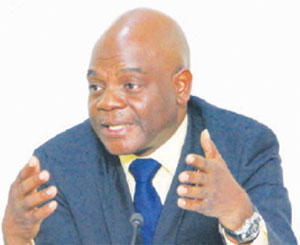
He does not come to you as an average Nigerian civil servant who commands enormous power as a Permanent Secretary. For Sonny Echono, the permanent secretary, Federal Ministry of Agriculture and Rural Development, humility is the hallmark.
 In the course of having this interview, Echono delivers his points lucidly saying that the investors and stakeholders in the agricultural sector need information in forming perspectives about the innovative interventions of the Ministry where he is serving, supporting the reforms being led by Dr. Akinwumi Adesina, as part of the Transformation Agenda of President Goodluck Ebele Jonathan.
In this interview, he talks on the mechanisation component of the Agricultural Transformation Agenda through which they have gone into a partnership with the private sector to provide mechanisation services to all Nigerian farmers.
Here is an excerpt:
On modernisation through mechanisation
The plan for mechanisation, which was conceived by the ministry, envisaged a number of expectations. First, we planned to create 800,000 additional jobs in the sector. Two, we want to bring 3.5 million hectares of additional land under cultivation.
So, we want to expand or increase production along this line. Three: 14,000 metric tons of additional food will be added to the national food reserve. Also, 10,000 million additional Nigerian farmers will now have access to mechanisation services.
At the beginning of the ATA, one of the goals we set for ourselves was to modernise Nigerian agriculture. We also wanted to, through that process, make it attractive to a new generation because, we are changing the demography of the Nigerian farmers. Our ageing farmers population, coupled with the need to employ the youths who are, today, unemployed, created the need to make agriculture very attractive and also creating more efficiency: hence Mr. President’s programme to introduce agricultural mechanisation into the country.
A number of progress has been recorded so far. We briefed earlier that Agricultural Equipment Hiring Enterprises (AEHE) centres have been established across the country. We are pleased to inform you that all the AEHE winners in the first batch have fulfilled their obligations and their equipment have been delivered.
The list of the beneficiaries is available for public scrutiny. But beyond that, additional 28 enterprises were also created through our various interactions with the states and other stakeholders such as the Cassava Growers Association.
On how it works
As at now, 118 of these AEHEs are on ground and will be running, just in time for the cropping season that is coming up right now. It will also interest you to know that this scheme is conceived purely as a public-private partnership.
Government is promoting it , but it is entirely private sector-driven. We know of the efficiency that the private sector has to bring to the table. Government is providing guarantee and some form of funding through the Bank of Agriculture that will be recovered. For emphasis, this is a private sector-driven programme.
Under the overall scheme, we intend to establish a total of 1,230 units. These units will have those tractors, threshers and planters. So, it is a full complement of mechanisation structure. We are not just putting tractors out there.
And we are dealing with direct producers of these equipment because we also want them to be sustainable. It comes with a package of spare parts and maintenance programmes. We have even gone into a scientific scheme we have designed to the point that it will attract each of these tractors and, at each point in time, we can tell which tractor is where, which one is operating, which is working, how many hectares has it cultivated.
This is an integrated scheme that ensures the returns on investment both for the investors and also enable the banks and other stakeholders to know the performance and to gauge the actual effective demand before we expand into the subsequent schemes.
The initial funding we got for this was through the courtesy of Mr. President. But we are also expanding this to involve commercial banks, and other development banks. We are also inviting state governments to participate in the scheme. We have advertised for expressions of interest in this regard.
On our target of 1,230, we intend to do this within three years or a maximum of four years time frame to ensure that the entire country is covered and also that no farmer will need to go more than 10 kilometres from his farm in trying to access mechanisation services across the country. Given the level of support we are getting for the scheme, Mr. President, at the launching of the scheme, recently, did promise additional funding for this programme.
Once these funds are available, we are going to fast-track the implementation: and in no distant future, Nigerian agriculture will be modernised.
We are going to be addressing the entire value chain. We started by addressing inputs, making sure that our farmers have the right seeds, have the right fertiliser, pesticides, and other chemicals. Now, we are moving into preparing the land, to ensure that they get good yields.
We are also moving into post-harvest. We are talking about threshing. We are talking about storage. We are talking about aggregation centres. So, we are addressing the entire value chains of agriculture. And we are right on course. I can assure Nigerians that, given the current support, and continuity in programme implementation, we will get there.
Getting the equipment is not done through the normal procurement in the usual form of government buying tractors and keeping them and allocating them. This is a private sector initiative. We have a situation where we have only those who produce tractors. They manufacture or, through their vendors, provide them.
Government is handling three things here. First, the seed fund that is on-lent to the operators is provided by government through the Bank of Agriculture. Then, we have these Agricultural Equipment Hiring Enterprises. They can help young Nigerians engage in business of creating tractor hiring services.
They put part of their money down, as down payment, but access a portion of these funds provided by the Bank of Agriculture to pay a deposit for the tractors. The manufacturers and owners of the tractors will have a stake in it. So, they also contribute to the cost of the tractors.
We are creating an ecosystem where everybody is participating and everybody has a stake. That is why you ensure that the manufacturer of the tractor will ensure that the tractor works well, because we are discussing availability. He also has an obligation to maintain those tractors. He has an obligation to provide the spare parts for those tractors.
On how subsidy work
So, government did not buy the tractors to sell. Government only makes funds available. Also, there is some element of subsidy that will come into it in terms of support. Otherwise, the actual seed funds will be recovered. That is what we are going to use for subsequent phases of the scheme.
So, it is a facilitation thing that is going to be owned by the private sector, through a partnership with the manufacturers of these equipment and those who are going to operate them.
Most of the support that government will actually be putting into the scheme will come by way of the benefits to the farmers, because we are saying when our farmers now use these tractors in the preparation of the land, they will not be paying full market value or the current market value of getting mechanisation services.
So this is the only aspect that government is actually subsidising: that the farmers will be able to get access to mechanisation services at a subsidised rate for them to be able to increase the land under cultivation and also to increase yields across the country.
It is unnecessary giving figures of what government is providing because it is not equal to the cost of the tractors. It is just the fund that is set aside there, and it is a rolling fund.
For the small holders to benefit: first, this was done through extensive consultation with the farmers. First, over the last few years, we have registered over 14.5 million farmers across the country.
We have also been able to deliver inputs to nearly 8.5 million of these farmers. So we know our farmers. We know where they are. We know the concentration of farmers. We know the type of crops that they plant. So, through consultation with them, we were able to determine where to locate these agricultural equipment hiring enterprise centres.
Each centre will have a minimum of five tractors, with accompanying implements. And they sell in a particular geographic area. So the farmers within that area become their primary customers. It does not stop you from meeting additional demands outside your bracket.
But, for our own subsidy programme, farmers who are registered within the location where you operate become our primary customers. So when you provide these mechanisation services to them, we know, because we already developed our electronic wallet system.
We are also going to make credit available to farmers, similar to what we do in other inputs like fertiliser and seed that they can utilise for the mechanisation services. So, the primary beneficiaries are the small scale farmers who are those we registered.
So, if you are going to derive any benefit from this, the first step is to ensure that you are in our farmers’ database: which means you have to register as a farmers in order to benefit directly. It is something similar to the GES.
We have smallholder farmers, but they also aggregate. It is the knowledge that, on their own, because of the small size of the farms that they have, it will not even be economical for them to own tractors. They may not also be able to afford the cost of a tractor.
What we will be subsidising is a specific percentage of the cost. The project level is 50 per cent, as we are doing under the GES. So, gradually, we will begin to reduce. This is how subsidies are done across the world.
When you introduce it, it is at its maximum. But when farmers begin to see the need for it, and the benefits, they will also be willing to make additional sacrifice. Gradually, as we also expand, serving more farmers, the volume of subsidy will be increasing. So, as the number of farmers increase, we will also gradually begin to reduce the level of subsidy so that it remains sustainable and we can go through it again.
Innovation at work
That is why we decided on the aggregation. We are working also through farmers associations, through farmers’ cooperatives. We are encouraging our farmers to come together as groups that will make things a lot easier for them. That is why there is a need for aggregation centres, which is also part of the business of the value chains.
Even when they all grow their small crops, when it comes to time of harvest, we encourage them to put all of them together so that you don’t have like a rice miller, for example, going to 100 small farmers to buy small quantities of rice paddy.
You aggregate them together. They know what quantity each farmer is contributing and when they sell them in bulk, they also distribute the benefits along this line. It is the same mechanism we are using for farm mechanisation. One tractor can be farming for six farmers on one date.
But each person knows what size of land is cultivated by that farmer, and that is the benefit. They pay a portion of it. That is why they will make sure that you are not going to inflate whatever you clear for them. So they pay a portion. That portion is registered in our system. The balance of it is what we pay as support for the farmer, which is what you can call subsidy.
On areas of implementation
Fund provided: For the take-off of the scheme, Mr. President graciously approved a sum of N3.6 billion for the ministry. Ultimately, a total of about N50 billion is earmarked for implementation throughout the implementation of the programme cycle.
This is supposed to be a revolving fund. As we recover, we put into subsequent use. We are very transparent in the whole thing.
Under the first phase, the first set of 80 selected have their details, which can be made available for the public to cross-check.
Among those who are already benefiting, we have Yobe State, for example, as one of the states that can be classified as having security challenge. We try to do it all across the geo-political zones. We have in Adamawa and in Borno states. Right now, Taraba and Ebonyi are benefiting.
On the current coverage
In the mechanisation spread, by the time we do 1,230 centres, we would have covered all the 774 local governments in the country. Nearly every local government will get at least one centre. Currently, we have a minimum of one per state and a maximum of five, to ensure that we have sufficient spread among the states we are doing in the first phase.
The second phase is already running. We advertised it because we want to afford all Nigerians the business opportunities. We want all Nigerians who are interested in this, who meet the criteria set, to participate. And that advert has been out there.
Each centre will have a minimum of five tractors, five power tillers, two rice harvesters, three rice threshers, two maize shellers, and so on.
It is a full complement, not just the tractor. In total, we are discussing about 2,000 power tillers, 3,400 of harvesters and other equipment that are currently already deployed. Zamfara, Oyo, Ondo, Ogun, Adamawa, Ondo, Taraba, Edo, Benue, Plateau, Kaduna, Niger, Lagos, Kebbi, Katsina, Nassarawa, Akwa Ibom, Gombe, Kano, Bauchi , Kwara, Cross River, Osun and Borno are states that are currently covered.
On operational details
That is why the numbers will vary from state to state. If you go to typical agrarian states where most of the people are farmers, you are going to have more numbers than if you go to a state that, may be is riverine, or other activities are predominant.
This is the way it is going to go. The subsidy to each farmer will depend on some factors because we don’t want the operators to cheat our farmers. Along with them and the farmer association, we agreed on cost per hectare.
This will vary from location to location. As we know, some have thick forest, some semi-arid desert, where the vegetation is not that much. Some are virgin ground, for example. Some have been cultivated in the past, so they are secondary forests, and so on.
We added implements such threshers, planters to be used after preparing your land. When you want to plant your seed, what our people do now is that they use local means.
Meanwhile, if you use the planter, an individual will do more than five hectares in a day. Why do you have to call your friends to assist on the day of planting? With the planter, one person can even plant three farms in one day.
So, we introduced the planters, particularly for the rice and wheat farmers, it is not only during preparation that we need tractor. We all harvest at about the same time, so we don’t have enough labour to go to everybody’s farm to harvest. So we need harvesters. We need threshers to remove groundnuts and maize from their stalk. And you do it at speed. So, we incorporated these elements.
We have a cropping season. Maize has already started in the south. It is moving northwards. So, the cropping season for the north is right about now. We have deployed four centres to Zamfara State to cover various implements and harvest and post-harvest equipment.
There was a security report from Zamfara State about losing all their farm traction. Immediately, we had to save the dry season farming. The four centres were deployed into four senatorial zones, including the state capital.
We are doing land preparation for 7,500 hectares for all the farms. We have over 3,000 farmers benefiting from this scheme. That programme was an emergency call because they lost all their animal traction and equipment to community problems. Immediately, it was released to them and that is working..
On partnership, counterpart roles and ownership
On the mechanisation support: currently, at the introduction stage, the federal government is bearing the cost. But we have advertised, and we have also approached the state governments to join us in partnership, along with commercial banks to implement the scheme.
When the schemes come on board, we will agree the sharing formula for the remaining fifty per cent currently being borne by the federal government. Farmers will bear 50 per cent too at the initial stage.
We want ownership. We are very transparent about this. We want Nigerians who are interested to participate. In the criteria set out, there are facilities you must provide to be eligible for it. There are other obligations on locations, which must be accessible.
The minimum staff requirements, and so on, all are set out in our Expression of Interest document. We also want to be able to match those who are expressing interest with the locations where we have our farmers.
This is not something you go and set up in Alaba market or in Dei dei. We want to be sure that the market or effective demand exists where you want to operate it. We are also trying to exercise some moderation because we don’t want a situation where only FCT will have over 50 people. We must have some level of spread,
Costing: This is a PPP. We went into the partnership with banks, the off-takers, and the federal government. Given at an average of N7 million per tractor, that will give you close to about N9 billion.
The total package of the intervention is coming in three phases, The phase one comes with 400 units of tractors, giving us about 80 centres. We had an additional funding from the cassava intervention programme, giving us 190 units of tractors.
That is why we have 590 units of tractors for the first phase. When we move into the second phase, whenever we receive the first 20 per cent of equity contribution and the refinancing window, we go back with the same funding to make another 400 units of tractors available, till we deplete the N4.5 billion given to us.
The ministry is using N4.5 billion to execute a project of N11.5 billion. The remaining balance is coming from the private sector section of the investment. In terms of the GES, we sectionalise the GES aspect to farmers. If you are a farmer, you have one hectare, and we are providing the mechanisation service delivery to you, you will get 50 per cent discount, It is meant for small scale holders.
Disclaimer
Comments expressed here do not reflect the opinions of Vanguard newspapers or any employee thereof.