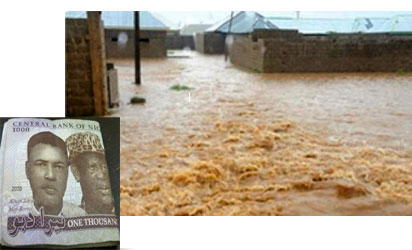
Research suggests that flooding poses a threat to roughly 21 million people across the world every year, costing the global economy roughly $90.65 billion, with the potential for an estimated six-fold increase over the next 15 years.

Data provided in connection with the launch of a new flood mitigation platform, the Aqueduct Global Flood Analyzer tool, co-developed by the World Resource Institute (WRI), Deltares, the Institute for Environmental Studies of the VU University Amsterdam, Utrecht University and PBL Netherlands Environmental Assessment Agency, highlights the economic severity of global flooding and its potential rise.
The research, conducted by the co-developers of the tool found that by the year 2030 a startling 54 million people will be exposed to flooding, causing the annual global economic cost to hike significantly, from the $90 billion seen today to around $513 billion per-year. With this in mind, Aon Benfield’s catastrophe modelling division, Impact Forecasting states that global insured losses from flooding over the last ten years average approximately $9 billion per-year. So a near six-fold increase could take average annual global insured losses from flooding to a staggering $54 billion, or greater, by 2030.
Hessel Winsemius, a researcher at Deltares and Philip Ward, a senior researcher at the Institute for Environmental Studies of the VU University Amsterdam, discussed the new tool and global flood resilience in a recent blog. Part of which read; “It will take decades and many billions of dollars to protect the tens of millions of people at risk from river floods and coastal storm surges.
But starting now and following the direction of tools like the Global Flood Analyzer will help decision makers in international relief organisations, reinsurance companies, multinational company and many others build advanced protection systems to protect people and infrastructure.” The WRI describes the new tool as aiming to “raise the awareness of flood risks and climate change impacts by providing open access to global flood risk data free of charge.”
Disclaimer
Comments expressed here do not reflect the opinions of Vanguard newspapers or any employee thereof.