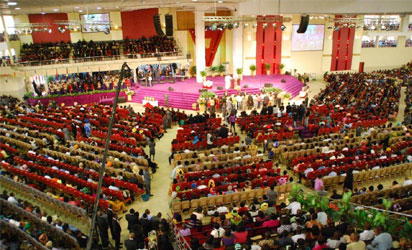
A cross section of worshippers at the closing service of Kingdom Life Conference.
*Being excerpts from a lecture delivered by Prof. Gabriel Yomere at Jubilee Word Festival of Word of Life Bible Church, Warri.
The relationship between religion and politics is a historically complex sub-ject and a frequent source of disagreement through-out the history of religion even in our 21st century. Some schools of thought hold the strong opinion that religion and politics should be allowed to operate separately without the one interfering with the other. Those who hold this view argue essentially from the position that religion mixed with politics is most likely to imbibe various vices associated with politics.
The other schools of thought, on the other hand, argue for a strong relation-ship between religion and politics. They anchor their arguments on social issues such as abortion, homo-sexuality, public education, etc. They conclude that if Christians hold responsible political positions the society will be better off for it because political power would no longer be the monopoly of those who might abuse it.
The objective of this dis-cussion is therefore to re-examine this age-old con-troversy with regard to the following issues:
- Should Christians take part in politics?
- Should Christians vote in general or local elect-ions?
III. Should Christians join political parties?
- Should Christians become elected represent-atives?
- Should Christians be involved in political dem-onstrations or pressure groups?
POLITICS AND RELI-GION
Politics is about the under-girding values that deter-mine how we govern our-selves or exercise power in the task of wielding the authority given to us. The Oxford Dictionary of words defines politics as “matters concerned with acquiring or exercising power within a group or an organiza-tion”.
Nkem Onyekpe (1998) defines the term politics as:- The struggle for power which itself is the authority to determine or formulate and execute decisions and policies which must be accepted by the society … it is the struggle for power of governance, especially executive authority.
The struggle for or the acquisition of power and the reaction of society to it
depend greatly on the level of political development of the nation. In an undemo-cratic society, it does not really matter whether the decisions and policies are accepted by the society. Thus the value of political power or policies leaves little or no room for the people to have input, except where democracy has been entrenched.
So the questions of power are always: who holds power: for whom and to what end? While it is possible to answer these questions of power from humanistic perspective, the moral dimension of power has not failed to assert itself. Indeed, there is always the problem of the source of authority and obligation.
Religion is intricately woven into the fabric of politics and provides the compelling touch stone of legitimacy or the love of the ruler by the ruled; the motive for exercising power; reason to be obeyed; the determination of the moral standards and the engine that moves governance (Kalu, O.U; 2003).
Consequently Kalu opined that the structure of gover-nment had tremendous im-pact on the modes of religious expression and religion could not there-fore be conjured out of politics.
The core values of true governance, as its concern religion cum Christianity are fundamental right, justices, fair play, equity, human dignity, equality, rule of law, equitable distribution of scarce re-sources, respect for con-ventions and norms, trans-parency and accountabili-ty, all wrapped in the total will of the people under God’s guidance. This spirit is also firmly and conspi-cuously entrenched in the constitution of the Federal Republic of Nigeria through its preamble:
“We the people of the Fed-eral Republic of Nigeria; having firmly and solemnly resolved to live in unity and harmony as one indivisible and indissoluble sover-eignty Nation under God.”
Thus, the constitution leaves no one in doubt that it is made for a moral and
religious people under God.
WHY CHRISTIANS STAY OUT OF POLITICS
- Politics is Dirty.
One of the objections put forward by Christians get-ting involved in politics is that politics is dirty and corrupt. Therefore it is in the interest of Christians to distant themselves from politics lest they become contaminated.
In point of fact a good chunk of the Old Testament of the Bible is devoted to politics.
Even some of the New Testament heroes involved themselves in politics. Luke 3:14 shows John the Baptist addressing numerous ethi-cal issues with King Herod. He was seeking to make politics clean. The Centu-rion, Zaccheus the Tax collector, Sergius Paulus and a host of others were involved in politics as Christians in seeking to be salt and light in society. By the way Matthew 5 says that if we aren’t salt and light,we are good for no-thing but to be cast out and trampled underfoot of men. Expressed in order form words; if the church did not get out there and do something, the human-ist would dominate. We would be under their feet, under their authority.
Distinguished ladies and gentlemen, Politics is dirty because Christians have refused to be involved.
- Business of Christian is Soul Winning
Some Christians argue that politics is not the business of the Church. The
sole task of the Church, according to this school of thought, is to “preach Christ’, win souls, and getting people to heaven. They consider this task as
being more important than trying to straighten out a falling world.
I think all we need here is faith to reverse a falling world besides before God nothing is impossible. Jonah’s message of repent-ance may have seemed impossible when he came to the wicked city of Nine-veh. Yet that entire city repented because he did what he was supposed to do.
When Zaccheus the Tax collector was saved he immediately started to change the way he did business.
It may interest you to know that this terrible slogan of “Church should concern itself only about salvation” is the handwork of Adolf Hitler. According to Adolf Hitler; “I will protect the German people; you take care of the Church. You pastors should worry about getting people to heaven and leave this world to me.”
Brethren, this misconceiv-ed theology of Hitler must be resisted. The Bible made it abundantly clear in Psalm 24:1 that “The earth is the Lord’s and the fullness thereof’. Should we retreat from that which God claims as His own? Cert-ainly not.
- Discouragement
Christian’s values are regarded as a rich source of renewal and empower-ment in a political system. It is therefore expected that Christians in government could bring about Christ-ian ethics and moral doctrines to play and thus human dignity.
However, with respect to Nigeria it is argued that these hopes and expectat-ions are initially there at the very beginning later turn to canal ambition. Examples abound where Christian politicians in legislatures,
executives, judiciaries and bureaucracies throw aside their moral values when discharging their official duties. In its lamentation this school of thought claims perhaps it is not God’s purpose for us to enjoy social justice in our present age. Others are quick at jumping into conclusion that these Christians have failed because Christ hasn’t given us sufficient grace to succeed.
The spies who went into the land of Canaan could only see the giants in the land and they saw them-selves as grasshoppers. They were so discouraged that they refused to believe that they could conquer the
land. Now Joshua and Caleb saw the same giants, but their focus was not on the giants; it was on the greatness of God, and they triumphed.
We will continue to be discouraged if we operate in our own wisdom and strength. But greater is He who is in us than he who is in the world.
- Political Activism not The Purpose of Church
The Church’s unique God -given purpose does not lie in political activism. That the mission of the Church lies not in changing the nation through political reform, but in changing hearts through the Word of God, only as the hearts of the individuals in culture are changed by Christ will the culture begin to reflect that change. Expressed in another form those advo-cating this idea are can-vassing for the separation of state and Church. The growth and influence of Christ cannot be aligned with government policies as politicians could use the platform to corrupt the mission of the Church.
Disclaimer
Comments expressed here do not reflect the opinions of Vanguard newspapers or any employee thereof.