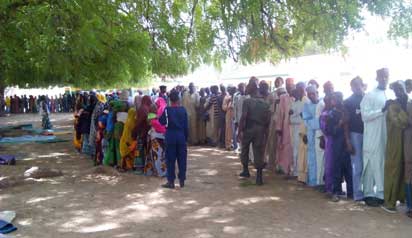
Displaced Chibok people in a camp in Kuje
By Suzan Edeh
Bauchi — The United Nations High Commissioner for Refugees, UNHCR, in Nigeria, is currently training 35 persons on both practical protection skills and the legal framework governing Internally Displaced Persons, IDPs.
The Director of the UNHCR, Mr. Herve Kuate made this known, yesterday, at the opening ceremony of a three- day training workshop on IDPs practical protection skills organised by the agency in Bauchi.
According to him, the training was targeted at staff from the National Emergency Management Agency, NEMA, in Gombe and its affiliates like the State Emergency Management Agencies, SEMAs, from the areas hosting IDPs.
“Participants will also be schooled on UNHCR Mandate and its role in IDPs protection in North East and they will be drawn from the local government areas concerned with protection related- issues such as health, social affairs, education, women affairs as well as community leaders and traditional rulers.
“The training is the second in a series of the six planned by UNHCR for the Northeast region. The last training focusing essentially on Camp Coordination and Camp Management, CCCM, targeted NEMA, SEMAs, local NGOs, the Red Cross and other actors involved in CCCM was held in December 2014 in Bauchi,” he said.
Kuate noted that the training was also in line with UNHCR’s resolve to fully support the government in its responsibility by intensifying UNHCR‘s activities in favour of IDPs collaboration with sister UN agencies as well as other humanitarian actors involved in the displacement crises in the North East in particular and in the country in general.
In his remarks, the Head of Operations in NEMA activities in Bauchi, Gombe and Taraba states, Saidu Ahmed described the training as timely in view of the increasing influx of IDPs into Bauchi and Gombe states.
Ahmed expressed optimism that the training will boost capacity of the humanitarian actors in the region as well as ensure protection of vulnerable groups, particularly women, children, the aged and physically challenged from abuse, exploitation, neglect and harm.
Disclaimer
Comments expressed here do not reflect the opinions of Vanguard newspapers or any employee thereof.