AMID overwhelming suspicion that the readjustment of Nigeria’s general election calendar by the Independent Electoral Commission, INEC, was done to sway political momentum in favour of a political party, an in-depth analysis, reveals that the aftermath of the decision has so far been characterised by profound gains and losses in some key areas.
IT was of course not the first time that elections were postponed in Nigeria. But there was no doubt that the rescheduling of the federal and state level elections took Nigerians to an edge.
So contentious was the action and tensed the days that preceded February 14 that the proponents of change and continuity in the polity were enveloped by the fear of uncertainty. In the end, the postponement helped to douse the tension, albeit for a while.
Amid the tension was the claim in some critical sections of the polity that INEC was pressured by the presidency to reschedule the exercise for March 28 and April 11 respectively.
In spite of denials by the presidency and the electoral umpire, the impression is apparently still being held particularly by those, who argue that the fear of imminent defeat on the part of the ruling Peoples Democratic Party, PDP, informed the postponement.
Opposition leaders say that all the reasons adduced for the adjustment of the polls do not hold water and that the postponement was mainly meant to stave off defeat for the PDP.
PDP officials and security chiefs were, however, quick to point at what they alleged as the poor preparation of the commission as expressed in the poor distribution of the voter cards and the spate of insecurity in the northeast.
Official and unofficial reasons

INEC official displays an empty ballot box
On the trail of these are three key concerns that prominently border on the following; the likelihood of Boko Haram remaining a threat as the new election date approaches, possibility of further postponement and sacredness of the May 29 handover date.
Findings by Saturday Vanguard in that regard revealed that while the acclaimed objectives of the postponement are being achieved in key areas, some incalculable losses are being recorded in some areas.
Specifically, the conspicuous dividends recorded in this light include; impressive victories over Boko Haram insurgency, improvement on the rate of PVC collection, training of INEC ad-hoc staff, resolution of the controversy over use of Card Readers, opportunity of further campaigns among others.
On the negative side, analysts are quick to point at the financial burden of additional campaigns and advertorials, plunge in the stock market among others.
What has happened since the postponement?
– Victories over Boko Haram
In the two weeks since the postponement, the military has scored a number of victories over the Boko Haram insurgents and liberated a number of cities hitherto held by the terror group heralding a turning point in the nearly six-year-old war.
Pointedly, the army recaptured key towns such as Gamborou Ngala (rescued by Chadian forces) Baga, Baga and Monguno, Gajigana, Ngaze, Ngenzai, Marte Junction, Mile 90, Yoyo, Kekeno, Kukawa, Cross Kauwa, Kangarwa, Amirari , Kichimatari, Borokari Barati, Kauwa among others.
So remarkable are the conquests that those, who saw Nigeria’s response to the crisis as ineffectual, are beginning to describe the triumphs as the needed game changer.
Even President Goodluck Jonathan who was criticised for showing little empathy for the people of the region even visited the region last Thursday following the liberation of Mubi and Baga.
Supporters of the president hope that he would garner more support through the successes recorded in the theatre of operation in the Northeast.
Rate of PVCs collection
As at when the election was shifted, the rate of PVC collection in the country was pegged at 66 percent. The rate of collection has, however, increased and as at last Wednesday, reached 77% considered by some to be acceptable even if the rate of collection is not uniform across the country. Zamfara State according to INEC has the highest rate of collection of 97% while Ogun with 40 % collection rate has the lowest.
Training of ad-hoc staff
Contrary to some reports that the training of ad-hoc staff had not commenced prior to the postponement, Vanguard reliably gathered that training had actually been done for some categories of staff.
The Public Affairs Officer of INEC in Lagos State, Mr Femi Akinbiyi, exclusively told Saturday Vanguard that: ‘’Before the postponement of the election, we trained some of the staff on how to carry out their duties. We will also commence another phase of training by next week. The main training will be done two weeks to the election date so that they can be able to perform their functions without challenge. Those who had been trained before would also be retrained to ensure good productivity.’’
Results of further probe also indicated that training commenced across the state before now. For instance, the training of master trainers among the ad hoc staff, who would train others, has commenced.
Card reader controversy
The feasibility of using the card reader, an electronic device introduced to minimise rigging in the political process was also in doubt long before the postponement.
That controversy is yet to abate with the PDP and the APC unwavering in the opposition and support of the device.
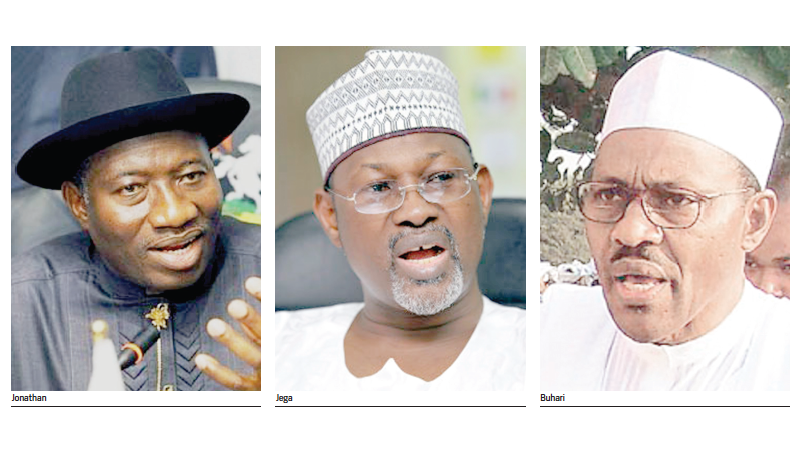
There was no doubt that before the postponement that many Nigerians were ignorant of the capacity of the card reader. However, the change of date has given the commission the opportunity to lecture stakeholders more on the usefulness of the device. Jega was at the Senate where he defended the use of the device and insisted that it would be used for the election.
He disclosed that the commission had so far procured about 180,000 readers sufficient.
Opportunity for further campaigns
Though the delayed election was the least thing most Nigerians expected, the opportunity has opened a window for politicians who had not sufficiently reached out to the electorate to do so.
For the presidential candidate of the PDP, whose campaign machine had been faulted for its poor communication strategies, the postponement was an opportunity to retool the communication strategies. The president is believed to have also reached out beyond the formal structure of the party to genuine friends who have lately been able to push the president’s message more successfully than the official campaign and PDP national secretariat.
However, time remains of an essence for the president. The postponement also enabled the APC presidential candidate get a needed rest from the daily campaign hustle as he was able to take a breather in London. Buhari’s visit to London which commenced last week also enabled him to brush off his international acceptability. The candidate delivered a lecture at Chatham House last Thursday to a critical acclaim from both critics and supporters underlining his readiness and capacity to take over leadership of the country.
Economic implications
Saturday Vanguard further found out that many electioneering activities that require huge funding have either ceased or shrunk considerably. The worst hit in this regard are; media houses, event planners, election monitors and the candidates.
The EU experience
The experience of the European Union, EU, election monitoring team, highlights the plight of other stakeholders as a result of the deferment.
From inception, the EU had budgeted €4.4 million (N10.5 million) for the purpose of keeping its team in the country for the February 14 and 28 polls. Following the shift, it now requires additional €1.8 million (N429 million)
Although some of the officials temporarily left following the postponement, investigations revealed that some others stayed back despite the financial loss.
Plunge of the stock market
In what appeared as a confirmation of the fears of anti-postponement analysts, the first casualty was the stock market. Less than a week after the shift, the Nigerian currency plunged to a record low against the dollar while stocks continued their declined.
The currency fell to just over 196 to the dollar in interbank trading, far below its officially traded bracket. The Nigerian Stock Exchange All-Share index also dropped 0.4 per cent, extending its decline this year to 14 per cent, the worst performance in the world after Ukraine.
The trend has continued with the exchange rate is now officially N197 and N225 at the black market as at February 26, 2015. To observers this does not sound surprising, considering the fact that both local and international investors need stable macro-economic environment and non-volatile socio-political atmosphere for investment decisions.
Negative signal about the country’s democracy
The country’s budding democracy is also seen as one of the big time losers, given that both local and international stakeholders saw the move as political interference with INEC’s duties. In a move suggestive of the mood across the globe, the United States of America lamented its disappointment over the move thus: ‘’The United States is deeply disappointed by the decision to postpone Nige ria’s presidential election, which had been scheduled for February 14. Political interference with the Inde pendent National Electoral Commission is unaccept able, and it is critical that the government not use se curity concerns as a pretext for impeding the democrat ic process.
Commenting on the matter, presidential candidate of Citizens Popular Party, CPP Chief Sam Eke and former National Secretary of Inter-Party Advisory Council, IPAC, told Vanguard that the losses are two-pronged, even as he acknowledged the existence of some advantages.
“The losses are basically in the area of the financial burden which it placed on the parties. At the time the decision was taken to shift the elections, most of the parties had concluded their campaign. Knowing how expensive open campaign could be, the parties now spend extra to keep their massages alive.”
“Some lives have also been lost as a result of the postponement, so the implications are not only financial. However, it has afforded INEC and most parties the opportunity of getting things right. With what we have on the ground, I believe that the conduct of the elections will meet international standards. We are only appealing for calm because power comes from God and not through questionable means.”
Disclaimer
Comments expressed here do not reflect the opinions of Vanguard newspapers or any employee thereof.