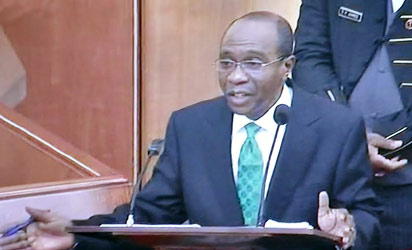
Mr Godwin Emefiele answering questions during his screening by the Senate for Central Bank Governorship in Abuja on Wednesday
By Akintola Omigbodun
The current controversies between a former Governor of the Central Bank of Nigeria, CBN, and the serving Minister of Finance have opened our eyes as to how policies are put in place and how they are implemented in Nigeria.

Mr Godwin Emefiele
If the electorate want a policy to be implemented, we must get the attention of the President, the Vice-President, the agency that would implement the policy and the National Assembly if the policy requires new legislation. One of the things that would require urgent action by whoever emerges as President on 28 March 2015 is the amendment of the Banking and other Financial Institutions Act, BOFIA.
Following on the banking failures of the 1990s, BOFIA was amended to include provisions for criminal prosecution of bank officials who do not follow stated and prudent procedures when granting loans and advances. The Minister of Finance should consider further amendments to BOFIA such that recovery of loans granted in contravention of the rules would be by civil action and a resort to criminal prosecution would be in cases of gross negligence on the part of the bank officials.
Criminal prosecution has not shown results in matters relating to bank loan recoveries and substantial government funds alleged to have been improperly removed. However, prosecutions involving much smaller sums are readily brought to a conclusion. Anyone facing a criminal charge can ask for the charge to be quashed without a trial. If the request to quash the charge is not granted, the person can appeal against the decision of the court and the prosecution of the charge is halted until the appeal process is completed.
Democracy rests on the principle that legal processes must be open and public. Laws are tolerable if people can readily discover what the rules are and if there is equality of treatment for all before the law. There is need for a constitutional amendment such that when there is a criminal charge, there must be a trial of the charge with the judgment delivered before there could be any appeals on any matters related to the trial of the charge.
The CBN grants operational licenses to banks and it has limited its role to the protection of bank depositors. The result is that shareholders’ funds continue to be under considerable threat from loan losses. The presence of two jack-up oil rigs in the Lagos harbor is demonstration of the impact of the Assets Management Corporation of Nigeria, AMCON. The investments in these rigs were made from bank loans in 2007 and it is apparent that the investments have failed.
AMCON acquired from the bank the loans associated with these oil rigs thus making it possible for the bank that granted the loan to make a one-time loss rather than carrying the losses on the loan from one year to the next year. AMCON has now called into question the ability of the company operating the rigs to remain in business, hence the rigs are in the Lagos harbor. The bank that granted the loan is also a major shareholder in the company operating the rigs. There would therefore be further losses for the bank’s shareholders. Why should an investment worth more than 10% of the bank’s shareholders’ funds at the time the investment was made fail within 7 years? Did the bank not understand the risks it was taking?
Disclaimer
Comments expressed here do not reflect the opinions of Vanguard newspapers or any employee thereof.