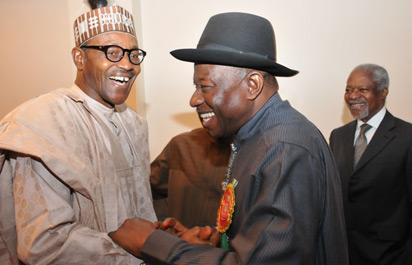
Jonathan and Buhari
By Michael Eboh & Sebastine Obasi
Opinions are varied as to why the two president aspirants have failed to clearly highlight their plans for the energy sector in their campaigns thus far. But stakeholders in the sector have warned the contestants against any plan to increase government’s control of the sector.
 The stakeholders, who spoke to Vanguard, argued that the current policies in the energy sector are adequate and capable of ensuring progress, adding however, that more efforts should be focused on developing the steel sector.
Both candidates have made a few, but not too significant mentioný of their plans for the energy sector. But noteworthy is that of the candidate of the All Progressives Congress, APC, the leading opposition party, Mr. Muhammadu Buhari’s promise to rein in the excesses of the Nigerian National Petroleum Corporation, NNPC, and tackle corruption in the sector.
A former NNPC boss and Chairman, Prime Energy Resources, Mr. Chambers Oyibo, the presidential candidates have not been saying much about the oil and gas industry because they don’t understand it. Besides, he added, they don’t want to scare away investors in the industry.
“If they don’t know much about the industry, they will not say much about it. They are not much because many of them are not businessmen. The technocrats, businessmen among them are not the frontline politicians. And the oil industry, I think they are very careful too. They don’t want to demonise the industry that is sustaining this country and make it difficult for foreigners doing business in the country or for banks. They do not want them to lose confidence in the industry.
“Many times they don’t even know exactly what to say about the industry. To me, I think that is why they are not saying much about the industry. They just criticize and without any concrete data,” he added.
For Dr. Boniface Chizea, of the Lagos Business School, Lagos, the presidential candidates don’t seem to have much to say about the oil and gas sector
He said, “There is not much to be said about this dominant and important sector of the economy. In point of fact, the campaigns have so far not been issue driven as most of us could have wished, and this development underscores the imperative for debates, because then, the candidates will have no choice but to discuss their agenda for the country.
“But what is there really to be said about the oil sector? I have heard promises made with regard to the approval of the PIB which is very important for the future of the oil sector, as it provides the ground norm and charts the way forward. As a matter of fact, therein is hidden the future of the oil sector, as it would re-orientate the operations of the NNPC for instance, to make it operate like most other national oil companies in the world. NNPC would have to adopt private sector templates in its operations; prepare its Annual Report and Accounts and declare a profit, and pay tax to the treasury, and generally avoid mismanagement which is the order of the day today,” he said.
Chizea further argued that the campaigns will become more interesting if the candidates could talk about Nigeria’s membership of the Organisation of the Petroleum Exporting Countries, OPEC.
“It will be most interesting if one of the candidates could stir the hornets’ nest by saying that he will work to terminate Nigeria’s membership of OPEC for instance.
“The other important matter is that it is common knowledge that the oil sector is undermined by corrupt practices, illegal bunkering, and leakages.
“Is there anything that could be said with regard to bringing that to an end? Other sectors related to oil and gas which are not now being fully tapped; the gas flaring and associated petrochemical products most of which the country throws away, the inherent opportunities because of the unfortunate practice of importing refined products. I have no doubt that there is more that could be said in this connection if the candidates are encouraged to do so under a debate umbrella,” he added.
Building on existing policies
But the Managing Director, HighCap Securities Limited, Mr. David Adonri, argued that the position of President Goodluck Jonathan on the energy sector is well known, as everything is encapsulated in the Petroleum Industry Bill, PIB.
According to him, the goals of the bill are to increase domestic participation in the petroleum industry, that is, increase local content, increase transparency and accountability, deregulation and privatisation.
These, he said, are laudable objectives that would enhance the fortunes of the industry if the bill is passed.
However, he said, “The full details of Buhari’s plan for the Energy Industry are still unknown. However, judging by his background and antecedence in office, his policies may be centered on government control of the industry.
“If he harbors such a plan, it may be retrogressive, and is better advised against it. The duty of government in the energy industry, henceforth, should only be regulatory.
“Concerning the electric power industry, Jonathan has already deregulated the industry and privatised state enterprises. Other than this, no other remedy can lead to Nigeria’s self-sufficiency in power supply.
“Since independence, under successive governments, the nation remained perpetually in darkness when electric power was supplied by government. Any attempt to reverse current policy on power Industry just like President Umaru Yar’adua did in the case of the refineries will lead to backwardness.
“The current policies on energy, power, automobile, and agriculture are progressive. If extended to the metallurgical industry, the road to acquiring the engineering infrastructure required for industrialisation would be opened.”
As far as the Principal Partner, Nextier Limited, Mr. Patrick Okigbo is concerned, “But for the declaration of the Transitional Electricity Market, TEM, and the Petroleum Industry Bill, PIB, the critical deliverables in the 2010 Roadmap for Power Sector Reforms have been accomplished. It is important that the successful presidential candidate maintains the momentum in the power sector to ensure the expected gains are accrued to Nigerians.”
“It would be great to hear the presidential candidates and their advisers discuss their plans for the full commercialisation of the power sector. It is a shame that the seventh National Assembly was not able to pass the PIB. Without the PIB, Nigeria will continue to suffer a loss of investments to other countries in the region that are expanding their oil industry.”
However, it is important to note that the leading parties, the People’s Democratic Party, PDP and APC, both highlighted their plans for the sector in their manifestoes, what remains to be seen is if they will be committed in carrying out these plans and programmes.
Party manifestoes on energy
Taking a looking at the manifestoes, ýthe APC promised to make the oil and gas industry and Nigeria, one of the leading/cutting edge centres for clean oil and gas technologists, scientists, mega structure installation, drilling, processing, production engineers supported with best services and research facilities.
It also plans to modernise the NNPC and make it the national energy champion, while also considering breaking up the NNPC into more efficient, commercially driven units, stripping it of its regulatory powers and enable it tap into international capital market.
The APC also plans to enforce the government master plan for oil companies to end flaring that pollutes the air and damages people’s health and also ensure that the companies sell at least half of their gas production within Nigeria;
Continuing, the APC said it plans to “Speedily pass the much-delayed Petroleum Industry Bill (PIB) and ensure that local content issues are fully addressed and also make Nigeria the world’s leading exporter of LNG through the creation of strategic partnerships.”
On the other hand, the PDP in its manifesto for the ‘Natural Mineral Industry’, said it is targeting the “judicious exploitation of Nigeria’s natural mineral resources. In particular, we shall emphasize the activities in the solid minerals sub-sector and restructure the liquid minerals industry.”
On its strategy for attaining this, the party said, “PDP Government shall: identify all solid minerals deposit in Nigeria; ascertain the commercial quality of each deposit, and set out a rational schedule of the exploitation; involve the private sector in the exploitation of the country’s mineral resources especially the exploitation for solid minerals.
Disclaimer
Comments expressed here do not reflect the opinions of Vanguard newspapers or any employee thereof.