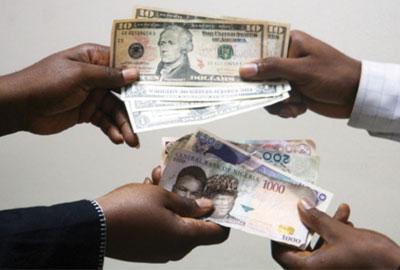
Naira-Dollar
By Henry Boyo
“In the medium to long-term, addressing truly economic transformation becomes imperative. Alignment between annual budget, medium –term framework and long-term national plan needs to be put in place; there should be a legal provision to issue dollar coupons to state governments as often advocated by economist Henry Boyo, to reduce or eliminate liquidity problems and bank’s dubious profits,” Sherriffdeen A. Tella.
The above is an excerpt from the con cluding part of a recently published article titled “Addressing Nigeria’s Bleak Economic Outlook in 2015″; the author Sherifdeen Tella, is a Professor of Economics at the Olabisi Onabanjo University.
Tella’s endorsement of our advocacy for a reformed payments system provides a refreshing reassurance that the totality of our minds has not become ensnared in a lethargic spell that restrains us from rational judgement, even when it pertains to the choices of the critical processes that determine the success of our economy and our chances of halting deepening poverty nationwide.
Sadly, the proposal for the adoption of dollar warrants coupons for the allocation of dollar derived revenue has been in the public domain since 2002. Indeed in August of that year, my colleague, Adiagofua Ojomaikre and I made a formal presentation on the beneficent economic multiplier impact of abolishing the “traditional” process in which the CBN unilaterally fixes a Naira exchange rate, before creating fresh Naira values as allocations in replacement of distributable dollars.
In our presentation to the National Economic Intelligence Committee (NEIC), we explained how this unfortunate payments strategy poisons the system and makes inclusive economic growth unattainable.
Not surprisingly, NEIC Council members to whom we made the presentation did not fault our observations and conclusions on the distortional impact of the surplus cash syndrome instigated by CBN’s monthly injections of hundreds of billions of additional Naira values into the money market.
They recognised such a payments process ‘inadvertently’ also engenders a systemic Naira surfeit which instigates disturbingly high rates of inflation as well as oppressive interest rates to the real sector, particularly the Small and Medium Enterprises which are the critical drivers of job creation and increasing productivity.
Over six months after the presentation, however, NEIC’s answer to our request, , for a feedback on the proposed further consultation with President Obasanjo and critical members of the Economic Management Team, was promptly given the following bewildering response in the their letter of 25th March, 2003, which read as follows: “The National Economic Intelligence Committee acknowledges receipt of your letter dated 8th March, 2003, on the above subject matter.
Also the two attached papers: Economists as Soothsayers and Nigeria’s Unlimited Supplies of Capital were received. The NEIC notes that you have already contacted Mr. President and the Governor of the Central Bank on the same subject matter. This development forecloses further consideration of your proposal by the Committee until Mr. President concludes his consultation on the matter.”
Subsequently, my colleague and I sent copies of the paper titled “A LIBERALIZED FOREIGN EXCHANGE MARKET: “A Proposal for a Liberalized Foreign Exchange Market in Nigeria and its Economic Benefits” to the Heads of Department of at least 12 Nigeria Universities for evaluation and feedback; sadly, there was no response or acknowledgment from our Ivory Towers, even though the mails were all delivered by DHL courier.
Indeed, the Head of Economics in a prime Nigerian University hurriedly shooed us out of his office, after we introduced the object of our mission. Similarly, NISER’s (Nigerian Institute for Economic & Social Research) concluding response to our paper in their letter of December 2, 2002 is as follows: “The study does not recognise the constitutional provision for the collection and maintenance of the Federation Account”.
Also, “The study suggests that earners of dollars (public and private) should be able to sell when necessary through their bankers. I think this may further compound the existing information asymmetry in the foreign exchange market especially, if for example, the three levels of government – federal, state and local governments – are allowed to trade with their revenue allocations (in dollars) at the foreign exchange markets through their bankers.”
Over 12 years have rolled by since our engagement with NEIC and NISER, and despite the unceasing advocacy in weekly Newspaper columns and countless interviews on Radio and Television, surprisingly, the Academia has remained totally mute despite of the clear reality that existing monetary strategies were taking us nowhere.
The foregoing may explain why I consider Prof. Tella’s recent public endorsement of the proposal for adoption of dollar warrants as a very courageous decision which probably distinguishes him as a true scholar with the pursuit of TRUTH as his Northern Star!
Hopefully, Tella’s intervention will bring forward other lovers of truth to support the adoption of a reform that has the potential of positively changing our lives, by throwing overboard the oppressive burden of ever surplus Naira so that low inflation and interest rates will become achievable to drive consumer demand and spur rapid industrial expansion with more job opportunities.
The Economic Management Team certainly recognises that high inflation and interest rates are the wrong medicines for an economy that has possibly over 50 million unemployed citizens, with youths constituting a high proportion of the jobless, but regrettably, the EMT appears unwilling to stand on the side of the people by also affirming that the adoption of dollar warrants will rapidly realign the forces for inclusive

Naira
economic growth in our favour.
Although both Prof. Tella and NISER raised an issue on the legality of the use of dollar certificates, I do not however see that such a payment process contradicts the provision in section 162 of the 1999 Constitution (amended). That section reads as follows: “The Federation shall maintain a special account to be called “THE FEDERATION ACCOUNT” into which shall be paid ALL REVENUES COLLECTED BY THE GOVERNMENT OF THE FEDERATION, except the proceeds from the personal income tax of the personnel of the armed forces of the Federation, the Nigeria Police Force, the Ministry or department of government charged with responsibility for Foreign Affairs and the residents of the Federal Capital Territory, Abuja.”
It is clear from the foregoing that CBN is vested with the responsibility for paying allocations according to ratios which are constitutionally enshrined but the Constitution certainly does not preclude States and other government agencies from operating a domiciliary bank account for the custody of their forex earnings. Indeed, if the laws currently permit every Nigerian citizen to operate a domiciliary account, it would be unconscionable for Sates and other agencies of government to be excluded from such liberty or privilege.
Save the Naira, Save Nigeria!!
Disclaimer
Comments expressed here do not reflect the opinions of Vanguard newspapers or any employee thereof.