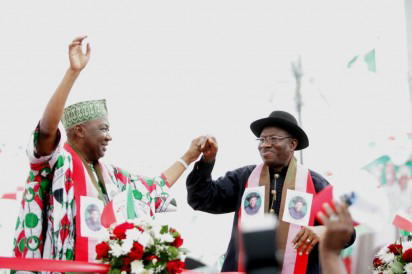
Nigerian President Goodluck Jonathan (R) and Nigerian Vice President Namadi Sambo greet supporters at a ceremony in Abuja on November 11, 2014. Nigeria’s President Goodluck Jonathan on November 11 declared his bid for re-election, vowing to finally defeat Boko Haram whose rise in strength during his first term has threatened the country’s sovereignty. The 56-year-old made the announcement to tens of thousands of supporters in the red, white and green of his ruling Peoples Democratic Party (PDP), at a carefully orchestrated ceremony including patriotic music, dancing, prayers and speeches. AFP PHOTO
Yesterday’s announcement of Arc. Namadi Sambo as the vice-presidential candidate of the Peoples Democratic Party, PDP was heralded by much intrigues and speculations within the Northern political establishment
By Emmanuel Aziken, Political Editor
AFTER dithering procrastination, President Goodluck Jonathan Wednesday night announced his decision to fight the 2015 presidential contest with the incumbent vice-president, Arc. Namadi Sambo as his running mate.
The decision was not largely unexpected even if there had been much apprehension in the Sambo camp over his continued stay on the ticket.
In the run-up to the announcement at least four outgoing governors had been strongly rumoured to be either angling or possible shoo-ins to replace Sambo, who had been largely flayed as almost bringing nothing of value to the ticket. But even where he was flayed for not bringing value, no one ever faulted the vice-president for bringing something negative to the ticket.
Successful businessman

Nigeria’s president Goodluck Jonathan (L) and vice president Namadi Sambo wave to supporters during a presidential primary in Abuja, on December 10, 2014.
A widely successful businessman before he was picked by former Governor Ahmed Makarfi as his chosen successor in 2007, Sambo was not a rooted politician before he became governor of Kaduna and three years later, he was handpicked as vice-president following the succession of the then vice-president to the presidency.
The similarities of the political track of Jonathan and Sambo are obvious. Both men spent very little period as governors before being chosen as vice-president. It was as such not surprising that they did not have sufficient time to build up independent political bases at home before relocating to Abuja.
As vice-president both men were not able to call the shots at home. It is easily remembered that as vice-president, Dr. Jonathan was indecorously humbled by Governor Timipire Sylva. When on February 28, 2008 the then vice-president as the highest elected official from Bayelsa State was invited for a meeting of the PDP state caucus with the governor in attendance, it was resolved to retain the Fred Agbedi led executive of the PDP. Agbedi was initially not a Jonathan ally having been a loyalist of Jonathan’s one time nemesis, Timi Alaibe. However, two weeks after the meeting, Sylva, it was alleged, unilaterally ordered the reshaping of the executive in his own image. Vice-president Jonathan was helpless and could do nothing about it despite entreaties made to Sylva by such powerful PDP figures as Chief Tony Anenih.
Vice-President Sambo has also had his own share of political humiliations especially on the electoral field where he has almost regularly failed to deliver his polling booth, ward and local government to the PDP. Indeed, it has become the practise of newsmen to watch out for results from where Sambo voted to splash on the headlines.
Given this electoral frailty it was not surprising that a number of stakeholders in the party canvassed for Sambo’s removal from the ticket. Their reason was that he was not bringing anything to the ticket.
Vice-presidents are supposed to balance a ticket albeit positively. Atiku Abubakar as vice-president had potential to rally votes and electoral fortunes for Chief Olusegun Obasanjo in 1999 and in 2003. Such advantages are said to be lacking in the incumbent hence the frenzy over his possible retention.
The speculations dated back to the beginning of the push for another term for the president. Among the early names mentioned were Governors Isa Yuguda of Bauchi State and Ibrahim Shema of Katsina State. Yuguda who was a very close ally of President Umaru Yar‘adua was in some cases alleged to be lobbying for the position, a situation that made the governor to deny it.
But it was doubtful if the core Jonathananians would have in sincerity worked harmoniously with Yuguda given his alleged membership of the cabal that sought to keep Jonathan away from the presidency during Yar‘Adua’s last illness.
Governor Shema was, however, a more welcoming consideration given the alleged beef between him and the members of the Yar‘Adua cabal. Shema and Jonathan were almost equally loathed by the core elements in the cabal who came from Katsina State. It was a popular saying in Abuja before President Yar‘Adua’s last illness that Shema was not going to serve a second term.
Major disadvantage
However, in the debate over his eligibility for vice-president a major disadvantage was the Buhari question. The fact that Buhari is from the same Katsina with Shema made it politically tactless to replace Sambo with Shema who is almost certain to lose the state’s presidential vote to the very popular Buhari.
Governor Babangida Aliyu was also speculated, but the governor’s vocal instability did not help his cause and not surprisingly, with the signs clear before him, he quickly grabbed a Senate ticket.
Governor Sule Lamido of Jigawa State was a more probable replacement given the governor’s political strength at home and national recognition. Just like Shema, he is considered among the best performing governors in the country. However, his overwhelming political clout and past differences with the president, especially in his grudging acceptance of the president’s second term made it unrealistic.
Some even alleged that Lamido was stepped down because Jonathan like some presidents before him did not want a strong vice-president.
In the end, the president yesterday morning decided to stick to the harmless Sambo. Now the circus show on Sambo’s polling booth would be on again on Election Day next February.
Disclaimer
Comments expressed here do not reflect the opinions of Vanguard newspapers or any employee thereof.