By OSA AMADI
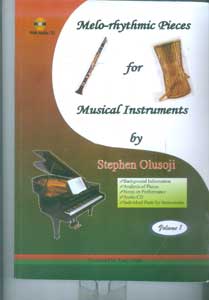
Musical literacy is a barrier between a book like Dr. Stephen Olusoji’s Melo-rhythmic pieces for musical instruments and millions of its potential readers. But that barrier has been largely removed by the author’s effort in recording the performances of the pieces contained in the volume and attaching the audio CD to the book.
So, even if one cannot read music, one can enjoy the masterpieces by listening to the audio CD. Besides the audio CD, the background information and analysis at the beginning of each piece creatively written by the author is a rich source of aesthetic enjoyment for the reader and listener.
However, the greatest beneficiaries of this exceptional musical labour of Dr. Olusoji are the instrumentalists who can read musical scores – music students, music teachers, and other music lovers who have been tutored in the art of reading and writing music.
As has already been revealed by the title of this review, Dr. Olusoji is a complete historian who uses classical music idiom as his raw material. More than in any other piece in this volume, he proved it with the composition titled Wa-zo-bia.
Wa-zo-bia means come in Yoruba, Hausa, and Igbo –the three main Nigerian languages. Here, Dr. Olusoji, born a Yoruba, attended university (UNN) in Igboland, and did his National Youth Service in Hausaland, draws from the experiences he gathered about the lifestyles of these people during his sojourns with them. He tells the story of Nigeria, as would a historian, taking a sample of the entire population as a social scientist would in a survey, and coming across to the audience in the language of classical music.
The Yoruba are stately and majestic in movement. The northerners employ call and response in their music as well as yodeling, while the Igbos are war-like people who play and dance fast and vigorous rhythms. Please get this wonderful book and discover how Dr. Stephen Olusoji captured the socio-cultural lifestyles of these three main parts of Nigeria in this composition.
Other compositions grouped under Solo/mixed ensemble pieces include Theme and Variations on Yoruba school song, Ipade Ilu (Village meeting), Tiwa-n-Tiwa (Ethnomusicology), Meri Lomo Agutan Kekere Kan (Mary had a little lamb), and Ojo maa ro. Under orchestral pieces, we have Melo-rhythmic Nigeriana, premiered at the 9th annual international chamber music festival of the department of music/conservatorium, Stellenbosch University, South Africa, on July 7, 2012; Waka, Sakara, Nike Nike, Amazing Grace, Jesus a Child of time (for Christmas) and the Nigerian National Anthem.
The book is fore-worded by Tunji Vidal, professor of music and musicology, Lagos State University. With this book, Dr. Olusoji has made a substantial contribution to knowledge and music creativity.
Disclaimer
Comments expressed here do not reflect the opinions of Vanguard newspapers or any employee thereof.