By Uche Onyebadi
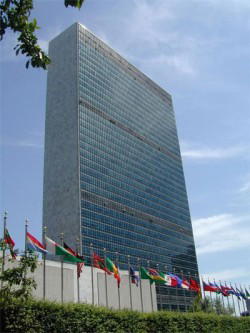
THIS time each year, heads of state and government from around the world congregate in New York for their annual ritual otherwise known as the United Nations General Assembly. This body is the main deliberative organ of the United Nations. Expectations are normally high that each of the General Assembly meetings will produce workable resolutions on how to move the world forward and make it a better place for mankind.
But each UN General Assembly meeting never disappoints its critics who say that the body is a mere talking shop, a podium that offers world leaders time for their fifteen minutes of global fame. Former Venezuelan president Hugo Chavez once delighted the critics when the highlight of his UN speech was the declaration that “yesterday, the devil was here,” a reference to the fact that former US President George Bush had addressed the Assembly the previous day.
Former Iranian president Mahmoud Ahmadinejad traditionally came to the Assembly to argue his pet thesis that the holocaust was only a historical phantom being propagated by Zionist Israel and its allies. Muammar Gadhafi of Libya made more news with his space-hunt to build his temporary residential tent in New York, and walking up to the podium to tear a copy of the UN Charter in a symbolic gesture that the United Nations was not a worthwhile organization. And two years ago, Israeli Prime Minister Benjamin Netanyahu tickled the world with his ticking-bomb graphics about the Iranians being on the brink of manufacturing nuclear weapons with which they would challenge global peace and security.
Will the heads of state and government take a different route this time and show more seriousness in tackling real issues of global concern? No one can say what will gain prominence as the 193-member General Assembly leaders meet for their 69th annual gathering. As they meet, it is obvious that the world has become less secure and more vulnerable since their last meeting in 2013. Since then, the menace of the so-called Islamic State in Iraq and Syria (ISIS) fanatics has gained center stage in global affairs.
With the U.S. and its allies putting together their war plan to challenge ISIS, there is little doubt that the brutal events taking place at the killing fields under the control of ISIS on the border between Iraq and Syria jihadists will preoccupy world leaders at the UN General Assembly. So might the activities of similar blood-thirsty organizations such as Boko Haram in Nigeria and al-Shabab in Somalia gain some attention.
Hopefully, the surge and determination to confront ISIS will not eclipse the need to confront another challenge to humanity: the Ebola epidemic. Without belittling the havoc being caused by ISIS, the threat of Ebola has greater potential to wipe out humanity.
So far, this sophisticated killer disease has claimed 2,630 lives, according to the September 18th Ebola Fact Sheet released by the U.S. Centres for Disease Control and Prevention, CDC. The statistics also show that 5,347 Ebola case counts have been recorded, with the figure for laboratory confirmed cases being 3,095.
What I found troubling in the CDC report is the statement that “The risk of an Ebola outbreak in the United States is very low. CDC and partners are taking many precautions to prevent this from happening.” This it-cannot-happen-in-the-US picture painted by the CDC is not consistent with President Obama’s speech last week after visits the CDC’s headquarters in Atlanta.
The president declared that: “If the outbreak is not stopped now, we could be looking at hundreds of thousands of people affected, with profound economic, political and security implications for all of us… It’s a potential threat to global security if these countries break down.” With that, he ordered 3,000 U.S. troops to be sent to West Africa, especially Liberia, to help in the fight to contain Ebola.
Outside ISIS and Ebola and perhaps the theatre of war in the Ukraine, the UN General Assembly will also face other items which perennially feature on its annual agenda: Iran’s nuclear threat, the need for lasting peace between Israel and Palestine as well as the regular platitudes to make the world a better place.
One of the important issues that might not feature on the UN agenda for its 69th meeting is Western Sahara. I bring this up because it is an irony that just last week, citizens of Scotland had an opportunity to vote for or against their continued belonging to the United Kingdom.
Contrast this with is a situation where the people of Western Sahara are still in bondage under the control of Morocco, despite decades of UN and African Union efforts to grant them independence. Today, the people of Western Sahara and their government live in refugee camps under squalid conditions. It appears the world has forgotten them and their dream Saharawi Arab Democratic Republic (SADR).
The challenge before the heads of state and government that are now in New York for the 2014 UN General Assembly is to match words with action. Each of the issues on their agenda is capable of causing great instability in the world, be it the ISIS savagery or the Ebola outbreak. The world cannot afford another talking forum by leaders who may sound like Macbeth’s tale told by an idiot, full of sound and fury, signifying nothing.
Disclaimer
Comments expressed here do not reflect the opinions of Vanguard newspapers or any employee thereof.